A Change of Guard

សូមស្តាប់វិទ្យុសង្គ្រោះជាតិ Please read more Khmer news and listen to CNRP Radio at National Rescue Party. សូមស្តាប់វីទ្យុខ្មែរប៉ុស្តិ៍/Khmer Post Radio.
Follow Khmerization on Facebook/តាមដានខ្មែរូបនីយកម្មតាម Facebook: https://www.facebook.com/khmerization.khmerican

Tuesday, 2 August 2011

VNA strengthens ties with Cambodian news agencies


VOVNews

The Cambodian news agency (AKP) has received active assistance from the Vietnam News Agency (VNA) in information exchange and personnel training, thus contributing to the fine development of the two countries’ relations, said AKP Deputy General Director Ouk Kimseng.

The AKP Deputy General Director made the statement at a reception given by Head of the Communist Party of Vietnam Central Committee (CPVCC) Commission for Communication and Education Nguyen The Ky, in Hanoi on August 1.

He informed the host of new progress in the cooperative relations between AKP and VNA and orientations for bilateral cooperation between the two news agencies.

Ky voiced the Vietnamese Party and State’s support for the comprehensive cooperation between VNA and AKP, which functions as a core in the relationship among press agencies and a bridge of friendship and cooperation between the two countries’ leaders and peoples.

He highlighted VNA’s role and position in the country’s media sector, saying it is the official Party and State organ in the fields of internal and external relations with various types of press, such as printing press, pictorial newspapers and e-newspapers.

He proposed VNA and AKP continue promoting the exchange of information and delegations, saying that he hoped to receive more Cambodian press delegations to Vietnam.

Earlier, VNA Deputy General Director Nguyen Duc Loi held talks with his Cambodian counterpart, Ouk Kimseng in Hanoi.

The VNA Deputy General Director affirmed that the two sides have effectively fulfilled the articles of a professional cooperative agreement signed between VNA and AKP in 2006 on information exchange, training of reporters and sub-editors and provision of technical assistance.

However, he said, they should jointly prepare for the signing of a new cooperative agreement in 2012 to meet future requirements for news.

Loi thanked AKP for creating favourable conditions for the VNA bureau in Phnom Penh to fulfil its mission.

AKP Deputy General Director Ouk Kimseng praised the diversification and high quality of news sources that VNA has provided to AKP.

AKP is always active in covering news on Vietnam’s socio-economic development, said Ouk Kimseng, saying he hoped for further consolidation of cooperation between AKP and VNA, particularly in human resource training and technical infrastructure development.

The two news agencies agreed to enhance the quality and efficiency of information exchanges to meet the requirement of fast, accurate and diversified news in politics, economics and culture so as to function as a bridge to increase mutual understanding between the two peoples.

The VNA Deputy General Director proposed both sides seek measures to enhance bilateral ties in multimedia information, establish a link between both countries’ websites and enhance the exchange of professional activities between reporters.

Loi and Ouk Kimseng signed a memorandum of understanding on the content of the visit. On the occasion, the AKP delegation toured the VNA television centre.

An open letter from Ksaem Ksan to ECCC Plennary

Ksaem Ksan Letter to ECCC Plennary Session-Eng

Angkor Beer violates Cambodian Labour Laws

Preah Vihear - a matter of shared responsibility


In this photo taken on July 6, 2011, a Cambodian police officer stands near the 11th century Hindu temple of Preah Vihear.

Published: 2/08/2011
Bangkok Post
Writer: Vitit Muntarbhorn

Any discussion of the recent decision of the International Court of Justice on the request for provisional measures concerning a dispute surrounding an ancient temple, which has been a bone of contention between Thailand and Cambodia for ages, is likely to raise emotions and passions in this region.

While some will debate on the question of "who won", "who lost", the preferred way ahead is to aim for greater rationalisation and see the issue as a matter of shared responsibility for all.

The dispute dates back to the World Court's decision in 1962, with the presence of 12 judges voting as follows:

"The Court, by nine votes to three, finds that the Temple of Preah Vihear is situated in territory under the sovereignty of Cambodia;

"Finds in consequence, by nine votes to three, that Thailand is under an obligation to withdraw any military or police forces, or other guards or keepers, stationed by her at the Temple, or in its vicinity on Cambodian territory;

"Finds, by seven votes to five, that Thailand is under an obligation to restore to Cambodia any objects of the kind specified in Cambodia's fifth submission which may, since the date of occupation of the temple by Thailand in 1954, have been removed from the Temple or the Temple area by the Thai authorities."

Basically, the Court repudiated Thailand's claim over the temple. The Court found that the country was "estopped" by its own conduct from rejecting a map dating back to colonial times; the Court viewed this map as indicating that the temple belonged to Cambodia.

In retrospect, it is interesting to note that the Court's decision was three-pronged, as seen in what is known as the three "operative clauses/paragraphs" above. Interestingly, these covered the last three of the five submissions, rather than all five submissions, originally put by Cambodia to the Court and which read as follows:

"May it please the Court:

1. To adjudge and declare that the map in the Dangrek sector (Annex I to the Memorial of Cambodia) was drawn up and published in the name and on behalf of the Mixed Delimitation Commission set up by the Treaty of 13 February 1904, that it sets forth the decisions taken by the said Commission and that, by reason of that fact and also of the subsequent agreements and conduct of the Parties, it presents a treaty character;

2. To adjudge and declare that the frontier line between Cambodia and Thailand, in the disputed region in the neighbourhood of the Temple of Preah Vihear, is that which is marked on the map of the Commission of Delimitation between Indo-China and Siam (Annex I to the Memorial of Cambodia);

3. To adjudge and declare that the Temple of Preah Vihear is situated in territory under the sovereignty of the Kingdom of Cambodia;

4. To adjudge and declare that the Kingdom of Thailand is under an obligation to withdraw the detachments of armed forces it has stationed, since 1954, in Cambodian territory, in the ruins of the Temple of Preah Vihear;

5. To adjudge and declare that the sculptures, stelae, fragments of monuments, sandstone model and ancient pottery which have been removed from the Temple by the Thai authorities since 1954 are to be returned to the Government of the Kingdom of Cambodia by the Government of Thailand."

Basically, therefore, the Court's judgement did not delve into the first two submissions of Cambodia. It did not declare that the disputed map established the frontier line between the two countries.

In international law, it is to be noted that in regard to contentious proceedings between states, the World Court has jurisdiction over a dispute only where both parties consent to use the Court; the Court has no power to compel a state to use the Court. Both countries above consented to the Court's jurisdiction in the temple case. However, once consent by a state is given to the Court in regard to a particular case, the Court retains the power to interpret its judgement in regard to that case, even subsequently without a time limit.

This is witnessed by Article 60 of the Court's Statute which provides that "in the event of dispute as to the meaning and scope of the judgement, the Court shall construe it upon the request of any party".

It is thus this context which has led to the recent request by Cambodia to the Court to interpret the 1962 judgement and also to indicate provisional measures, pending the Court's interpretation of that judgement.

The recent case in 2011 related to the provisional measures, while the request for interpretation of the 1962 judgement has yet to be dealt with by the Court. Generally, the Court will only order provisional measures if there is a risk of irreparable harm to one of the parties.

Even though Thailand asked the Court to dismiss the request for provisional measures, the Court proceeded to decide as follows, with 16 judges voting, two of whom were ad hoc judges chosen by the two countries specifically for the case:

"The Court,

(A) Unanimously,

Rejects the Kingdom of Thailand's request to remove the case introduced by the Kingdom of Cambodia on 28 April 2011 from the General List of the Court;

(B) Indicates the following provisional measures:

(1) By eleven votes to five,

Both Parties shall immediately withdraw the military personnel currently present in the provisional demilitarised zone, as defined in paragraph 62 of the present Order, and refrain from any military presence within that zone and from any armed activity directed at that zone;

(2) By fifteen votes to one,

Thailand shall not obstruct Cambodia's free access to the Temple of Preah Vihear or Cambodia's provision of fresh supplies to its non-military personnel in the Temple;

(3) By fifteen votes to one,

Both Parties shall continue the cooperation which they have entered into within Asean and, in particular, allow the observers appointed by that organisation to have access to the provisional demilitarised zone;

(4) By fifteen votes to one,

Both Parties shall refrain from any action which might aggravate or extend the dispute before the Court or make it more difficult to resolve;

(C) By fifteen votes to one,

Decides that each Party shall inform the Court as to its compliance with the above provisional measures;

(D) By fifteen votes to one,

Decides that, until the Court has rendered its judgement on the request for interpretation, it shall remain seised of the matters which form the subject of this Order."

The Court thus took a proactive approach in imposing on the parties a map with the provisional demilitarised zone. It also underlined in its reasoning that its orders on provisional measures have binding effect, creating legal obligations. It even cited to support its rationalisation earlier cases decided upon by the Court in regard to disputes between other countries, such as a case between Germany and the United States on access by nationals to consular protection ("Lagrand case") and another case on armed activities between the Democratic Republic of the Congo and Uganda. However, the Court has no power to sanction against parties that fail to abide by the Court's order. This will depend upon other international channels, particularly the power of the United Nations Security Council.

Vitit Muntarbhorn is a Professor at the Faculty of Law, Chulalongkorn University. He has helped the UN in a variety of capacities, including as an expert, consultant and Special Rapporteur. All views expressed in this article are personal. This is the first of a two-part article, the second of which will be published tomorrow.

Tourists Increase in Cambodia in the First Half of 2011

Tourists visiting Angkor Wat temple.

AKP Phnom Penh, August 1, 2011 –In the first six months of this year, foreign tourist arrivals in Cambodia increased 13 per cent to 1.38 million in 2011 from 1.22 million in 2010, according to a report of the ministry of Tourism.

However, in the same period Thai tourists visiting Cambodia decreased 57 per cent to 48,136 from 75,695, the reason of which is attributable to armed clashes between Cambodian and Thai soldiers at the border in February, April and May.

Vietnamese took the first place with 289,736, an increase of 18 per cent, Koreans ranked the second with 172,568, an increase of 20 per cent, Chinese the third with 113,775, an increase of 35 per cent, the US the fourth with 79,066, of 3.9 per cent, Japan the fifth with 76,278, of 1.7 per cent.

Last year, Cambodia received 2.5 million tourists, earning revenue of nearly US$ two billion for the national budget. This year’s expected total is 2.7 million with a revenue of $US 1.9 billion.

By THOU Peou

Is she the first Khmer girl to study at Oxford University?


Hean Polyne is working as an intern for the Stara Rescue Center and School in Kibera, one of the world’s largest slums.

Student Puts Studies to Work in Kenya

Monday, 01 August 2011
Huy Sampors, VOA Khmer | Washington, D.C
Photo: Courtesy of Hean Polyne

“I’ve learned a lot from my work that can put my knowledge from the UK into practice. I’ve also learned how to communicate with different nations and cultures.”

Hean Polyne, who completed her master’s in development studies in the UK and was recently accepted to Oxford, has spent her summer in Nairobi, Kenya.

She is working as an intern for the Stara Rescue Center and School in Kibera, one of the world’s largest slums. As one of the few Cambodians working in Africa, she told VOA Khmer recently she has many ideas to help her organization.

She said she hopes her work will improve awareness for the organization, to help people internationally understand the work of Stara, providing information that could help it find funding. She has been busy collecting data to post on the website, writing funding proposals and participating in student home visits.

“I’ve learned a lot from my work that can put my knowledge from the UK into practice,” she said. “I’ve also learned how to communicate with different nations and cultures. These experiences can be implemented in other areas in Cambodia as well.”

“Countries have borders,” she said. “But humanitarianism has no borders.”

Cambodia to co-host Asian Cross Country Rally 2011 this weekend

By PNA / Xinhua and U.S. News Agency / Asian

Cambodia will co-host Asian Cross Country Rally 2011 from August 6-11 in order to promote sports and tourism, Vath Chamroeun, secretary- general of the National Olympic Committee of Cambodia, said Monday.

Five countries will participate in the rally; they are India, Japan, Thailand, South Korea and Malaysia, he said in a press briefing, adding that there will be 43 cars in the rally, but only 14 cars are racers, the rest are organizers, security guards, and doctors.

He said that Cambodia had no racing car to join the event, but Cambodia was pleased and honored to host the rally in a bid to promote sports and boost its tourism industry.

The event is organized by the Asian Automobile Federation and co-hosted by Thailand and Cambodia.

The rally will start from Pattaya, Thailand on August 6 and enter Cambodia through Poipet international border gate in Banteay Meanchey province on August 10 to end in front of Angkor Wat temple in Siem Reap province.

The total length is 1,875 kilometers including 185 kilometers in Cambodian side.

Cambodia co-hosted such event once in 2002.

Exports to EU Jump After Relaxed Trade Rules


Photo: VOA - Palacio
A cassava field in Colombia. Cambodian exports needs greater diversification, including production of sugar, cassava and other goods.

Monday, 01 August 2011
Chun Sakada, VOA Khmer | Phnom Penh

Cambodian exports to the European Union have soared in the last six months and are expected to reach more than $1.5 billion by the end of the year.

The increase comes from relaxed rules under an EU preferential scheme, the EU said in a statement, as more than 100 Cambodian exporters from various sectors met in hopes of benefiting from preferential trade status.

Cambodian producers can benefit from the EU’s “Everything But Arms” plan, which allows for tariff-free exports. It has also benefitted from relaxed “rules of origin” that began in January.

“The European Union is one of the main promoters of trade openness as an important lever to economic growth and jobs creation, particularly in developing countries,” Rafael Dochoa Moreno, charge d’affairs of the EU’s Cambodia mission, said.

Moreno said trade had nearly doubled over the last six months, compared to the same period last year, to $930 million. He estimated the total exports from Cambodia could reach $1.6 billion by the end of the year.

Cambodian exports include garments, footwear and agricultural products, he said. However, he said, Cambodia needs greater diversification, including production of sugar, cassava and other goods.

Moa Thura, secretary of state for the Ministry of Commerce, told producers they needed to work to ensure Cambodia’s economic growth through the EU trade scheme.

Judges, Prosecutors Meet in Full Session Ahead of Major Trial


Photo: AP
Judges and prosecutors will meet for the next three days to adopt amendments to the internal rules of the court, including adjustments to appeals for the Supreme Court Chamber.

Monday, 01 August 2011
Kong Sothanarith, VOA Khmer | Phnom Penh

International and Cambodian jurists of the Khmer Rouge tribunal met in full session on Monday, as they made plans for the UN-backed court’s biggest trial to date.

International judge Sylvia Cartwright said judges at the tribunal “have to restore the trust of the people,” as the plenary session began.

The tribunal, which is preparing to try four senior leaders of the regime later this year, has faced an onslaught of criticism in recent months, following the hasty conclusion of a controversial case by investigating judges and continued allegations of political interference by Prime Minister Hun Sen and his supporters.

“We hope to succeed in delivering some measure of justice for the Cambodian people,” Cartwright said. “This takes courage and determination [and means] the judges will fully examine all evidence and legal submissions and will make decisions that are unaffected by outside influences or by personal bias.”

The court has completed one trial, of Khmer Rouge torture chief Duch, and is preparing for trial of senior leaders Nuon Chea, Khieu Samphan, Ieng Sary and Ieng Thirith.

Two more cases, which would require indictments that Hun Sen opposes, are still under investigation, but critics say they worry political opposition are hampering those efforts. In a recent interview with VOA Khmer, investigating judge Siegfried Blunk said the cases had not been dismissed.

Cases 003 and 004, as they are known in court parlance, remain confidential, drawing the ire of Khmer Rouge victims who say they can’t file proper complaints for five additional suspects and specific crimes.

However, Cartwright said Monday that public comment on court work is “unusual in most countries.”

Judges and prosecutors will meet for the next three days to adopt amendments to the internal rules of the court, including adjustments to appeals for the Supreme Court Chamber, Cambodian judge Kong Srim said.

Cartwright said the jurists will work to balance the rights of civil parties with the rights of the accused.

Public Invitation to meet MP Son Chhay in Long Beach, California 8/20/2011


Dear SRP family and Khmer patriots,

On behalf of Sam Rainsy Party in Long Beach, California I would like to invite all of you to join dinner party to honor MP.Son Chhay and Mr.Keo Phirum on Saturday, August 29th, 2011 at Dragon Sea Restaurant,1223 EAST ANAHEIM ST. LONG BEACH CA 90813. Please see the attach file for detail.
For more information, please contact:
MR. LEANG,VANNAK at (562) 607 5511
MR. KUNG, TATH at (562) 508 6886
MR. VANN, PRASOEUR at (562) 492 1320
MR. MOM, SOK at (818) 570 4635
MR. LY,BAKCHHRUN at (562) 423 1680
MR. LOR, SOK at (818) 391 0824
MR. KHIEV,THEANG at (909) 881 2937
MR. VORN, YEN at (562) 659 3984

Help the orphans in Cambodia


Image Credit: Supplied
Darren and Kasey Smith with their daughter Madison Smith in May 2011.

The container of items to help the children at the Orphanage Kais Village Community will leave on September 12. Text and Pictures By Kasey Smith, Gulf News Reader

Published: August 2, 2011
Gulf News

We began our Cambodian journey three years ago when we decided to adopt a child from Cambodia; luckily we were successful and have a beautiful daughter Madison who has been home since November 2010.

We knew we wanted to help the orphanage and give back in some way after Madi was settled. Now the time has come and we have started a Cambodian Donation Drive to send essential second-hand items such as babies and children's clothing, shoes, children's bikes, home appliances, linen and towels to the orphanage.

We put the word out to a number of freight companies and Relogulf came to the rescue immediately. After a few days they confirmed they can send a 20 feet container. Adoption Support Group Dubai, Expat Women, Charterhouse Partnership, Ranches Ladies, Jumeirah Island and The Springs Community Pages as well as other expat websites and nurseries have also been a great help.

The Orphanage Kais Village Community is run by KaisKids http://www.kaiskids.org who rely on volunteers to sponsor a child, make individual donations, or expatriates who volunteer at the orphanage.

Unfortunately adoptions in Cambodia have been put on hold for another year, which means no children will find families, therefore they need all the assistance they can get as each day more children arrive, and they home all children from premature babies and toddlers to teenagers.

We understand KaisKids are only one of many orphanages in Cambodia and all over the world, however we are hoping to do what we can for the orphanage; we also guarantee all items donated will go directly to them.

The container will leave on September 12, therefore as noted above we are collecting the following second-hand items such as babies and children's clothing, shoes, children's bikes, white goods, linen and towels etc to fill the container. If you can help please contact us darrenkasey@yahoo.com or Kasey's mobile: 050 724 1413 and we will be happy to collect items from you.

Thanks so much for your support!

— The reader is an associate director at Charterhouse Partnership in Dubai

Public Invitation to Meet Mu Sochua in Montreal, Canada

July 31, 2011

Dear Compatriots,

We are very pleased to invite you, family and friends to a public gathering which will be held in honour of our elected member of Cambodian parliament, Ms. Mu Sochua. A former Minister of Women's Affairs and a leading human rights activist, MP Mu has been a defending champion of Cambodian women's rights and dignity. She has been inspirational in her fearless journey to empower Cambodian women, promote and defend their rights and dignity.

This public gathering will be held on SUNDAY, August 7, 2011, from 2:00pm - 9:00pm, at Centre de Loisir located on 1375 rue Grenet, Ville Saint Laurent, Quebec, Canada.

For detail information and contact info., please CLICK HERE

Your supports and encouragement is vital to the cause of advancing Cambodian women's rights and dignity inside our native land. Hope to see you all there.

Truly Yours,

Pretty Ma, SG
Sam Rainsy Party of North America
450-712 4998

Contact Info.
Mr. Pang Heng 450-934 3873
Mr. Chuop Samnang 514-543 1479
Mr. Tep Sokhavouth 514-678 8583

The U.S arm-twisted Cambodia into signing deportation agreement

Op-Ed by School of Vice
1st August, 2011
Re: An American lady plans to live with her deported husband in Cambodia

It's been speculated that the US government arm-twisted Cambodia into signing the repatriation agreement by threatening to impose certain restrictions on wealthy CPP officials' interests in the United States, including, perhaps, those of Hun Sen himself. So it comes as no surprise to learn that while this family's tragedy is unfolding before our eyes, one of the PM's sons has been awarded half a million dollars by the same American government to pursue his elite education abroad.

The US government might also have threatened to cut off that annual aid package to Cambodia that could have serious socio-political implications for the Phnom Penh regime. International aid has got to be a major contributor to the durability and survival of the regime given the dire state Cambodia is still in economically.

Almost 1 billion US dollars every year from this international assistance has given the Phnom Penh regime a massive life-line. Whilst Hun Sen would argue that aid organisations themselves, and not his administration, is responsible for budgeting or spending the aid money, it nonetheless represents a huge cash-flow into the national economic stream enabling various unscrupulous elements to divert much of that flow right into their private or corporate pockets. Even the current American ambassador - Carol Rodley - estimated that every year 500 million US dollars had been swallowed up by governmental corruption.

The irony is that international aid's medium and long term impact in a country systematically mismanaged like Cambodia is, tends to work to the disadvantage of the poorest who constitute Cambodia's vast majority by subsidizing not merely an economy that has been struggling to recover from three decades of destruction, but also the administrative personnel or engine that deliberately and ruthlessly mismanages economic activities out of a combination of incompetence and private greed.

One of the recently fallen regimes in North Africa and the Arab World - Egypt - is another instance of how a repressive and authoritarian regime had been helped to stay in power for several decades through generous US political and financial succour. In his long stay in power, Hosni Mubarak of Egypt had seen off at least half a dozen American presidents. And just like Dr. Hun Sen he had also claimed or witnessed regular electoral 'landslides' for his lengthy stay in office.

Hun Sen and Bun Rany: The Dishonorable Wise Doctors of Cambodia?

Op-Ed by Anet Khmer
Re: Cambodia: Human rights on a slippery slope

Bun Rany Hun Sen and Hun Sen should be ashamed of themselves for wanting so much honor and respect that they do not at all deserve.

They continue to accept and encourage more honorary degrees knowing consciously and very well that they do not deserve all of them.

This is the character of Cambodian leaders and it has shown so far that it does not matter who is in power; they simply have no attributes required of a leader since they all come to power by forces and demagoguery.

Honorary degrees are generally awarded for one of three reasons:

1. To recognize extraordinary intellectual or artistic achievement;

2. To honor service to the university and to the wider society; and

3. To recognize men and women who might serve as examples to the institution's student body.

An honorary degree, it is said, honors both the grantee and the spirit of the institution.

Honorary degrees are generally not awarded to any of the following:

current faculty or staff with some institutions extend the ban to retired faculty members from that institution; current Trustees or members of the Board of Regents; and

current holders of political office.

If Bun Rany Hun Sen and Hun Sen strongly believe that they have done great things for Cambodia and her people then one degree should be enough and there is no need to entertain and encourage more from obscure low-class universities and local academy who give such degrees for the purposes of getting things back in return whether in the form of personal profit or company gain.

Remember that they should not receive them at all considering that they are holding political positions or offices!

I would not write this comment if they were happy with just one or two of such degrees.

It seems like the degrees bestowed upon her are to indicate her intelligence; thus she should know better and clearly that the bestowers of those degrees could not have thought of her as being intelligent; otherwise, they wouldn't dare to praise her so sincerely on the outside, but quite insincerely on the inside. After all, she herself realizes how much she knows about knowledge in the universe.

Title such as "Honorable Wise Doctor" clearly indicates the insincerity of those who confer it and much more the stupidity of a person upon which such a title is bestowed.

Hopefully, one day she does not start to believe that she is God in human form!

The power and the glory [of Cambodia's rich and powerful]


Motorcycle taxi drivers wait for customers across a casino on Koh Kong. The development of the island has contributed significantly to the economy, but not without cost.

New cables show how Cambodia is caught in a tough balancing act between economic growth and fledgling efforts to curb corruption

Published: 1/08/2011
Bangkok Post

PHNOM PENH : "Mr Rough Stuff." "The Gatekeeper." "Gambling Kingpin." "Hun Sen's Money Man."

These are just a few of the nicknames bestowed on some of the most prominent members of the Cambodian business community by American diplomats writing in a cable made public over the last few weeks by the anti-secrecy organisation WikiLeaks. The authors of the communique raise concerns about this collection of oligarchs, their close relations with Cambodian Prime Minister Hun Sen and the implications of such links for Cambodia's avowed war on corruption.

Ranked 154th out of 178 on Transparency International's global Corruption Perceptions Index, Cambodia has long been dogged by graft in both the private and public sectors. Hun Sen and his ruling Cambodian People's Party (CPP) have publicly acknowledged the issue, and last year the country passed its long-awaited anti-corruption law, legislation years in the making that had long been urged by donor countries.

A few high-profile busts have been made since the law came into effect, but few doubt the systemic nature of Cambodia's corruption challenge. Complicating the fight are the country's well-connected tycoons, whose close ties with the government "reinforce the culture of impunity and limit progress on reforms such as Hun Sen's self-declared 'war on corruption", the US cable says.

Among those listed in the cable, which dates from August 2007, is Ly Yong Phat, a Cambodian agriculture mogul who holds dual citizenship with Thailand and is dubbed "the King of Koh Kong" for his prominence in his home province. Also a ruling party senator, he operates a joint venture with Thailand's Khon Kaen Sugar and has been accused of pushing thousands of Cambodian villagers off their land to clear the way for his plantations.

"Hun Sen's Money Man" is Mong Reththy, another senator and agribusiness baron whose construction company reportedly received an exclusive contract to construct all of the buildings for Hun Sen's charity projects.

Senator Lao Meng Khin and his wife are termed Cambodia's "Power Couple", having received hundreds of thousands of hectares worth of land concessions throughout the country, including one in central Phnom Penh that is set to displace 20,000 people.

"Mr Rough Stuff" is the president of the Cambodian Chamber of Commerce, Kith Meng, who heads the Royal Group conglomerate. A local businessman describes Mr Meng as "a relatively young and ruthless gangster", according to the cable, while another says he is "notorious for using his bodyguards to coerce others into brokering deals".

Mr Meng was travelling this week and declined to comment, though Stephen Higgins, the CEO of ANZ Bank's Cambodian joint venture with Mr Meng's Royal Group, defended his colleague.

"He is someone who in the past attracted a lot of rumours, the vast majority of which turned out not to be true," Mr Higgins said. He added that while there were some tycoons listed in the cable with whom ANZ "would never have anything to do", foreign companies were not put at a disadvantage by the existence of a local elite.

"The government is very supportive of foreign business, moreso than in other countries," he said.

The tycoons themselves have partnered with the government in recent years to finance infrastructure projects and local charities, also funnelling millions of dollars to the ruling CPP. As such, the US cable describes Hun Sen's relationship to the group as both "symbiotic and self-limiting".

"The tycoons help to finance the CPP, contribute greatly to economic growth, and undertake important charitable work," the cable says. "However, Hun Sen's very reliance on his tycoon network may hinder progress in battling corruption, illegal logging, and other sensitive issues that he claims are priorities."

An American businessman who works in Phnom Penh noted that cronyism is common in many countries, but said the challenge for Cambodia would be to enforce clear standards that apply to all businesses equally.

"You just want to know what the game rules are," he said. "You don't want someone moving the goalposts in the middle of the game, and that's what they're capable of doing."

Blood brothers [Facebook reunites two long lost Khmerican friends]


Top: Sonan Samreth, right, reuniting with William Buth earlier this summer: “It’s unbelievable. We talked about the past, the time we studied together, about suffering. Life was full of hardship. We talked about that. He cried. Me too. We were so happy to be together again.” (Courtesy)

Below: Sonan Samreth in Cambodia. (Courtesy)

A chance encounter on Facebook reunites two friends ripped apart and long thought dead in the perilous killing fields of war-torn Cambodia

July 31, 2011
By Jennifer Torres
Record Staff Writer

STOCKTON - The Facebook account was his wife's idea.

"I never thought about it," said William Buth, who teaches math at Cesar Chavez High School. "But my wife thinks that this is a good idea - to share her pictures so that friends and relatives from all over the country can see. ... She explained to me how to open an account, how to set it up."

Earlier this summer, soon after registering, Buth received a message from another Facebook user - someone he didn't recognize at first.

"I did not know what was going on," he said. He ignored it.

But two days later, there was another message: "I'm so sorry, but you look really familiar, like my friend since 1974. Sitha Buth."

It was a name William Buth hadn't used in decades.

The messages had come from Sonan Samreth, who had been Buth's friend when the two were teenage classmates in Cambodia. They were separated when Pol Pot's Khmer Rouge forces took over the country in 1975. Each came to believe the other had died in the subsequent years of forced labor, starvation and execution that killed nearly 2 million Cambodians and sent thousands more fleeing.

"He said my original name," Buth said. "All of a sudden, I was crying. Sitha Buth."

Buth was about 15, and Samreth about 17 when they were students together at Tuol Svay Prey school in Phnom Penh. The Khmer Rouge would eventually convert the campus into a now-infamous prison and torture center.

After graduating, Buth moved with his parents to Battambang in northwestern Cambodia. In the early years of the Pol Pot regime, he said, it was safer than the capital. Still, Buth said Khmer Rouge officials tested him three times, trying to discover whether he could read - citizens who were educated and who were members of the middle and upper classes were targeted for execution.

He held the pages upside-down and pretended confusion.

"We survived during the Pol Pot reign for about three years," Buth said. When the Vietnamese invaded Cambodia in late 1978, the family fled to Thailand on foot. It took them 10 days to reach the border.

At a refugee camp in Thailand, Buth's parents bartered what little jewelry they had escaped with to pay for him to take English lessons. "Just enough to learn how to write to the U.S. embassy and beg the embassy to take us to the United States," he said.

Finally, on Dec. 15, 1981, the family landed in San Francisco.

"We had lived just like you would live in the forest," Buth said. "We didn't see any lights for five or six years. Then we saw lights, we saw buildings, and in my mind, I thought, 'I live again now.' "

An uncle brought the family to Stockton, where Buth enrolled at San Joaquin Delta College and later earned a scholarship to attend University of the Pacific. He got married, became a teacher, changed his name.

It was a picture of Sophaline and William Buth on their first wedding anniversary - posted to Sophaline's Facebook profile - that convinced Samreth his old school friend was alive.

"I saw William Buth, but I didn't pay attention," Samreth said. "Then I looked again. He didn't change much. 'Maybe,' I thought. 'Maybe.' "

Buth had been about 16 when Samreth last saw him. Thirty-seven years had passed. "Still, I recognized him," he said. "We studied together, played sports together. A lot of things."

Samreth did not escape Cambodia until 1983.

"My people died," he said. "Most of the people who were educated were killed."

He fled to Thailand and then to Houston, where a brother and sister were living. In 1987, with a wife and young children to support, he moved to Long Beach, where he had heard there were more jobs.

Samreth studied at Long Beach City College and now works as an aviation mechanic. When he joined Facebook this summer, he began seeking out classmates from Tuol Svay Prey.

For the refugees who were scattered across the United States in the years following the Vietnam War, informal word-of-mouth networks and community organizations have offered the best means of finding lost friends and relatives, said Pang Houa Moua of the Southeast Asia Resource Action Center.

Samreth had tried over the years. "I couldn't find any classmates," he said. "I thank Facebook for the opportunity to find my friend."

Buth froze when he received Samreth's message.

"I've never seen a man cry like that," Sophaline Buth said. She encouraged her husband to contact Samreth.

"No," he said. "I kind of hesitated. It's all too much. ... We never thought he could be alive."

Finally, he responded. "Yes, I'm Sitha Buth."

The men met in Long Beach a few weeks later.

"We spent time just talking about being in class together, and about how things would be in our country if we did not have the war," Buth said. "Everyone in the classroom would have a good job and maybe ... ." His voice tapered. "It's so sad, because all of us, we had no choice. The important thing is that we are here and we never forget the history."

The friends speak weekly over the telephone.

"It's unbelievable," Samreth said. "We talked about the past, the time we studied together, about suffering. Life was full of hardship. We talked about that. He cried. Me too. We were so happy to be together again."

Educators trade insults [The karate kids from the Shaolin temple?]

Monday, 01 August 2011
Mom Kunthear
Phnom Penh Post

Officials in Kampong Cham province traded bitter accusations yesterday in a bureaucratic argument engulfing the province’s education department.

Sim Kimsan, director of the National Education for Development Association and a representative of Kampong Cham teachers, filed a complaint to the provincial court and the Ministry of Education yesterday accusing Eang Thaihong, the deputy bureau chief of education in Chamkar Leu district, of extortion, slander and forgery.

He claimed that since taking up the position in February this year, the deputy bureau chief had leveled crude insults at various education officials and coerced the directors of more than 40 district schools into giving him money. “Eang Thaihong also faked his high-school diploma so that he could be promoted from a secondary school teacher to deputy bureau chief,” he said. The deputy bureau chief fired back, dismissing Sim Kimsan as “jealous” of his new position.

“On July 20, Sim Kimsan tried to bludgeon me with a chair during an official meeting, but I wasn’t injured because others stepped in to help me,” he said.

The two had never argued before, he said, adding that Sim Kimsan had only started “making problems” for him after he received the promotion.

Eang Thaihong denied allegations of extortion and defamation, but admitted to having not completed high school.

“Sim Kimsan has defamed and was condescending to me, but I don’t want to fight with him,” he said.

Sim Kimsan is also claiming that the provincial director of education promoted Eang Thaihong without the required permission from the Ministry of Education.

“I want the ministry to punish this official under the law and investigate other officials who may be involved in the case,” he said.

Svay Phalla, Kampong Cham provincial director of education, could not be reached for comment yesterday.

Rong Chhun, president of the Cambodian Independent Teacher’s Association, said yesterday that the process of promotion in the education sector can be fraught with infighting and corruption.

“These problems persist because leaders in the education system are incompetent,” he said.

Bollywood is coming to Cambodia


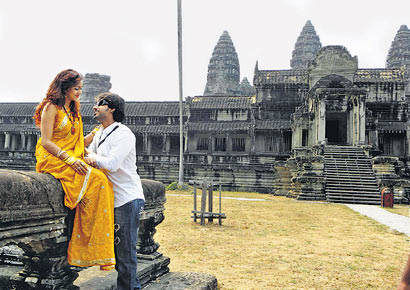
Actors Sheetal Ijantkar and Prajwal Devraj romance in front of the famed Vishnu temple

Kannada film shot at world’s biggest Vishnu temple in Cambodia

Published: Monday, Aug 1, 2011
By Kavya Christopher
Daily News and Analysis

Cinematic experiences are of more value to the audience that we may think. It lets one travel to exotic locales at the cost of just one movie ticket — visually that is. That is one of the main reasons why film-makers strive to give their viewers that little something that they may be looking out for. The latest team to join the bandwagon is the soon-to-be-released Kannada film Mr Duplicate, which promises to serve you a slice of history in the midst of all the comedy.

Producer Kashyap Dakoju reveals, “We travelled to Cambodia to shoot a song sequence for our film Mr Duplicate. The unique part about this destination is that it’s home to one of the biggest Vishnu temples in the world. Spread over 35 acres, we found that this is one of the hottest tourist destinations for those who love history and architecture. Considering the enormity of even the built area, tourists are offered a choice of buying themselves either — a day pass, a three day pass or a week-long pass which allows them access into the temple premises. It takes that much time for a tourist to see the entire temple while learning all about it from the guides there.”

Called the Angkor Wat, the temple dates back to the early 12th century and is said to have been built for the king Suryavarman.

Today, though the temple is not open for religious ceremonies, it is more a galleried one that is a fine example of South Indian Hindu architecture. “On a lighter side, people also say that this temple was built by the aliens — only because it is such a spectacular structure that one can’t imagine how mortals could have even conceived such a thing,” says Kashyap.It was tough for the team to obtain permission to shoot at the location, which is why most of the scenes in the song only have the temple as a backdrop.

The film, that stars Diganth, Prajwal Devraj, and Sheetal Ijantkar in lead roles, features a romantic number featuring the latter two. “The film is set against a college backdrop, and is basically a love triangle. It also touches on the concept of mistaken identity. It is definitely going to be a laugh riot, considering it is all about situational comedy,” says the producer. That’s a little something more to look forward to.

‘Hell’ over for abused fishermen [who were trafficked into Thailand and Malaysia]

Monday, 01 August 2011
Sen David and David Boyle
110801_5
Photo by: Meng Kimlong
Migrant worker Nouv Vuthy (right), aged 21, hugs his father Chheung Heab upon returning to Cambodia from Malaysia on Friday.
Phnom Penh Post

Trafficking victim Thith Sopheak had a strong warning for people contemplating the promises of labour brokers when he returned home to Cambodia on Friday – don’t believe them, you’ll end up in hell.

“It just put tears in my eyes to see them [other victims]. It is a hellish situation. There are a lot of Cambodians, not just 100, maybe 1,000 on the boats,” he said.

An unknown number of Cambodian men, like him, have been trafficked onto Thai and Malaysian fishing boats as slave labourers and subjected to appalling abuses.

Those deemed expendable – falling ill or exhausted from 22-hour work days – have reportedly been beaten and then tossed in the South China Sea to die.

Thith Sopheak and six other men were the “lucky” ones, who jumped ship and were eventually rescued in Malaysia, before finally arriving home on Friday.

“They mistreated us so much. They hit us and so many Cambodians died at sea,” said the 29–year-old at Phnom Penh International Airport.

“I decided to jump into the water. I thought that if I was lucky, I would live. I swam 200 metres and arrived in Malaysia.”

Chan Phally, the mother of 21-year-old victim Nouv Vuthy, who also returned on Friday, said she had warned her son that offers of lucrative jobs in Thailand from brokers were dangerous, but he stubbornly decided to go anyway.

“I was ill when he called me once and said he had been trafficked as a boatman,” she said, tentatively waiting to hug the son she had not seen for months.

“I missed my relatives, especially my mum, so much. Right now I feel reborn,” her son said following their reunion.

Although six of the group have now returned home, their future remains uncertain, said Huy Pich Sovann, a programme officer at the Community Legal Education Center in Cambodia, yesterday.

“They are still worrying about their lives. They have no jobs and they have no income … it’s very difficult to find them jobs or provide them training,” he said. But the men had received gifts of noodles, canned fish and US$10 each from the Cambodian Red Cross and could perhaps find some work as paid advocates, warning potential victims of the horror they endured, he added.

Most were keen to start their own businesses, he said, but were unaware of any financial assistance to be provided from the government.

Repatriated victim Sun Baraing, aged 47, said on Friday that he would never make the mistake of going abroad to work again.

“I am alive, this is my luck. I am illiterate and I don’t know what to do in the future. I just want to live with my mum in happiness. I am a man, I will not cry,” he said.

Bith Kimhong, director of the anti-human trafficking and juvenile protection department at the Ministry of Interior, said yesterday investigations were underway to identify and arrest the brokers responsible for trafficking the men in late 2010 and early 2011.

“After we interviewed [the victims], we made a conclusion that it was a suspected case of human trafficking across the border and we have been working to conduct an investigation,” he said.

ADDITIONAL REPORTING BY VONG SOKHENG

Monday, 1 August 2011

Vietnamese defence delegation visits Cambodia

VOVNews

A Vietnamese defence ministry delegation led by Deputy Minister Nguyen Chi Vinh paid a working visit to the Kulen War Invalids Centre 317 in Siem Reap province of Cambodia from July 30-31.

The delegation attended the inauguration of 50 houses for wounded soldiers at the centre on July 31.

Speaking on the occasion, Cambodian Prime Minister Hun Sen highlighted the Cambodian wounded soldiers’ contributions to the cause of national liberation and defence. He also highly valued the support of the People’s Army of Vietnam to his country.

Hun Sen encouraged the wounded soldiers to further contribute to the country’s development.
On the afternoon of July 30, the Vietnamese delegation had a working session with the Cambodian side.

The two sides discussed issues of mutual concern. They spoke highly of the effective cooperation between the two ministries in recent years, pledging to further strengthen the traditional friendship between the two peoples in the future.

VNA/VOVNews

Foreign tourists injured in Cambodia bus crash


Photo by: Photo Supplied
People look at the wreckage of an accident after a passenger bus and a truck carrying corn collided in Peamro district in Prey Veng province early yesterday morning.

Tourists hurt in bus smash

Monday, 01 August 2011
Mom Kunthear
Phnom Penh Post

Seven foreign nationals were seriously injured when a night bus and a truck crashed in Prey Veng province early yesterday morning.

The Kampuchea Angkor Express bus, carrying 34 passengers, was travelling from Siem Reap to Vietnam when it crashed in Peamro district at about 4:10am.

District police chief Seng Ponlok said the double-decker bus hit a truck carrying bags of corn parked beside the road – causing serious injuries to three Spanish nationals and four South Koreans.

Another 27 passengers sustained light injuries. Five of the seriously injured passengers were women.

“We have to investigate this accident to see why it happened like this, but the unofficial conclusion is that we think that it was caused by the driver being sleepy,” said Seng Ponlok.

“He could not control himself anymore – that’s why he moved the bus to hit the lorry.”

Provincial police officials helped send the injured to referral hospitals and an undisclosed hospital in Phnom Penh, he said.

Both vehicles have been taken to Peamro district police station to aid an investigation.

“We will investigate this accident by cooperating with the bus company and we will also cooperate with them to look for the driver, who escaped after accident,” said Seng Ponlok.

Kampuchea Angkor Express officials could not be reached for comment yesterday.

The collision is the latest in a series of bus accidents to take place in the Kingdom.

In May, 35 people were injured when a night bus travelling from Phnom Penh to Siem Reap crashed into a rice truck. Two died when an Angkor Express bus transiting from Laos to Phnom Penh struck a motorbike carrying two men in Stung Treng town in early June.

A Paramount bus allso exploded in Kampong Thom province a week prior to that incident.
---------------------------------
Monsters and critics
Aug 1, 2011,

Phnom Penh (DPA) - Seven foreign tourists suffered serious injuries after a bus crashed into a truck in Cambodia, a report said Monday.

Four South Koreans and three Spaniards were injured when the bus carrying 34 passengers collided with a parked truck while en route to Vietnam from the Cambodian tourist hub of Siem Reap.

A police official said the driver fled the scene.

Government figures show 1,076 people died on the roads in the first six months of the year, up 14 per cent from 2010.

Tourism is a key pillar of the economy and has shown signs of growth after the post-2008 slump. The Cambodia Daily newspaper reported Monday that tourist arrivals increased 13 per cent to nearly 1.4 million in the first six months of 2011, with growth driven by visitors from China, South Korea and Vietnam.
----------------------------------
Irishman injured in Cambodian crash

The Irish Times

An Irishman is in hospital in Cambodia following a bus crash. Michael O’Riordan (29) from Cork is in a critical condition after the bus in which he was travelling close to the Vietnamese border was involved in a crash yesterday morning.

It is understood there were some fatalities, but numbers had yet to be confirmed last night.

Mr O’Riordan, who lives in Dublin, had been on holiday in Cambodia. He was being treated in hospital in Phnom Penh after sustaining pelvic and internal injuries.

The Irish embassy in Hanoi, Vietnam, is providing assistance to Mr O’Riordan’s family.

Cambodian shoe factories under the spotlight

Radio Australia
Updated August 1, 2011

German sportswear giant Puma has been on the back foot recently after a report the company commissioned showed a litany of abuses at one of its subcontractors in Cambodia.

The company commissioned the investigation after more than 200 workers fainted at a shoe-making factory in Phnom Penh.

Presenter:Robert Carmichael
Speaker: Chuon Momthol, trade union leader; Catherine Vaillancourt-Laflamme, International Labour Organisation

CARMICHAEL: In April around 200 workers at a factory that makes shoes for Puma fainted and were taken to hospital. A few days ago another 49 fainted too.

The April incident drove Puma to commission an independent report from a US-based non-profit called the Fair Labor Association, and the results made for uncomfortable reading in Germany.

The subcontractor, a company called Huey Chuen, employs around 3,300 workers, and was found to have failed in dozens of areas.

For instance, deductions from employee wage packets were unclear; there was no fire safety plan; new employees received no training; the firm deducted sick days from annual leave entitlements. The list of breaches of Cambodian law is long.

All of Huey Chuen's Cambodian employees are members of the Cambodian Union Federation, whose president Chuon Momthol visited those who fell ill earlier this year.

CHUON MOMTHOL: When I met the workers at the hospital, most of the workers say they have difficulty in breathing. And then some of them put on oxygen - and they say they feel so dizzy, blackout, they cannot open their eyes. Something like that.

CARMICHAEL: Shoemaking uses some potentially dangerous glues and solvents, and the report also found significant problems with storage of chemicals and poor ventilation.

In fact the concentration of chemicals in the air was so strong that the investigators said they were unable to take measurements for their own health reasons. They concluded that the April faintings were likely due to a combination of exposure to chemicals and excessive overtime.

Puma has since ordered health checks for all workers, implemented a program to improve working conditions at the firm, and is considering providing meals for workers.

Later this year Puma's executive chairman will visit the factory to ensure it is now up to standard.

Chuon Momthol says he is satisfied with Puma's actions.

CHUON MOMTHOL: Puma is now try to put some conditions to Huey Chuen to improve it - so far from April until now, frankly Huey Chuen did not get a lot of orders.


CARMICHAEL: It is unlikely that Huey Chuen's problems are confined to one factory.

Garment manufacturing is a vital industry here, employing 300,000 people and earning the country around $3 billion a year.

Most garments are exported to the United States and the European Union - and are ordered by big brands such as Levi Strauss, H&M, The Gap and Adidas.

To minimize reputational risk, interested parties crafted a program called Better Factories Cambodia - or BFC. It was set up 10 years ago, and monitors garment factories to ensure labour standards are met and maintained.

Every one of around 300 factories that export garments must comply with BFC.

However shoemaking is a more recent development and is not subject to monitoring.

Catherine Vaillancourt-Laflamme is a BFC training specialist with the International Labour Organisation, or ILO, the UN's labour body, which helped establish Better Factories Cambodia.

BFC has no mandate to monitor footwear factories, she says, but has helped some on a voluntary basis.

VAILLANCOURT-LAFLAMME :There's only a little bit less than 40 footwear factories in Cambodia - so if there were interest for BFC and the ILO to get more involved into this sector, the small number of factories would allow that we can have a very comprehensive approach and intervention in this sector bringing in 100 percent of the manufacturers together to look into the issues and the opportunities that we would have to improve working conditions in this sector.


CARMICHAEL:In other words, with just 38 factories, now is the time to raise standards across Cambodia's shoe-making industry.

On Thursday, says Chuon Momthol, Buddhist monks went to the Huey Chuen factory to hold a blessing ceremony in order to banish the bad spirits that some workers believe are causing the problems.

Puma has also insisted the factory institute a raft of improvements in a less spiritual vein, including better ventilation and proper storage of chemicals, and an insistence that pregnant woman and nursing mothers - who total around 120 of the workers - are kept well away from chemicals.

Khmerican's crimes are the by-products of the American policy

Khmerization's Note: The comment below is published without any editing due to time constraint. Sorry.

Warrior Blood said...

Re: An American lady plans to live with her deported husband in Cambodia

This is very sad story; family are breaking apart because of the past crime that he served time already. We are talking about the person paid for his crime yet he continues to be punished after he served his time. The sad part, children are the one who is paying the price. None of us can choose the place to be borned. People probably wanted to open their mouth, well if he can't do the time don't committ crime. It is easy to say. Don't you think Americans commit crime too? Why only punish the Cambodian refugees? You know why they were refugee? America should bare some responsibility of the secret bombing in Cambodia which created the monster Pol Pot regime which led to killings of 2 millions Cambodian. The anger from American bombing, and endorsed by King Sihanouk, KR rosed from 7,000 troops to over 70,000 troops due to US bombing. American cut supplies to the Lon Nol regime which allowed KR to take over the country. How did Lon Nol came to power in the first place? The American again, it backed Lon Nol on a coupe against Sihanouk. The immigration policies torn family apart. Cambodian refugees were systematically placed in the law income, gangs and drug infested neighborhood when they arrived in America. Cambodian children fought their way to school and they usually ganged up as group to protect themselve from being beaten by American kids; it left them with very little choice. Many brought knife to school to protect themselve and were expelled from school. Despite all of the issues, many Cambodian children made through college were able to get good job. However, about 50 percent felt into street life. Girls were pregant when they were teenager, they have to quit school to support their children. As you can witness today Cambodian gansters were arrived from the oppression of American street life. At first, they joined gangs for protection which led to drug and othe illegal activities. Many of them will never return to live normal life. All they know are street life. For those that change their life around, raise family but the law continue to drag them out from their family and placed them into the land that they dont know anything about the culture or language. In 2002 Cambodian government signed repatriation agreement with United States to accept Cambodian deportees. Currently there over 2000 deportees in the waiting list to be deported. Imagine, Cambodia lack of jobs already. How will they survive? Will Cambodia turn into the land where criminal being dumped there without any type of support for them to reenter into Cambodia society. What will happen next? Only time will tell. Deportation law passed in 1996, however it is retroative. If you committed crime when your were young prior to 1996, you are subject to deportation after your served your time. On contra, Vietnam government signed the agreement with United States in January 22nd, 2008. However, Vietnam only accepts individual that came to United States on or after July 12th, 1995. This is the key factor that Vietnam government did serious study before it sign the agreement to take deportees. As you are well aware, many people came on or after 1995 mostly immigrant and less likely to get into trouble with the law. Many of them were here for the main purpose is business. People that came to the United States between1979 to 1995 are refugees. Many of them were borned along the Thai border in refugee camp. Most of them get into trouble when they were young. There are more shocking immigration policies recently expanded the scope of deportation crime which will efect many Cambodian and I expected more number to be deport for minor crime such as shop lifting, drunk driving, writing bad check etc.

As I started to write more comment and I couldn't help but to question Cambodian government why in the hell they signed the agreement with the United States. Is it money? If it is not money why would you endorse such policy that weaken the Cambodian American community abroad. Vietnamese American are strong in the United States; some already became the Mayor, state representative and congressman. Have you ever wonder why? There are many Vietnamese American and they now can vote and became political candidate in the United States. Although, Cambodia American started to participate in American politic but there is no comparision to the Vietnamese population. The more people being deported the weaker the Cambodian American community will become. The sad part, it doesn't deported one person as you can see in this story. The wife and children planned to move back to Cambodia. You have 4 peoples moving back to Cambodia. Imagine you have thousands of deportees and still counting because the new law most likely will deport individual with less violence crime such as shop lifting, wrote bad check, drunk driving etc. The other sad part, there is no program to help deportees reenter into Cambodian society such as job trainings, housing needs etc. Many of them most likely ended up back on the street of Phnom Penh or committed suicidal which happened already. What happen if Cambodia government cancel the MOU signed with America? I wonder what happen if Cambodia government doesn't issue visa for travel document? What happen if Cambodian government made revision to the MOU so that it is similar to Vietnam government? There are many question that is unanswered. The Cambodian embassy can only stated, Cambodian American needed to lobby with the American government. Cambodian government cannot do anything. Cambodian government only did what was told by American government. I wonder if it is BS answered? President O'bama needed to deport 400,000 deportees by year 2010. I am not sure if that number required falling behind that is why we seen ICE prayed on Cambodian American community. People are running scare; some afraid to sleep at home. It is like KR regime, if you hear the door knock 5AM; you run to the back door. Sometime, they get you while you were sleeping.

Kem Sokha claimed he was threatened

The HRP leadership: R-L: Kem Sokha, former Prime Minister Pen Sovan and Mr. Son Soubert.

By Khmerization
Source: FPMOnline

The leader of the minor opposition Human Rights Party (HRP), Mr. Kem Sokha, has claimed during a public address during the party's congress that he had been threatened after he refused to switch side to join the ruling Cambodian People's Party (CPP).

Speaking to about 500 party members during the congress on Saturday 30th July, Mr. Kem Sokha, president of HRP, said that he had been coerced to support the government of Prime Minister Hun Sen, but when he refused he was threatened.

Mr. Kem Sokha's sensational claim was made after Prime Minister Hun Sen released the so-called 2007 secret telephone conversation between himself and Mr. Kem Sokha in late May. The conversation between the pair, which seemed very innocent, but was very patronising on the party of Mr. Hun Sen, covered general issues, but they both have strongly criticized Mr. Sam Rainsy's style of leadership.

However, Mr. Kem Sokha claimed that he was coerced and threatened after he refused to side with the government. Without naming who threatened him, he said: "Some dishonest politicians who are trying to coerce and buy out other politicians have threatened me in all forms to buy me out, but when I refused to sell out, they threatened me. I am not scared and I will continue with my (clear) conscience steadfastly based on the principles of national interests and people's interests as the priority. That's why these people used all sorts of cheap tricks to label me and smear the HRP", he said.

Mr. Kem Sokha had indirectly criticized the leadership of the SRP, saying that they have no genuine willingness to join hand with other democratic forces. "Some politicians, who are very recalcitrant, who did not respect the will of the people and who did not want their party to unite with the HRP and have tried very hard to avoid (the unity), have turned around and used the same "divide and conquer" strategy that the dictators have used", he said.

Despite his harsh words against the SRP, Mr. Kem Sokha still hopes to one day unite his HRP with the SRP to form a strong opposition.

Mr. Son Soubert, president of the HRP's steering committee who is also the son of former prime minister and leader of the anti-Vietnamese resistance movement, Mr. Son Sann, said the unity of all democratic forces is the only the key to defeating the ruling CPP and future electoral successes.

Please read article in Khmer below:
កឹម សុខាថា​ខ្លួន​ត្រូវ​បាន​គំរាម​និង​លួង​លោម​ទិញ
837 Views
AddInto AddInto

សៅរ៍ 30 កក្តដា 2011 10:55 AM | ដោយ ៖ ពេជ្រ បណ្តូល

ជា​ផ្នែក​​នៃ​ការ​ឆ្លើយ​តប​ ចំពោះ​​វោហារ​ស័ព្ទ​​ដែល​គេ​​បាន​​ដឹង​​ជា​សាធារណៈ​ តាមរយៈ​សម្ដី​របស់​នាយក​​រដ្ឋមន្ត្រី​ខ្មែរ កាល​ពី​ពេល​ថ្មីៗ​នេះ​ថា គណបក្ស​សិទ្ធិ​មនុស្ស​ត្រូវ​បាន​បង្កើត​ឡើង​គ្រាន់​តែ​ជា​ល្បែង​​នយោបាយ​របស់​នាយក​រដ្ឋមន្ត្រី​រូប​នេះ​នោះ ​លោក កឹម សុខា​បាន​លើក​ឡើង​នៅ​ព្រឹក​ថ្ងៃ​សៅរ៏​ទី​៣០កក្កដា នេះ​ថា ​​រូប​គាត់​​ត្រូវ​​បាន​​គេ​​គំរាម​ផង​​និង​​លួង​លោម​ទិញ​ផង ។​ហើយ​ការ​នៅ​តែ​រក្សា​ឧត្ដមគតិ​ ​មិន​​លក់​ខ្លួន​​នេះ បាន​ផ្ដើម​ឲ្យ​​មាន​​ការ​វាយ​ប្រ​ហារ​លាប​ពណ៌​ក្នុង​យុទ្ធ​សាស្រ្ត​បំបែក​បំបាក់​ដើម្បី​គ្រប់គ្រង​។

ថ្នាក់ដឹកនាំទាំងបីរបស់គណបក្សសិទ្ធិមនុស្ស

នៅ​ក្នុង​មហាសន្និបាត​​ ​ក្រុម​ប្រឹក្សា​ជាតិ​លើក​ទី២​ ​ដែល​មាន​អ្នក​ចូល​រួម​ប្រមាណ​ជាង ៥​រយ​នាក់​មេ​ដឹក​នាំ​​គណបក្ស​សិទ្ធិ​មនុស្ស​រូប​នេះ​ បាន​ថ្លែង​ដូច្នេះ​ថា”អ្នក​នយោបាយ​ទុច្ចរិត​ខ្លះ ដែល​ខិត​ខំ​​ទិញ​​ដូរ​ទាក់​ទាញ សម្លុត​គំរាម​​ខ្ញុំ គ្រប់​រូប​ភាព ​​ហើយ ទិញ ខ្ញុំ ខ្ញុំ​មិន​លក់ សម្លុត​​ខ្ញុំ ខ្ញុំ​មិន​ខ្លាច នៅ​តែ​រក្សា​​និង​បន្ត​ឧត្ដមគតិ របស់​ខ្ញុំ​ឥត​ងាក​រេ ឈរ​លើ​គោលការណ៍ ដែល​ជា​ប្រយោជន៍​ជាតិ និង​ប្រយោជន៍​​ប្រជា​ពលរដ្ឋ​ជា​ចម្បង​​ទើប​ពួក​គេ​នាំ​គ្នា​ ប្រើ​ល្បិច​កល​ថោក​ទាប​ ​មក​លាប​ពណ៌​ខ្ញុំ លាប​ពណ៌​គណបក្ស​សិទ្ធិ​មនុស្ស “។

ការ​ថ្លែង​បែប​នេះ​របស់​លោក កឹម សុខា គឺ​បន្ទាប់​ពី​មាន​ការ​ប្រើ​ប្រាស់​វោហារ​ស័ព្ទ​ដោយ​នាយក​រដ្ឋមន្រ្តី​ខ្មែរ​ រួម​ទាំង​មាន​ការ​ទម្លាយ​ឯកសារ​សម្លេង​ទាក់​​ទង​គ្នារ​តាម​ទូរស័ព្ទ​វាង​លោក កឹម សុខា​ ​និង ​ហ៊ុន ​សែន ជា​សាធារណៈ​ ដែល​ថា លោក ​កឹម ​សុខា​ បាន​​ស្នើ​​យោបល់​​ខ្លួន ក្នុង​ការ​បង្កើត​គណបក្ស​សិទ្ធិ​មនុស្ស​។

ជា​មួយ​គ្នា​​មេដឹក​នាំ​គណបក្ស​ប្រឆាំង​ លំដាប់​ទី២​នៅ​ក្នុង​​ប្រទេស​កម្ពុជា​រូប​នេះ​ ក៏​​បាន​​ធ្វើ​ការ​វាយ​ប្រហារ​បែប​បញ្ឆិត​​បញ្ឆៀង​ផង​ដែរ ​ដែល​គេ​ដឹង​ថា​ ​សំដៅ​ទៅ​រក​គណបក្ស​សម​រង្ស៊ី​ពី​ការ​ដែល​គណបក្ស​ប្រឆាំង​ធំ​មួយ​នេះ​ពុំ​បាន​បង្ហាញ​ឲ្យ​ឃើញ​ពី​ឆន្ទះ​ក្នុង​ការ​ច្របាច់​បញ្ចូល​គ្នា​ជា​មួយ​គណបក្ស​សិទ្ធិ​​មនុស្ស​​​ ​ឲ្យ​ក្លាយ​ទៅ​ជា​គណបក្ស​ប្រជាធិបតេយ្យ​ខ្លាំង​តែ​មួយ​នោះ។

លោក​ កឹម សុខា ​បាន​លើក​ឡើង​ដូច្នេះ​ថា​”អ្នក​នយោបាយ​ខ្លះ ​ដែល​មាន​ចិត្ត​មានៈ​ ដែល​មិន​គោរព​តាម​​ឆន្ទៈ​របស់​ប្រជាពលរដ្ឋ​ខ្មែរ ​ដែល​មិន​ចង់​​ឲ្យ​​គណបក្ស​ខ្លួន​រួប​​រួម​ជា​មួយ​​គណបក្ស​សិទ្ធិ​មនុស្ស​​ខំ​យក​​ឡេះ​គេច​វេស ​បែរ​ជា​ទទួល​ធ្វើ​តាម​យុទ្ធសាស្រ្ត បំបែក​បំបាក់​​ដើម្បី​ត្រួត​ត្រា​របស់​ជន​ផ្ដាច់​ការ”។

ប៉ុន្តែ​យ៉ាងណា​ក៏ដោយ ដើម្បី​ធ្វើ​​ឲ្យ​កម្ពុជា ក្លាយ​ជា​ប្រទេស​ប្រជាធិបតេយ្យ​ត្រឹម​ត្រូវ​គណបក្ស​នេះ​នូវ​តែ​មើល​ឃើញ​ពី​​ភាព​ចាំ​បាច់​​នៃ​ការ​ធ្វើ​សមាហរណកម្ម​​បញ្ចូល​​គ្នា​ជាមួយ​គណបក្ស​នានា​​ដែល​មិន​មាន​​ប្រវត្តិ​ជា​បក្ស​កុម្មុយនិស្ត។

លោក ​សឺន ស៊ូបែរ្ដិ៏ ​ប្រធាន​គណៈកម្មាធិការ​នាយក​ របស់ គណបក្ស​សិទ្ធិ​មនុស្ស បាន​លើក​​ឡើង​ដូច្នេះ​ថា​”នៅ​ក្នុង​រង្វង់​​នៃ​គណៈកម្មាធិការ​នាយក​​យើង ​បាន​ស្រប​មតិ​​គ្នា​​ថា ការ​បង្រួប​​បង្រួម​កម្លាំង​អ្នក​ប្រជាធិបតេយ្យ ​ជា​កត្តា​គន្លឹះ ​និង​​ចាំ​បាច់​បំផុត​​​ដើម្បី​កម្លាំង​ចលករ​​ក្នុង​​ការ​ពុះពារ​រុញ​​ច្រាន​និង​វាយ​បំបាក់​​រាល់​ទង្វើ​​វិទ្ធង្សនា​ ទាំង​ឡាយ​ណា​ដែល​បង្អាក់​ដំណើរ​ការ​​ឈាន​​ទៅ​មុខ ​នៃ​ចរន្ត​លទ្ធិប្រជាធិបតេយ្យ ​និង​​ការ​​គោរព ​សិទ្ធិមនុស្ស ​​ដែល​ជា​​ប្រភព​​នាំ​​មក​​នូវ​ការ​​អភិវឌ្ឍន៍​​ប្រ​កប ​ដោយ​​និរន្តរភាព ​ស្មើភាព ​និង ​យុត្តិធម៌ “៕

New border gates to Cambodia opened


Vietnam News
AsiaOne
Sunday, Jul 31, 2011

BINH PHUOC - Viet Nam and Cambodia yesterday opened another pair of border posts, Hoa Lu in Viet Nam's Binh Phuoc Province and Trapeang Sre in Cambodia's Kratie Province.

This is the fifth of seven pairs of border posts the two countries agreed to open under a road transport agreement signed in 1998 and a protocol signed in 2005.

Deputy Minister of Transport Nguyen Ngoc Dong said the gates would not only facilitate trade and economic development between the two border provinces, but also improve co-operation between the two countries.

The four border points currently open for road transport between the two countries are Moc Bai - Bavet (Tay Ninh and Svay Rieng provinces), Tinh Bien-Phnom Den (An Giang and Takeo provinces), Xa Xia - Prek Chak (Kien Giang, Lork, Kam Pot provinces), and Xa Mat -Trapeing (Tay Ninh and Kampong Cham provinces).

Two other pairs of border crossings are expected to open later this year, including Le Thanh - Oyadav (Gia Lai and Andong Pich - Ratanakiri provinces) and Bu Prang - O Raaing (Dak Nong and Mundulkiri provinces).

Last year, two-way trade between Viet Nam and Cambodia was US$1.83 billion. At present, Viet Nam is the fourth biggest importer of Cambodian goods and Cambodia is the 16th largest importer of goods from Viet Nam.

For these doctors, giving their hearts to those in need


Hundreds of Cambodians wait in line to receive medical care from Korean doctors, who went on an annual volunteer trip last year to Kampong Speu, Cambodia. Members of the KCSC are scheduled to leave on Aug. 8 for this year’s weeklong trip. Provided by the KCSC

Group brings Cambodian children to Korea for free life-saving operations

By Yim Seung-hye
Kore JoongAng Daily
August 01, 2011

Seven-year-old Loeng Sonisa received the gift of life last Monday after receiving an all-expenses-paid heart surgery at Soon Chun Hyang University Hospital in Bucheon, Gyeonggi.

Loeng Sonisa, who hails from a small Cambodian village, was one of three children invited to the hospital to receive free life-saving operations.

The three children - Loeng Sonisa, 7; Run Sokry, 9; and Taing Guuochly, 9 - all suffer from ventricular septal defect, or holes in the wall that separates the right and left ventricles of the heart.

Since 2002, the nonprofit Korean Community for Service in Cambodia (KCSC) has sponsored three children with heart diseases each year to come to Korea and receive treatment at SCHU Hospital.

Comprised of SCHU Hospital staff and members of Bucheon Jeil Church, which is adjacent to the hospital, the KCSC aims to provide free medical care to Cambodians in poverty, including annual summer trips to Cambodia’s neediest regions.

The organization was started in the summer of 2002 after a group of doctors from SCHU Hospital visited Cambodia for volunteer work, not knowing then that the trip would become an annual event. Realizing the lack of modern medical care in the country, the KCSC was formed to help more than just a few people each year.

Among the doctors on the 2002 trip was Shin Won-han, director of SCHU Hospital in Bucheon, who credits the support of Seo Kyo-il, executive director of Soon Chun Hyang University, for the KCSC’s long-running success. Seo’s father was the founder of the university.

Shin recalled Seo telling doctors after the KCSC’s establishment, “In 1954, when the Korean War just ended, Korea’s medical standards were terrible. But a medical staff from the University of Minnesota visited Seoul National University at that time. Thanks to them, Korea was able to learn advanced medical techniques.”

Shin said, “That’s why Korean doctors should be the ones who help those people in developing countries like Cambodia and train doctors in advanced medical technology in these countries.”

Every August, around 20 medical staff from SCHU Hospital and members of the KCSC give up their weeklong summer vacation to treat the neediest Cambodians. Last year, a total of 26 KCSC members went to Kampong Speu Referral Hospital, a provincial hospital in Kampong Speu, Cambodia, and treated a total of 3,523 Cambodian patients and performed surgery on 60 more patients over six days.

Lee Gi-cheol, 45, chief of a dental hospital in SCHU Hospital, has never missed a trip for the past decade, saying that the annual trip to Cambodia is “part of his life.”

“Although sometimes we, the doctors, think of this trip as an extension of what we do every day, for the Cambodians who we meet, they wait for a year to see us,” said Lee. “I also believe this trip is a good opportunity for doctors in Korea to realize how lucky we are in Korea and feel compassion toward the people in Cambodia, who die every day due to lack of medical care.”

The KCSC also invites six Cambodian doctors every year to the SCHU Hospital for yearlong training. So far, a total of 43 Cambodian doctors in various departments - including general surgery, obstetrics, urology and anesthesiology - have come.

“I am learning a lot at SCHU Hospital right now,” said Chhor Kompeak, 27, a Cambodian anesthesiologist training at the hospital who arrived in early July. “I want to take the experience that I have here to Cambodia and treat the people in my country.”

Chhor Kompeak said that medical technology in Cambodia is not as advanced as in Korea so only a limited number of doctors can perform delicate operations.

“Cambodian doctors have a lot of knowledge but they rarely have the chance to watch and learn the techniques like I am doing right now in Korea,” said Chhor Kompeak.

“After a year of training, I think I will have watched diverse operations, and I want to train other doctors in Cambodia who don’t have the chance to go abroad to have such experiences.”

Shin, the KCSC director, explained that Cambodia not only lacks doctors but also facilities for doctors to receive proper training.

According to Shin, there are only 2,000 doctors in Cambodia, which has a population of 12 million, meaning that there are 6,000 people per doctor. In contrast, in Korea, there is one doctor per 600 people.

“Cambodia’s economy will gradually develop and medical facilities will also improve,” said Shin. “But improvement in medical practices cannot be achieved in a day or two. That’s why training Cambodian doctors is crucial.”

KCSC members are preparing to go on their 11th trip to Cambodia in two weeks.

And Lee, the dentist, has the date circled on his calendar.

“I feel great to be able to participate in such a meaningful journey for over a decade, but my wife and kids complain sometimes because I haven’t spent my summer vacation with my family for ten years,” said Lee, chuckling.

“I may have to skip next year to calm my wife down.”


By Yim Seung-hye [sharon@joongang.co.kr]