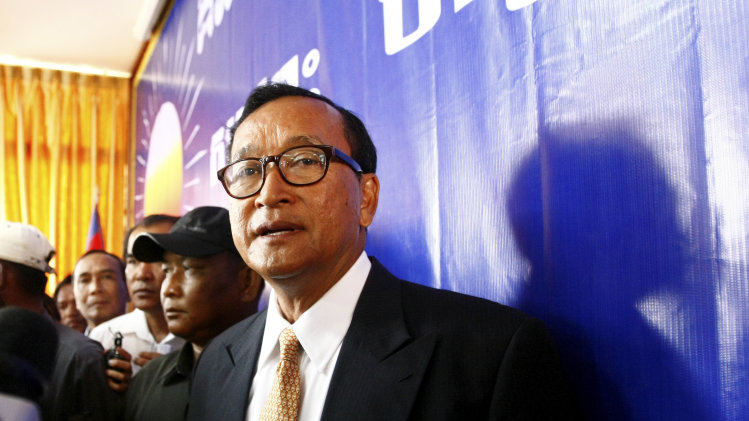
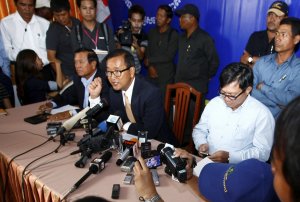
CNRP Press Conference on its position of Election Results, 29 July 2013. More photos...
The CNRP is Right to Contest the Election Results
Theary C. Seng, 30 July 2013
According
to the provisional election results announced by the biased National
Election Committee and the ruling CPP, the democratic opposition CNRP lost the popular votes by the razor-thin margin of 200,000 -- a difference of as little 0.6 percent.
On
Monday (July 29) at a press conference, CNRP president Sam Rainsy
rejected the election results due to the gross irregularities prior to
and during election day: “Fifteen
per cent of voters – about 1.2 to 1.3 million – were unable to vote
because of list irregularities. There were also about 1 million ghost
names on the voter list and about 200,000 duplicate names.”
(Here, we have not
factored in the grossly manifested uneven playing field, a powerful
election machinery that systematically favors the ruling CPP: CPP-biased
National Election Comittee, all the 10+ state-affiliated TV stations,
most radio stations, state resources marshaled for CPP campaigns, the
hundreds of millions of dollars, the military PLUS FEAR, the chiefs of
the commune and village level controlling the
registration/information/financing apparatus, how certain mobile
companies shut off the ability for voters to use their phones all day
till night time, etc.)
NDI's Voter Registry Audit
raises many concerns, one of the more glaring ones is the over
registration across the country, in certain places reaching 200 percent
(see the detailed, well-researched, well-analyzed Phnom Penh Post
article "Giving More than 100%").
The CNRP is right to contest the election results in light of the gross, numerous irregularities. Not only is it politically correct to do so, but it is the CNRP's moral imperative if it is to respect the will of the people.
(Reuters) - Cambodia's government rejected on Tuesday calls by the
opposition for an international inquiry into allegations it used massive
fraud to win re-election, and said it wanted parliament to approve a
new cabinet quickly. The United States and European
Union expressed concern about irregularities in Sunday's election but
both said an investigation should be conducted by Cambodian electoral
authorities, failing to endorse the opposition's call for an inquiry
involving the United Nations.
The
government announced on Sunday that the Cambodian People's Party (CPP)
of long-serving Prime Minister Hun Sen had won 68 seats in the 123-seat
parliament, a sharp fall from its previous tally of 90. The opposition
Cambodia National Rescue Party (CNRP) nearly doubled its seat total to
55, in a major surprise and a setback for Hun Sen.
CNRP
leader Sam Rainsy said up to 1.3 million names had been missing from
the electoral rolls and complained about lack of access to the media as
well as intimidation on the campaign trail.
Ouch Borith, secretary of state at the Foreign Affairs Ministry, rejected such allegations at a news conference.
"We
have over 10,000 national observers and over 100 international
observers who reckoned our election was held in a peaceful manner
without any violence, free and fair," he said.
There
was no proof of any missing names, he added. "The opposition party
should be asked to show clearly what evidence it has about the
irregularities it alleges. The National Election Committee has already
said 'please bring up evidence, don't just say it, so we can work
together to solve things'."
IT IS not surprising that Cambodia’s opposition party rejected the outcome of Sunday’s parliamentary elections, despite a strong showing. The opposition leader, Sam Rainsy, declared, “There are too many irregularities, with far-reaching implications.” Election monitors reported that scores of people were turned away because their names were not on voter lists, and supposedly indelible ink to prevent fraud was easily washed off. On top of this, systematic problems in
the election process were reported, including campaigning by security
officers for the ruling party and unequal access to the media for
opposition parties. Moreover, Sam Rainsy, a former finance minister, was
permitted to return to Cambodia
only in the days before the balloting. Clearly, the country’s
long-serving prime minister, Hun Sen, has not abandoned his
authoritarian ways.
But it would be a mistake to write off the vote as just another
day in Hun Sen’s 28-year rule, which has brought a certain stability to
Cambodia along with his heavy hand. The outcome suggests that
democratic awakenings are afoot, despite the odds.
In the previous parliament, the governing Cambodian People’s
Party held 90 of the 123 seats, but after this election it will hold
only 68 seats. The main opposition party, the Cambodia National Rescue
Party, appears to have won 55 seats, compared with only 29that
two now-merged opposition parties held previously. If these totals
hold, the new balance of power will make it much harder for Hun Sen to
amend the constitution, which requires two-thirds of the National
Assembly, and give the opposition a larger voice on other matters.
Cambodian Prime Minister Hun Sen (TANG CHHIN SOTHY/AFP/Getty Images/Newscom)
The ruling Cambodian People’s Party (CPP) has once again been returned to power in Cambodia.
Election results are hotly contested by the opposition Cambodian
National Rescue Party (CNRP), and allegations of voter fraud are being
levied against the ruling party.
The party’s leader, Prime Minister Hun Sen, has been in power for 28 years.
He is one of the longest-ruling prime ministers in Asia. His lengthy
tenure in office has been seen by many in the opposition party and the
international community as a symbol of the government’s authoritarian culture.
Even with the prospect of serious voting irregularities, the ruling
party’s victory was slim — with the CPP’s seats in parliament declining
from 90 to 68.
The remaining 55 seats went to the opposition CNRP. This election was
the closest in 15 years with the ruling party garnering only 55 percent of the vote.
The opposition was surprised by the unexpected royal pardon granted to the self-exiled former opposition leader Sam Rainsy. Rainsy had been sentenced to 11 years in prison for defamation of the CPP.
Rainsy’s return in the month leading up to elections and an invigorated
youth vote led to high voter turnout and a more powerful opposition
party. Despite his return, Rainsy was not allowed to run to reclaim his
seat in parliament or vote in elections.
Rainsy has made statements
suggesting that opposition will not accept the results of the election
and is calling for an investigation of the elections. He alleges that
ineffective voter registration mechanisms, fake names on the voting
rolls, and other improper practices led to Sen’s re-election. Rainsy also claims that an estimated 1.3 million Cambodians were not allowed to vote.
Sam
Rainsy, leader of the opposition Cambodia National Rescue Party, greets
his supporters at Democracy Park during the general election campaign
in Phnom Penh on July 26, 2013
As widely expected, Hun Sen has returned as Prime Minster of Cambodia, although describing the 60-year-old as head of a parliamentary democracy is much like saying Muammar Gaddafi
was merely a colonel in the Libyan military. Hun Sen’s re-election
means he will have spent 38 years leading the country, in one guise or
another, by the time this new term finishes in 2018. However,
dissatisfaction arising from inequality, corruption and ecological
degradation led to his Cambodian People’s Party (CPP) to now boast a
reduced 68 lawmakers within the 123-seat parliament, as opposed to 90
during the last term (current predictions are unofficial but likely to
be accurate).
The slenderness of this majority has surprised many observers.
Although 100,000 or so people greeted opposition leader Sam Rainsy with
cheers of “Change!” upon his return from exile earlier this month —
pardoned of charges of racial incitement and destruction of property he
insists were politically motivated — few believed this would translate
to the ballot box. Cambodia has generally slipped under the radar when
one considers dictatorial regimes, yet it is one of the world’s more
autocratic governments. “I have escaped assassination attempts, and they
tried to put me in jail and exile,” Sam Rainsy tells TIME. “If you
enter Cambodian politics you have to accept these things.”
Young voters revolt against the Hun Sen government.
Cambodian politics entered a new era on Sunday after voters turned to
the opposition in surprising numbers. Though the economy is growing at a
7% clip and living standards are improving rapidly, a groundswell of
dissatisfaction over corruption and land seizures nearly toppled the
Cambodian People's Party (CPP) in the parliamentary election.
Optimists believe Prime Minister Hun
Sen, a canny leader after 28 years in power, will use his narrow victory
to clean house within the CPP and prepare for the newly competitive
environment. The cynics, of which there are many in this war-scarred
land, fear that the CPP will try to intimidate or silence opponents as
it has in the past.
EPA
Cambodian Prime Minister Hun Sen at a polling station in Kandal province on Sunday.
International
election monitors have largely given up on poll watching in Cambodia,
and it's hard to blame them after irregularities in Sunday's election
emerged as they predicted. Transparency International Cambodia, one of
the two domestic election monitors, says that citizens arrived at 60% of
polling stations to find their names weren't on the register. Others
discovered somebody else had already voted in their name. Double
registrations were also common.
Almost all the districts around the
capital had more registered voters than residents, the Phnom Penh Post
reported, and according to the National Election Commission, the
government issued about half a million provisional identification
documents, which were supposed to be reserved for those who lost their
ID cards between registration and the election. Although the run-up to
this election was free of the killings that plagued previous campaigns,
Prime Minister Hun Sen warned of "civil war" if he lost.
Disenfranchised voters protested and
even rioted in a few areas Sunday night. The opposition also cried foul,
saying the election was stolen. Such claims can't be dismissed.
Transparency International Cambodia's figures showed the ruling
Cambodian People's Party took 48.5% of the popular vote and the
opposition Cambodia National Rescue Party 44.4%. TIC Executive Director
Kol Preap chose his words carefully on Monday: "This result does not
necessarily reflect the will of the Cambodian voters."
4. However, the election results were changed before Information Minister Khieu Kanharith declared that his party "won 68 seats, as the final result", after 6:30pm.
5. On 29th July, the opposition CNRP rejected the election results announced by the NEC.
#Breaking
news: The US State Department has expressed concerns about the numerous
reports of election-related irregularities and called on the Cambodian
government to conduct a “transparent and
full investigation of all credible reports of irregularities” and that
can be viewed by the Cambodian people as credible. Stay tuned to VOA Khmer's upcoming news report on the story.
Sam Rainsy and Kem Sokha have declared their party, the CNRP, the election winner as people gathered at their party's headquarter to demand the CNRP takes action about election irregularities. Rainsy has threatened to lead mass protests through out the country if the National Election Committee refused to form a mixed committee to investigate election irregularities. The NEC and the ruling CPP have declared the CPP the winner by winning 68 seats to the CNRP's 55 seats. However, results released by the civil society and NGOs show that the CNRP won 62 seats and the CPP 61 seats of the total 123 seats. Many CNRP officials have also claimed that the opposition won 76 seats, some even suggested it won up to 90 seats.
Calling for an investigation into alleged cheating, Cambodia's
opposition has rejected its narrow loss to long-time Prime Minister Hun
Sen's party.
By
Simon Roughneen,
The Christian Science Monitor Correspondent
July 29, 2013
Rescue
Party (CNRP) President Sam Rainsy, center, speaks during a press
conference in his main party headquarters in Chak Angre Leu in Phnom
Penh, Cambodia, Monday, July 29, 2013.
Heng Sinith/AP
Phnom Penh, Cambodia
Just minutes after the polls closed Sunday, an orange-robed monk
remonstrated with officials at a central Phnom Penh voting station, less
than a kilometer from Prime Minister Hun Sen's House.“Where was my name? They did not have my name,” he shouted, saying he
wasn't listed to vote, even though he cast his ballot at the same place
in previous elections.
His was a common complaint on Sunday.
The opposition Cambodian National Rescue Party (CNRP) claimed that more
than 1 million voters were omitted from polling center lists all over
the country, preventing them from voting in Cambodia’s closest election in nearly two decades.
Opposition leader Sam Rainsy
rejected the ruling party’s claim to victory on Monday morning, citing
cheating and calling for an investigation into the alleged election
fraud.
“We ask the government and the NEC [National Election
Committee, Cambodia's electoral management body] to send a
representative to join the committee we propose,” says Yim Sovann,
spokesman for the CNRP.
Government spokesman Phay Siphan dismissed
the opposition’s call for an investigation, saying that opposition
parties typically contest election results and that there are official
agencies in place to address electoral complaints. “The NEC was
established by the assembly and has this mandate, and there is also the
Constitutional Council,” he says.
Prime Minister Hun Sen's ruling Cambodian People's Party
(CPP) says it has won 68 seats compared with the opposition's 55 – out
of 123 available. Though the CNRP gained 26 seats for the new coalition,
the opposition was satisfied by neither the increase nor the potential
emergence of a two-party system.
Mr. Hun Sen has been in power in
Cambodia since 1985, and the CPP had been widely expected to win the
election, but the widespread reports of polling irregularities –
including reports that the indelible ink used to indicate that someone
had voted was easily washed off, and that voters went to the polls only
to find out that someone else had already used their ballot – marred the
results.
The Cambodian wing of Transparency International, a
global corruption research group, called for an investigation, saying
that 60 percent of polling stations had complaints from voters who said
they were not on voter lists.
“It was rigged,” says Mam Sonando, a
radio journalist jailed numerous times, most recently on charges of
“insurrection,” adding that Cambodians may yet take to the streets to
protest the election outcome.
(Reuters) - Cambodia's long-ruling Prime Minister Hun Sen faced his
biggest political setback in two decades on Monday as the country's
opposition rejected an election result as tainted by widespread fraud,
despite heavy losses for the ruling party.
Opposition leader Sam Rainsy,
buoyed by a near doubling of seats in parliament, called for an inquiry
into what he called massive manipulation of electoral rolls in Sunday's
vote.
The government announced late
on Sunday that Hun Sen's Cambodian People's Party (CPP) had won 68
seats in the 123-seat parliament to the opposition's 55, a loss of 22
seats for the ruling party.
That
marked the 60-year-old Hun Sen's worst election result since the
war-torn country returned to full democracy in 1998, although the CPP
retained a governing majority to enable the prime minister to extend his
28-year rule.
Prolonged wrangling
over the result and a weakened Hun Sen could raise policy uncertainty in
the small but fast-growing Southeast Asian nation that is drawing
growing investor interest and has forged strong economic ties with China and Vietnam.
But
the opposition's chances of overturning the outcome are slim given the
ruling party's grip on the courts and with major foreign donors like the
United States unlikely to reject the result without evidence of massive
fraud.
The Cambodia National
Rescue Party (CNRP), whose campaign was given a boost by the return from
exile of leader Sam Rainsy, said it wanted an investigation committee
set up with representatives from the political parties, the United
Nations, the election authority and non-governmental organisations.
"There
were 1.2 million to 1.3 million people whose names were missing and
could not vote. They deleted our rights to vote, how could we recognize
this election?" Sam Rainsy, a French-educated former finance minister, told a news conference.
"There were ghost names, names only on paper, over a million people that may been turned into votes."
The
opposition appears to have tapped into growing concern among Cambodians
over rising inequality and entrenched corruption that Hun Sen's critics
say his policies have exacerbated.
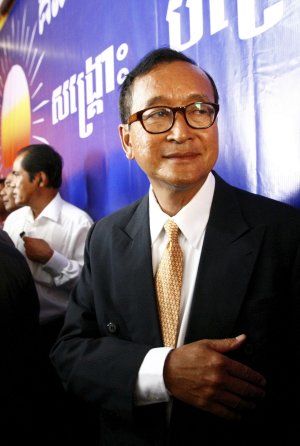
Press Conference at CNRP this Monday morning, July 29 (Photo: Theary C. Seng)
29 July 2013
CNRP POSITION ON ELECTION RESULTS
At this morning’s press conference the CNRP rejects the election results as published by the CPP and the NEC.
The opposition party calls for the establishment of a joint
investigation committee in order to identify all serious election
irregularities and assess their impact on the above election results.
The investigation committee should be made up
of representatives from the two main political parties, the civil
society, the NEC, national and international election monitoring
organisations and other specific NGOs.
On the basis of the
investigation committee’s findings and recommendations, political
leaders from both sides will find ways and means to strengthen democracy
and to redress the injustice done to the Cambodian people whose will
has been distorted for too long.
SOPHENG CHEANGPHNOM PENH, Cambodia (AP) — Cambodia's opposition leader on Monday
rejected the results of a contentious election won by the long-time
ruling party, even though the opposition made its biggest gains in
years.
The challenge by opposition leader Sam Rainsy, who returned
from exile last week to campaign for his Cambodia National Rescue
Party, could lead to post-poll instability and even parliamentary
paralysis.
Provisional results from Sunday's voting showed the
opposition capturing 55 of the 123 seats in the National Assembly. Prime
Minister Hun Sen's Cambodian People's Party won 68 seats, or a majority
of 55 percent.
Rainsy called for an independent investigation
into allegations that as many as a million people may have been deprived
of their right to vote, among other irregularities.
He said the
results protest was not a bargaining chip to get into government but
instead a sign that his party was "interested in rendering justice to
the Cambodian people to ensure that the will of the Cambodian people not
be distorted or reversed."
If
the opposition party boycotts the assembly — as has happened after past
elections — it may be impossible for Hun Sen to legally form a
government.
Rainsy did not specifically threaten a boycott, but
election experts pointed out that the constitution says a quorum of 120
assembly members is needed to open a parliamentary session, raising the
possibility that an opposition boycott could leave the country without a
fully functioning government.
Hun Sen has not spoken publicly
since the election. Mercurial in temperament, he has a record of
accepting neither defeat nor victory with good grace.
The
opposition's challenge could be mostly bluster. Hun Sen's ruling party
has control or dominating influence over all the state bureaucracy and
the courts and will almost certainly affirm the CPP victory. Past
appeals have not succeeded, and it was unclear what the opposition would
do if its complaints were not sustained.
Foreign countries such
as the United States, which had expressed doubts before the election
about its fairness, are unlikely to pursue the point with enthusiasm.
They have accepted the results of past elections with much more open
intimidation and violence as fair enough, and will likely regard this
year's results as a major step forward.
The
opposition could nonetheless cause a lot of mischief by refusing to
take its seats. Hun Sen could seek to open parliament through a legal
loophole, though such a move would support charges of unfairness and
autocratic behavior.
He could also simply try to wait out his
opponent as head of a caretaker government. The position would be
awkward, but also preserve the status quo, which leaves his hands on the
levers of power.
Cambodia faced a similar situation after its
2003 election, when Hun Sen's party failed to win enough seats to
legally form a government on its own. The deadlock was broken only after
11 months and violence in the streets. But Hun Sen faced a divided
opposition then, while his opponents this time are united.
Critics
alleged that the election process was heavily rigged toward the ruling
party. Rainsy's party and nonpartisan groups charged that the ruling
party used the machinery of government and security forces in an unfair
manner to reward or pressure voters. They also said that voter
registration procedures were badly flawed, possibly leaving more than 1
million people disenfranchised.
Leader of the opposition Cambodia National Rescue Party, Sam Rainsy speaks in Phnom Penh on Monday.
Phnom Penh, Cambodia (CNN) -- The opposition party
in Cambodia has rejected the results of the country's national election,
which handed another win to long-serving Prime Minister Hun Sen.
The Cambodia National
Rescue Party (CNRP) said Monday the weekend balloting was marred by
irregularities, and demanded an investigation.
Cambodians went to the polls Sunday.
According to preliminary
results released by the national election commission, the opposition won
55 seats. But the number wasn't large enough to unseat the ruling
Cambodian People's Party, which won 68 seats.
Cambodia election biggest in 20 years
In a statement,
opposition leader Sam Rainsy said a committee -- made up of
representatives of the main political parties, the election commission
and foreign election monitors -- should look into "all serious election
irregularities."
Once the committee issues
its findings, political leaders from both sides will find ways to
"redress the injustice done to the Cambodian people whose will has been
distorted for too long," he said.
Hun Sen has been in office for 28 years.
Still, opposition groups were energized.
The two main parties
teamed up to form the CNRP, and hoped for strength in numbers: Enough
votes to take over control from the ruling party.
More than 9 million people were eligible to vote.
The excitement bubbled over Friday when Rainsy returned home from exile in France.
PHNOM PENH,29th July 2013 (The Cambodia Herald) -- Princess Norodom Vicheara dies from lung cancer early Sunday morning in France.
Pen Sangha, spokesman for Prince Norodom Ranariddh, announced her death to reporters on Monday.
King
Norodom Sihamoni will pay tribute to the death of the princess at the
home of Prince Norodom Sirivudh, her younger brother, Norodom Sirivudh
was quoted as saying.
Sirivudh said Princess Vicheara was the half sister of late King Norodom Sihanouk, who passed away late last year in Beijing.
- See more at: http://www.thecambodiaherald.com/cambodia/detail/1?page=15&token=NWExZWY4Y2QxODJ#sthash.b2gGrLEu.dpuf
Illustrating
a rapidly changing information network in Cambodia, social media played
a major role yesterday, as images and videos that appeared to depict
fraudulent election activity went viral on Facebook and Twitter.
Videos
of voters washing off the supposedly indelible security ink used to
identify those who have cast their ballots and alleged illegal
Vietnamese voters being blocked at poll stations were two primary social
media stories that surged across the internet.
In video footage
uploaded by Facebook user Lin Chin that garnered more than 3,000 shares
and a swath of online commentary, papers are ripped from the hands of a
voter alleged to be Vietnamese and a crowd chants “get out, get out”.
In
a second video posted on Facebook, voters are shown washing off the
security ink used to identify those who have cast their ballots. Posted
yesterday under the username “I Love Cambodia Hot News”, the video
scored 300 shares in less than one hour. More than 450 Facebook users
responded to the video, with some declaring the National Election
Committee (NEC) a sham, levelling the committee with a public relations
nightmare in lieu of the televised press conference held on Saturday, in
which NEC chairman Im Suosdey claimed the election ink could not be
removed after voters stepped outside and were exposed to sunlight.
“It
is 100 per cent certain that the ink would not be able to be removed
[after a vote], because when the ink is exposed to [sun]light, it is set
at good quality,” Suosdey told reporters.
Both videos show multiple phones and cameras documenting the two incidents.
Just
a few percentage points separated the incumbent government and the
opposition in Sunday’s poll, Transparency International reported at a
press conference today, where it called for an investigation into
irregularities.
The TI findings, which the organisation said were
based on an accurate representative sample, come despite the Cambodian
People’s Party winning 13 more seats than the Cambodia National Rescue
Party, in what was essentially two-horse race.
The CPP registered
48.5 per cent of the popular vote while the CNRP took home 44.4, though
with a 1.8 per cent margin for error, the difference could have been as
little as .6 per cent.
TI Cambodia executive director Preap Kol
said that given the closeness of the race and the number of
irregularities, the outcome “does not necessarily reflect the will of
Cambodian voters”.
“All this that happened was consistent with the
warnings made to the NEC by independent organisations … we regret that
the [National Election Committee] didn’t take any action to prevent the
irregularities,” he said.
Echoing calls from the CNRP earlier
today, Preap said votes should be counted transparently and recommended
the formation of an independent body to investigate alleged
irregularities.
But Preap stressed it was not the role of a civil
society organisation to determine whether the election should be
recognised or not, which he would leave to the political parties.
“We only demand justice for the people who wanted to vote and were disenfranchised.”
Anger
flared and instances of violence broke out in a number of communes
during Sunday’s election because of alleged instances of electoral
fraud.
តារាងខាងលើជាលទ្ធផលដែលគជប ប្រកាស់ថា បក្សប្រជាជនឈ្នះបាន ៦៨កៅអី, ឯបក្សសង្គ្រោះជាតិឈ្នះបានតែ ៥៥កៅអីទេ។ ឯតារាងខាងក្រោមប្រកាសដោយអង្គការក្រៅរដ្ឋាភិបាល បង្ហាញថា បក្សសង្គ្រោះជាតិឈ្នះបាន ៦២កៅអី ឯបក្សប្រជាជនវិញទទួលបានតែ ៦១ កៅអីតែប់ណ្ណោះ។ The result in the first table was announced by the National Election Committee showing the CPP winning 68 seats and the CNRP winning 55 seats. The result from the second table was announced by the civil society (NGOs) showing the CNRP winning 62 seats and the ruling CPP winning only 61 seats.
ជួយរកយុត្តិធម៌អោយកម្ពុជាផង !សហគមន៍អឺរ៉ុប USA... The poster below said: Preliminary results:
CPP = 2,555,030
CNRP = 2,295,022
Total = 4,850,053
Other parties = 500,000
Where are more than 4 million votes because total people registered to vote were 9.5 million people.
National Election Results Released on July 28, 2013
As the U.S. Embassy continues to monitor reaction to the July 28,
2013 elections, we will be closed to the public on the morning of
Monday, July 29 with regular consular services resuming at 12:00 noon.
We regret the inconvenience. If you had an appointment for American
Citizens Services on that morning, please reschedule your appointment.
If you need an emergency service, please contact the Embassy at
023-728-000. Please continue to monitor the Embassy's website for
updates on the status of services to the public.
Due to the potential for civil unrest over the next few days, the
U.S. Embassy encourages U.S. citizens to limit their movements, avoid
areas prone to gatherings, and immediately vacate any area where crowds
are gathering. Rival groups may take to the streets and public areas to
express their political views. Demonstrations or events intended to be
peaceful can turn confrontational and possibly escalate into violence
without warning. The Embassy advises U.S. citizens to remain alert to
local security developments by monitoring local news reports, be
vigilant regarding your personal security and preparedness, be aware of
your surroundings, and plan your activities accordingly.
We strongly recommend that U.S. citizens traveling to or residing in Cambodia enroll in the Department of State’s Smart Traveler Enrollment Program (STEP).
STEP enrollment gives you the latest security updates, and makes it
easier for the U.S. embassy or nearest U.S. consulate to contact you in
an emergency. If you don’t have Internet access, enroll directly with
the nearest U.S. embassy or consulate.



 Cambodia election biggest in 20 years


