A Change of Guard

សូមស្តាប់វិទ្យុសង្គ្រោះជាតិ Please read more Khmer news and listen to CNRP Radio at National Rescue Party. សូមស្តាប់វីទ្យុខ្មែរប៉ុស្តិ៍/Khmer Post Radio.
Follow Khmerization on Facebook/តាមដានខ្មែរូបនីយកម្មតាម Facebook: https://www.facebook.com/khmerization.khmerican

Friday, 3 February 2012

Amnesty International: Cambodia: Stop the use of excessive force against peaceful land activists

Borei Keila - Houses demolished by forced eviction in Jan. 2012 (Licadho).

2 February 2012

Notes to Editors

For information or comment please contact –
In Cambodia, Rupert Abbott + 855 175 00778 / rupert.abbott@amnesty.org
In London, Katya Nasim + 44 7904 398 103 / + 44 207 413 5971 katya.nasim@amnesty.org

Cambodian authorities must stop the use of excessive force against peaceful land and housing activists, Amnesty International said today, after police violently dispersed a group of around 150 women protesting forced evictions in the capital Phnom Penh.

Police yesterday beat and arrested several of the women, who were peacefully protesting against last month’s forced eviction of the Borei Keila community and the effects of past evictions at the capital’s Boeung Kak Lake.

“Communities all over Cambodia are peacefully resisting forced evictions and taking action to claim their rights,” said Donna Guest, Deputy Director of Amnesty International’s Asia-Pacific Programme.

“The Cambodian authorities must stop the use of excessive force against these communities, and bring to justice those responsible for such violence.”

Yesterday’s episode follows more serious incidents elsewhere in the country, where land activists were reportedly shot and injured in Kratie province in eastern Cambodian by military personnel working for a private company, and in Battambang province in the west by military police.

Several of the women protesting in Phnom Penh yesterday were half naked, as they removed their clothing in an apparent show of desperation. Police reportedly grabbed and beat the protesters, including elderly women, to the ground, before six women were thrown into a police van and detained overnight at Phnom Penh police station.

The six women included Borei Keila residents Seng Kunthea, Seng Rany, Tom Sakmony, Nen Sarith and Ath Samnang, as well as Srang Srey Tuch, a former resident of Boeung Kak Lake.

At least two of them were injured during the arrest but reportedly received no medical care, while none of them were given full access to lawyers.

Four of the detained Borei Keila women had previously been held at Prey Speu Social Affairs Center, after a peaceful protest last month against the Borei Keila forced eviction.

All six were released today without charge after being detained overnight. Phnom Penh authorities agreed to discuss the disputes with representatives from the two communities.

Women from Borei Keila are seeking compensation for damaged property and calling on the authorities to address their housing needs after more than 300 families were evicted from a development site on 3 January. The developer, Phan Imex, has failed to build the on-site housing it previously promised them.

Seven people arrested during the Borei Keila eviction remain in detention.

Residents from Boeung Kak Lake are calling for the authorities to follow through on the Prime Minister’s promise, made in August 2011, to grant land titles to remaining residents and allow construction of on-site housing around the lake.

They are also demanding that the authorities take measures to alleviate flooding caused by the company filling in the lake. Former residents are calling for additional compensation for being forced to leave their homes and relocating elsewhere.

Earlier this week, Cambodian Prime Minister Hun Sen warned against the use of violence in land disputes.

“The Cambodian government is saying one thing and authorities at the local level are doing another. Yesterday’s use of excessive force by police in Phnom Penh contradicts the Prime Minister’s call for peaceful resolutions to land disputes,” said Donna Guest.

“Instead of trying to silence these communities through intimidation and violence, the Phnom Penh authorities should listen to them. These communities have a right to a prompt solution that meets Cambodia’s international legal obligations to provide adequate housing,” said Donna Guest.

Cambodian FM to Visit China to Boost Ties

2nd February, 2012
Xinhua Web Editor: Zhangxu

Cambodia's Deputy Prime Minister Hor Namhong (pictured), who is also a minister of foreign affairs and international cooperation, will lead a delegation to visit China on Feb. 5-7 in order to strengthen bilateral ties and ASEAN- China relations, according to the ministry's press release on Thursday.

The visit is made at the invitation of Chinese Foreign Minister Yang Jiechi.

During the visit, Hor Namhong will hold talks with Yang Jiechi on some bilateral and international issues, said the press release.

The minister will deliver a speech on the ASEAN-China relations at the ASEAN-China Center. He will also meet with some other Chinese high-ranking officials.

Cambodia is the chair of ASEAN in 2012. With the chairmanship, the country pledged to strengthen closer ties and cooperation between ASEAN and China.

The Association of Southeast Asian Nations (ASEAN) groups Brunei, Cambodia, Indonesia, Laos, Malaysia, Myanmar, the Philippines, Singapore, Thailand and Vietnam.

Cambodian workers hold 'people's tribunal' to look at factory conditions

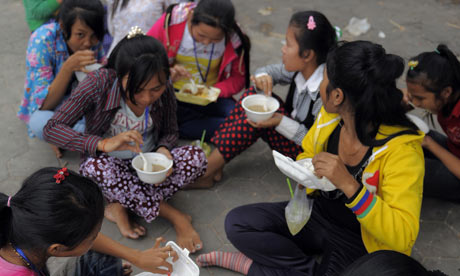
Garment workers eat in front of a clothes factory in Phnom Penh. The minimum wage in Cambodia is equivalent to £42 a month. Photograph: Tang Chhin Sothy/AFP/Getty
The original article at The Guardian.

H&M and Gap criticised for not agreeing to attend hearing next week investigating pay, working hours and 'mass faintings'

Workers in Cambodia will hold a "people's tribunal" next week to investigate pay and conditions at factories working for fashion brands including H&M and Gap.

An international panel of judges will hear evidence from workers, factories and multinational brands including Puma and Adidas. H&M said it would not attend but would supply information about how it was addressing wages at its suppliers' factories in the country.

The two-day hearing aims to raise awareness of low pay and long working hours that workers say are partly responsible for a series of "mass faintings" involving hundreds of workers at factories supplying H&M, Gap and sports brands.

Up to 300 workers will give evidence about the fainting incidents and about living conditions resulting from low wages.

The minimum wage in Cambodia is the equivalent of just $66 (£42) a month, a level that human rights groups say is almost half that required to meet basic needs.

Ath Thorn, president of the Cambodian Coalition for Apparel Workers Democratic Unions, said: "Because the workers get low wages they try to work 10 to 13 hours a day to get the money they need for their family."

He said workers needed a basic wage equivalent to at least $100 (£63) a month to get by without putting their health in danger. "Workers are fainting because of long working hours and the environment in the factory," he said.

Fumes from chemicals, poor ventilation, malnutrition and even "mass hysteria" have all been blamed for making workers ill.

A report by the International Labour Organisation said at least 11 garment factories experienced fainting incidents and more than 1,500 workers fainted or collapsed during working hours last year.

In August, nearly 300 workers passed out in one week at a Cambodian factory supplying H&M, prompting an investigation by the Swedish retailer. More than 100 people were reported to have been taken to hospital after the incidents at M&V International Manufacturing in Kampong Chhnang.

A report commissioned by H&M blamed the faintings on mass hysteria caused by work-related and personal stress.

About 100 workers fainted at the Huey Chen factory, which supplies Puma, in April last year and another 49 passed out at the same factory in July. Puma said it had implemented an improvement plan at the factory and commissioned a report into the reason for the faintings. It said it was working with the factory and local authorities to "take every precaution that compliance with our social and labour standards is ensured".

Jeroen Merk, of the workers' rights pressure group Clean Clothes Campaign, said it was "disappointing" that H&M and Gap had chosen not to attend the tribunal.

A spokeswoman for H&M said: "Workers should earn a fair wage and we strive for decent supply chain working conditions. To tackle this challenge we last year joined the Fair Wage Network to find out more about how we can contribute to more fair wages."

Adidas said its factory workers earned nearly twice as much as police officers or teachers in the same region and considerably more than the minimum wage. A spokesman said: "Workplace conditions at our major suppliers have been the subject of independent verification and certification and we constantly question and improve our performance."

The Clean Clothes Campaign and the British campaign group Labour Behind the Label supported local members of Asia Floor Wage, a coalition campaigning for higher minimum wages across the continent, in setting up the tribunal. They said the event was an attempt to raise awareness in a less confrontational way than strikes.

The move comes after 1,000 union leaders were dismissed after strikes for better pay and conditions involving 200,000 workers last year.

Clothing and footwear is a vital part of Cambodia's economy, employing more than 300,000 people, mostly women. Last year exports of garments and footwear rose by 25% from to $4.24 bn (£2.68bn), making up 85% of total exports.

Cambodia at loggerheads with UN over Khmer Rouge trials

Appeal … Kaing Guek Eav, who ran the Tuol Sleng prison, in which ''enemies'' of the state were tortured and killed. Photo: AP

Lindsay Murdoch
The Sydney Morning Herald
February 3, 2012

PHNOM PENH: One of the worst mass murderers of the 20th century will learn his fate today at a controversial war crimes tribunal convened to investigate allegations of genocide and other crimes against former leaders of the Khmer Rouge, which ruled Cambodia from 1975 to 1979.

However, proceedings have thrown the United Nations and the Cambodian government into dispute and hundreds of staff have not been paid for months.

The UN, which wants to prosecute more alleged perpetrators of crimes against humanity, says it is being blocked from doing so by the government.

The decision on an appeal against the 19-year jail sentence for Khmer Rouge executioner and torturer Kaing Guek Eav - better known as ''Duch'' - will be handed down today in the Courts of Cambodia, where the UN-appointed Swiss judge, Laurent Kasper-Ansermet, has been prevented from assuming his official duties.

The judge has been accused of commenting on Twitter about cases the government in Phnom Penh does not want to proceed.

Despite the tribunal costs blowing out to more than $150 million, many of its 300 Cambodian staff have not been paid since October and no money will be available for any of them until at least the end of February, possibly even longer, officials say.

The stand-off over the appointment of the judge has prompted speculation that the UN could withdraw from the proceedings before the trials of three other ageing Khmer Rouge leaders are completed. Including Duch, only four members of the Khmer Rouge government have been charged with any crimes. The UN is insisting that Mr Kasper-Ansermet push on with other prosecutions, including against the former naval commander Meas Muth and former air force chief Sou Met. Meas Muth is now believed to be a high-level adviser to the Cambodian government.

David Scheffer, an American appointed by the UN to advise the tribunal, said Mr Kasper-Ansermet ''has clear authority to fulfil his duties and we look forward to him doing so''.

The Cambodian Prime Minister, Hun Sen, a former Khmer Rouge cadre, has repeatedly demanded the tribunal undertake no new prosecutions, warning of civil war if more indictments are issued.

The Information Minister, Khieu Kanharith, said on Tuesday that if the UN withdrew from the tribunal, Cambodia would appoint its own judges to hear the remaining cases against the Khmer Rouge's chief ideologue Nuon Chea, the former head of state Khieu Samphan, and the Khmer Rouge foreign minister Ieng Sary.

The 19-year sentence Duch, 69, received after his trial in July 2010 angered many victims of the Khmer's Rouge's rule, during which an estimated 1.7 million people were executed or died from starvation or disease.

But Duch, the head of Tuol Sleng prison, claimed during an appeal hearing last year he would not have survived the brutal regime unless he ''respectfully and strictly followed orders''.

Hundreds of victims have registered to witness the appeal verdict at the tribunal on the outskirts of Phnom Penh and then attend a ceremony later today at the nearby Choeung Ek ''killing fields'' where the Tuol Sleng victims were buried.

Prosecutors have argued the jail term imposed on Duch, which took into account time already served, should be increased because of the shocking crimes he was responsible for and because he had shown no remorse.

Trial observers say it is unlikely that Duch will go free.

Since he was found working as a Christian aid worker in the Cambodian jungle in 1999 he has repeatedly admitted his role at Tuol Sleng, also known as S-21.

Thursday, 2 February 2012

A personal message from Sam Rainsy

Paris, February 2, 2012

Dear fellow countryman,

Over the last 12 months we have won two successive legal victories versus the Hun Sen government at the Paris tribunal:

1. My definitive victory versus Hor Nam Hong at the "Cour de Cassation" (French Supreme Court) on April 27, 2011, exposing the criminal past of one of the leaders of the current regime.

2. The reopening by the state prosecutor on January 24, 2012 of the case concerning the grenade attack in Phnom Penh on March 30, 1997, carried out on the orders of Hun Sen.

These legal victories are the prelude to further successes. They set the stage for the truth to emerge and will have very important political consequences which will hasten the fall of the Hun Sen regime. After the truth follows justice. The triumph of justice in Cambodia will signify liberty for the Khmer people and the coming of democracy to our country.

I await democracy's coming in the knowledge that night is never eternal and that dawn always breaks.

The legal struggle against this murderous and treacherous regime must be continued before independent courts in democratic countries, and before competent international bodies such as the International Criminal Court.

I count on your support and participation in this peaceful but decisive battle to save our country.

Please accept my warmest fraternal greetings,

Sam Rainsy

_________________________________________


STATEMENT BY THE SAM RAINSY PARTY (SRP)

January 27, 2012

ANOTHER STEP TOWARD THE END OF IMPUNITY IN CAMBODIA

On January 24, 2012 the Prosecutor of the French Republic at the Paris
Tribunal decided to resume the judicial investigation into a deadly
grenade attack perpetrated in Phnom Penh on March 30, 1997. The attack
was an assassination attempt on Sam Rainsy who is a French citizen.

For more details please read our statement in Khmer http://tinyurl.com/8aaqa9b

_____________________________________________________________________


Message personnel à tous les membres et amis du Parti Sam Rainsy (PSR)

Paris, le 2 février 2012

Cher compatriote,

Au cours des douze derniers mois, nous venons de remporter deux
victoires judiciaires successives devant le Tribunal de Paris sur le
régime de Hun Sen:

1. Ma victoire définitive sur Hor Nam Hong devant la Cour de Cassation
le 27 avril 2011 qui expose le passé criminel d’un des principaux
dirigeants du régime actuel

2. La réouverture par le Procureur de la République le 24 janvier 2012
de l’information judiciaire portant sur l’attaque à la grenade
perpétrée à Phnom Penh le 30 mars 1997 et commanditée par Hun Sen.

Ces deux victoires judiciaires en annoncent d’autres qui vont venir.
Elles préparent la voie à la victoire de la Vérité et vont avoir des
conséquences politiques très importantes qui vont hâter la chute du
régime Hun Sen. Car après la Vérité viendra la Justice. Le triomphe
de la Justice au Cambodge signifiera la Liberté pour le peuple khmer
et l’avènement de la Démocratie dans notre pays.

J’attends l’avènement de la Démocratie au Cambodge comme j’attends que
le jour se lève, car il n’y a pas de nuit éternelle.

Il faut donc continuer la bataille judiciaire contre ce régime
d’assassins et de traîtres devant des tribunaux indépendants,
c’est-à-dire ceux de pays démocratiques, et devant les juridictions
internationales compétentes comme la Cour Pénale Internationale.

Je compte sur votre soutien et votre participation pour continuer
cette bataille pacifique mais décisive pour sauver notre Patrie.

Veillez recevoir mes salutations fraternelles.

Sam Rainsy

_________________________________________


COMMUNIQUÉ DU PARTI SAM RAINY (PSR)

27 janvier 2012

UN AUTRE PAS VERS LA FIN DE L’IMPUNITÉ AU CAMBODGE

Le 24 janvier 2012 le Procureur de la République près le Tribunal de
Grande Instance de Paris a signé la réouverture de l’information
judiciaire portant sur l’attaque meurtrière à la grenade perpétrée à
Phnom Penh le 30 mars 1997. L’attaque correspondait à une tentative
d’assassinat à l’encontre de Sam Rainsy qui détient la nationalité
française.

Pour plus de détails veuillez lire notre communiqué en khmer
http://tinyurl.com/8aaqa9b

Twelve Cambodian maids return to Cambodia

Published: 02-Feb-12

PHNOM PENH (Cambodia Herald) - Twelve Cambodian women trafficked to Malaysia to work as maids returned home Thursday, sources said.

The sources said police planned to question the women about who arranged their employment in Malaysia after they received health checks.

Sem Sok, an officer with the Cambodian League for the Promotion and Defense of Human Rights (Licadho), said one of the workers, identified only as Ya, had just given birth after being raped by her Malaysian employer.

The return of the maids was arranged by the Cambodian Ambassador to Malaysia in collaboration with the Ministry of Foreign Affairs and International Cooperation and the International Organization for Migration (IOM).

Court orders former Cambodian ambassador to return $332,000 to Foreign Ministry


Published: 02-Feb-12

PHNOM PENH (Cambodia Herald) - Phnom Penh Municipal Court ordered former ambassador to Brunei Nan Sy (pictured) Thursday to return $332,000 and pay 150 million riel ($37,500) in damages to the Ministry of Foreign Affairs.

Judge Ke Sam Ang also set a new date for a court appearance by Nan Sy, who is still at large.

In November, the court sentenced Nan Sy to four years in prison and fined him eight million riel ($2,000) for stealing more than $430,000 slated for the construction of an office at the embassy in Brunei in 2008.

Phnom Penh authorities agree to conditional release of Borei Keila residents

Published: 02-Feb-12

PHNOM PENH (Cambodia Herald) - Authorities from Phnom Penh City Hall agreed Thursday to release five Borei Keila residents on condition they stop their illegal protests, sources said.

The sources said the agreement came during a meeting between City Hall officials and three Borei Keila representatives, who vowed to stop protesting and work with authorities to resolve the land conflict.

Five people were arrested Wednesday during a protest by about 200 residents of Borei Keila and Boeung Kok in front of City Hall.

Promises of Australia evaporate for villagers

Sen David with additional reporting by David Boyle
Thursday, 02 February 2012
The Phnom Penh Post

Military police have charged the wife of a provincial deputy police chief who allegedly cheated 37 people out of up to US$5,000 for non-existent jobs in Australia.

Lor Lai, Takeo provincial military commander, said yesterday that Heng Keo Dina, the 43-year-old wife of deputy police chief Kuo Keng, was charged with breach of trust on Monday after numerous complaints from victims over the weekend.

“She was detained by the court awaiting trial and what we need to do next is to catch the other brokers who are related to this case,” he said.

The victims, who had been promised jobs as fruit pickers in Australia, had borrowed money, mortgaged land and sold property to raise between $2,500 and $5,000 that the brokers were charging for the phony jobs.

Ses Hot, 39, said he realised he had lost everything after waiting 10 hours with 36 others at Phnom Penh International Airport on Saturday for the brokers, who never arrived.

“We sold our cow, other property, borrowed some money and mortgaged some land,” he said.

“We are poor. We needed jobs so we hoped that we would get a job in Australia, but our hope disappeared when we realised we were really cheated . We lost our money.”

After hesitating, because of threats from the brokers, the group of would-be migrant workers from Takeo and Battambang provinces and Phnom Penh decided to go to the police.

Panha Than, an integrity officer at the Australian embassy in Phnom Penh, said once brokers names had been verified, they would be flagged.

“This one will go straight into our local warning record and all our case officers will be able to get this information,” he said.

Another official at the Australian Embassy who declined to be named said it was highly unusual for Cambodians to be granted working holiday visas to Australia, which are offered for foreign fruit pickers.

Un Thanann, Takeo provincial coordinator for rights group Adhoc, said the victims had not taken the time to consider whether they could realistically get jobs in Australia or not.

“It is a rare case for the broker to cheat people to find a job in Australia. Before, we’ve had cases of [promised jobs] in Thailand, or Malaysia. So it is an example for the residents that they should think before deciding to believe,” he said.

Agro firm bows to pressure

By May Titthara
Thursday, 02 February 2012
The Phnom Penh Post

A day after Prime Minister Hun Sen threatened to withdraw TTY Company’s economic land concession licence if it refused to cooperate, the company yesterday began assisting police to find security guards wanted over the shooting of villagers during a protest in Kratie province last month, it said.

120202_05
Heng Chivoan/Phnom Penh Post

A woman from Kratie province’s Snuol district walks through the land that is the subject of the dispute with the TTY company.
Heng Sarath, deputy-general of TTY, denied the company had ordered the shootings and said he was cooperating with provincial and military police to find the three company security guards, Koe Sovanna, 29, Yon Chhaina, 32, and Phin Oeun, 35, who have been summonsed to court.

“We could not accept their activity,” he said. “They destroyed the company, we have to find them so can they can be arrested.”

On January 18, four villagers were seriously injured when a company security guard opened fire with an AK-47 on a group of about 400 people in Snuol district’s Pi Thnou commune as they tried to prevent bulldozers from clearing their cassava trees.

Hun Sen said on Tuesday that he would fire TTY director Na Marady as his adviser if he did not turn in the guards responsible for the shootings.

Heng Sarath denied TTY had issued guns to the security guards and said blame directed at the company was unwarranted.

“We employ security guards, but we provide them only batons – the government should not abuse my company like this.”

“We don’t know how the security guards got guns. Our company has only three handguns,” he said.

Those guns, which are logged with the government each month, had not been given to the security guards, he said.

Heng Sarath said TTY officials did not know which provinces the security guards were from, but had told its staff to cooperate with police.

If there were employees who knew which province any of the three guards were from they should go there to assist local authorities, he said.

Mao Rainny, deputy military police chief in Kratie province, said military and provincial police had cooperated with TTY and officials in neighbouring Mondulkiri and Kampong Cham provinces yesterday as the search continued.

A photo that shows a security guard brandishing an assault rifle and another guard was being distributed with copies of the provincial court summonses, he said.

Police were also still investigating the possibility that the company was hiding the men.

“My officers are still been deployed near TTY’s office in case the guards are being hidden inside,” he said.

Ket Socheat, the investigating judge in Kratie, said he was examining the backgrounds of the security guards.

“I would like to ask to not speak about those three guys because it could affect my job,” he said.

Evictees detained again

Protesters scuffled and being arrested by the police.


Khouth Sophak Chakrya with additional reporting by Shane Worrell
Thursday, 02 February 2012
The Phnom Penh Post

Five former Borei Keila women who escaped from the Prey Speu social affairs centre last month after being detained without charge were among six arrested when a protest turned violent in Phnom Penh yesterday.

Women shouted at officials and two tore off their clothes and bared their breasts as more than 50 female evictees from Borei Keila and Boeung Kak blocked traffic outside the city hall on Preah Monivong Boulevard in a bid to have municipal governor Kep Chutema listen to them.

Their requests were familiar – they wanted officials to resolve their land disputes through proper housing or compensation and release seven Borei Keila evictees who have been detained in Prey Sar prison since January 3, when more than 200 homes were demolished at Borei Keila.

Yesterday’s protest turned violent when Daun Penh district governor Sok Sambath ordered security forces to arrest protesters using the ratio of “five [security guards or police] to each woman”.

Guards in blue uniforms were the first to use force, followed by police, who rushed to restrain women – some of them frail or elderly – and dragged or carried them to a municipal police truck.

Some of the women ran away in fright as others fought with police and security guards.

One woman fainted after a struggle with officials, while a security guard passed out after receiving a blow to the groin.

Five of the six women arrested had been detained in a similar protest on January 11 and held without charge at Prey Speu social affairs centre before climbing the walls and escaping a week later.

The other woman arrested was a former resident of Boeung Kak.

Among those police tried to detain was Chum Ghan, an evictee of Borei Keila. She escaped the clutches of police and disappeared into the crowd of screaming protesters, but later told the Post she had been injured during the scuffle and expected she would be arrested.

“In spite of a crackdown from the police, we will keep protesting until we receive a proper resolution from the municipal authority,” she said.

Earlier, the women had gathered with their letter of requests and an intervention paper from Heng Samrin, president of the national assembly.

Villagers said Heng Samrin had signed a complaint from them on January 19 requesting that Kep Chutema find a resolution to the dispute.

The women’s banners showed images of development firm Phan Imex’s machinery destroying their homes at Borei Keila last month, and they repeated calls for the company to finish the final two of 10 buildings it had agreed in 2003 to construct.

Chan Soveth, an investigator for the human-rights group Adhoc, said the authorities’ constant use of violence to break up protests was an abuse of the villagers’ rights.

“We are really disappointed when the authorities use violence,” he said.

Sia Phearum, the secretariat director of the Housing Rights Task Force, shared this view.

Kiet Chhe, city hall deputy administration chief, declined to answer questions put to him about the arrests.

“I have two eyes and you have two eyes, so what I saw you also saw,” he said.

Earlier, more than 100 former Boeung Kak residents, who agreed to accept US$8,500 in compensation, gathered to demand more money, claiming they could only afford to buy land but not houses to build.

Many, however, had left for home by the time the main protest began.

The Phnom Penh municipality released a statement yesterday criticising the former Boeung Kak protesters for asking for another $20,000 per family.

“They violated their agreement,” the statement reads.

SRP lawmaker Mu Sochua condemned the treatment of the protesters and said authorities should have listened to Prime Minister Hun Sen’s speech the day before, in which he ordered an end to violent land disputes.

“This is exactly what he is speaking about,” she said.

The arrested women were being targeted by Phan Imex and protesters were being ignored, Mu Sochua said.

“This is continued harassment that is an attempt to keep them silent.”

But Mu Sochua doubted harassment would deter villagers and cited Boeung Kak evictees as an example of people who had remained strong despite losing their houses and land.

“Their spirit is stronger than ever,’’ she said.

“Who in the government has ever spoken to these protesters? There has been a total lack of accountability.”

Villagers have high hopes for ox-cart racing

By Ou Mom
Wednesday, 01 February 2012
The Phnom Penh Post

In a rice field left fallow after the harvest, residents of Prey Ta Ouk village, Kampong Speu province, watched and cheered on the winners of the village’s 7th Khmer traditional ox-cart race.

120201_17
Sreng Meng Srun/Phnom Penh Post

An ox-cart driver races in Prey Ta Ouk village.
“We hold the event to promote ox cart racing, as well as local tourism and agriculture. The proceeds from tickets also help support the poorest children in the village,” said Pok Saoly, one of the race organisers.

The tradition of ox-cart racing began in the village a long time ago, but was lost during the Khmer Rouge regime, according to Pok Saoly, one of the race’s organisers. The sport has seen a resurgence since 2007, he said.

The Prey Ta Ouk race is held twice a year – once to celebrate the January harvest and once a few days before Khmer new year – and has become so popular that organisers hope to hold more races throughout the year.

“We hope to promote ox-cart racing outside the village, and create a championship for the district or province to select the best oxen,” said Pok Saoly.

“We plan to have a weekly or monthly competition to attact local and foreign visitors,” he said.

According to organisers, nine pairs of oxen participated in the race, while others were also busy racing in other villages and districts.

“Normally, I train my oxen for about half a month before the competition. We do six laps a day around a field,” said race winner Yub Kom, adding that he feeds his oxen plenty of rice and grass to keep them healthy between races.

Even though competitions have already spread to different places in the Kingdom, Pok Saoly hopes ox-cart racing will someday reach all Cambodians on television like other sports.

“Now we are looking for sponsors so we can support a national championship,” Pok Saoly said. “I think it can promote traditional Cambodian sport.”

China's aid contributes greatly to Cambodia's economic growth

Li Ruogu (L) and Hun Sen at the Peace Palace on 01 Feb 2012 (Photo: Sok Serey, RFA)

Updated: 2nd February, 2012

PHNOM PENH (Xinhua)- Cambodia's Prime Minister Hun Sen said Wednesday the country's strong economic growth in past years owes a great deal to China's steady technical and financial assistance.

The premier made the remarks during a meeting with Li Ruogu, visiting chairman and president of the Export-Import Bank of China, said prime minister's spokesman Eang Sophalleth.

The country's economic growth last year was 6.9 percent and is estimated at 6.5 percent this year, said the Finance Ministry.

Hun Sen said at present Cambodia is the weakest among all ASEAN member states in terms of infrastructure development and asked Li to consider financing about $500 million for Cambodia's seven infrastructure and irrigation projects in 2012.

"All the proposed seven projects are hugely important to develop Cambodia's economy, tourism and agriculture," he said.

On his part, Li said China would help finance these projects for Cambodia.

He said during his visit here he would sign three agreements with Cambodia to finance the country for two road construction projects and one irrigation system project.

DC-Cam director vouches for docs

By Mary Kozlovski
Thursday, 02 February 2012
The Phnom Penh Post

Youk Chhang, director of the Documentation Centre of Cambodia, testified at the Khmer Rouge tribunal yesterday that the organisation’s archives were accessible to all parties at the court, including defence teams that have recently claimed the organisation is biased.

120202_04
Will Baxter/Phnom Penh Post

Youk Chhang, director of the Documentation Centre of Cambodia, pictured last month at Tuol Sleng Genocide Museum, took the stand at the ECCC yesterday.
Under questioning from senior assistant co-prosecutor Tarik Abdhulhak, Youk Chhang said that since 2006, prosecution, defence and civil party lawyers had been allocated days during which they could conduct research at DC-Cam.

“They may ask questions or sometimes they hold their internal discussions and if they have any questions for us, then they will put questions to me,” he said.

“The documents that we have indicate that they are the documents belonging to the Democratic Kampuchea period, based on the content, the physical appearance, the source of the document."

Under earlier questioning from the prosecution, Youk Chhang said he could immediately identify a “Khmer Rouge document”.

“The language is so specific, it is not that difficult to distinguish, or to have to have a doctoral degree, to distinguish this type of document,” he said.

“Reading documents is like having breakfast for me.”

In recent evidence hearings, defence teams have suggested that DC-Cam’s research is biased against the defendants in Case 002, and have requested that Youk Chhang be called to testify.

Civil party lead co-lawyer Elisabeth Simmoneau Fort later questioned Youk Chhang about a statement he gave to investigators in 2009, in which he said he had received “veiled threats” in 1999 that led him to “put a pause” on his research.

Michael Karnavas, co-defence counsel for Ieng Sary, objected that the question was “non-relevant”.

The Trial Chamber, however, allowed Youk Chhang to answer the question, to which he responded that his sister was told to inform him to stop “conducting these activities”, but that he had refused.

DC-Cam was established as an independent NGO in 1997 and has provided about 500,000 documents to parties at the ECCC. Defence teams will begin questioning Youk Chhang in court today.

Cambodia's inflation rate holds 5.5 pct in 2011

PHNOM PENH, Feb. 2, 2012 (Xinhua) -- Cambodia's inflation rate stood at 5.5 percent last year, an increase of 1.5 percent from 4 percent in a year earlier, according to the report of the Finance Ministry on Thursday.

The rate was the same one forecast by the Asian Development Bank, but lowered than the forecast by the International Monetary Fund and the World Bank at 5.7 percent and 7.5 percent respectively.

Soaring oil prices mainly drove up the inflation rate last year. A liter of premium gasoline goes for 1.4 U.S. dollars on Thursday, up 12 percent compared with this time last year.

The ministry predicted that the Consumer Price Index (CPI) inflation rate in 2012 and 2013 would be at 5 percent and 3 percent respectively.

The report also recorded that the Cambodian "riel" currency value remained stable last year compared to the U.S. dollar -- at 4,040 riel against a U.S. dollar.
Editor: Lu Hui

Cops Hunt For Olney Home Invasion Killers [in Philadelphia after a Cambodian man was found beaten to death]


Published : Wednesday, 01 Feb 2012
http://www.myfoxphilly.com

PHILADELPHIA - Philadelphia's Cambodian community wants answers after a man was found dead, gagged and beaten, in his Olney home.

The victim's wife found Sophos Siv's body in their home on the 200 block of Ruscomb Street on Tuesday.

The community is a tight knit group of about 20,000 people. Over 100 Cambodian friends and family members turned out at the home of 40-year-old Siv, stunned by his murder.

Police say two or more suspects broke in through this back window Tuesday afternoon, when Siv confronted them he was tied up, shot and beaten to death.

He had been shot multiple times and he also had a 45 pound weight plate that they had taken and bounced off his head

Friends and family members say siv helped members of the Cambodian community get jobs, then drove them to work each day in this van.

Homicide detectives re-interviewed family members trying to determine why anyone would target siv. Police believe this was a home invasion gone bad.

Siv was murder victim number 34 in a bloody month of January in Philadelphia, and those close to him hope police can identify and arrest his killers.

Long Beach nonprofit brings heart surgery to Cambodian children


Top: A team of physicians and health professionals from California and Wisconsin volunteered their services to help 15 Cambodian children to receive heart surgeries during a recent medical mission to the country. The Long Beach nonprofit Hearts Without Boundaries helped sponsor a team of physicians who performed procedures. Bottom: One of 15 Cambodian children to receive heart surgeries during a recent medical mission to the country.

By Greg Mellen Staff Writer
The Contra Costa Times
Posted: 02/01/2012

For the first time, Long Beach nonprofit Hearts Without Boundaries was able to offer life-extending surgeries to destitute Cambodian children in their home country, rather than bringing them to the United States.

During a five-day medical mission, doctors from California and Wisconsin repaired the hearts of 15 children at Angkor Hospital for Children.

Peter Chhun, founder of the nonprofit who first began bringing children to the U.S. when the equipment for open-heart surgeries was not available in Cambodia, was delighted with the outcome.

"To come to the country of my birth and witness sick children before the surgery, and then to see them after the surgery, smiling, playing and not having the same blue color on their fingertips and lips is a great feeling," Chhun said. "I don't think I can find anything better than this to do."

For Hearts Without Boundaries, which has brought four children to the United States for surgeries over the last four years, the recent medical mission was a boon and proved to be a much more efficient way to treat the children.

Chhun said it is much more costly and time-consuming to bring one child at a time to the United States. By sponsoring the mission, in five days the number of children treated was more than three times what the nonprofit achieved in four years. And the cost was a modest $3,000 per child.

The added benefit is that during the missions, surgeons train Cambodian health professionals to one day be able to perform the surgeries.

A group of doctors that once performed minor heart repairs called PDAs has been able to discontinue because physicians at Angkor Hospital are now able to do them.

Chhun said recent research shows more than 100,000 children in Cambodia suffer from heart defects, with very few ever receiving treatment.

He hopes sponsors will be able to help his nonprofit continue to support missions either once or twice per year.
The Long Beach nonprofit Hearts Without Boundaries helped sponsor a team of physicians who performed procedures on 15 Cambodian children, including this patient.

"This is a part of our mission now," Chhun said. "I would like to do more.

Chhun said some more serious cases would still be brought to the United States.

He said the mission had another benefit.

"This trip is more up close and personal," Chhun said. "To have been able to provide care to a child from my village is something I had never dreamed of. A long way from my village ... a long way to accomplish my goal."

greg.mellen@presstelegram.com, 562-714-2093, twitter.com/gregmellenpt

Cambodia: Mass Fainting in Garment Factories

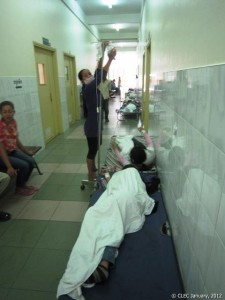
Workers of King First Factory rushed to hospital after fainting. Photo from Community Legal Education Center

The Asia Floor Wage network is organizing Cambodia’s first ever People’s Tribunal on Minimum Living Wage and Decent Working Conditions for garment workers. The tribunal is scheduled on February 8 in Phnom Penh.

The garment industry in Cambodia represents 90% of all exports. However, despite its relative economic importance, workers receive only half of what is needed to safely support their families and the statutory minimum wage is currently the lowest in the Mekong region.

One of the major issues which will be discussed is the poor working conditions in factories which resulted in fainting incidents in numerous workplaces.

Another issue of concern currently facing garment factories and their workers has been mass fainting. In 2011 year alone, the Free Trade Union has reported some 2,300 workers fainting in 5 Cambodian factories… Investigations and company statements have varied in their conclusions on contributing factors, but many have highlighted physiological causes such as low blood sugar, malnutrition, dehydration, food poisoning and over-exertion. Read the rest of the article and see more pictures at The Global Voices.

The senate election: A win-win for everyone

Op-Ed by Khmerization
30th January, 2012

The 2012 senatorial election has produced an impressive result for both sides of the Cambodian political spectrum, with the opposition and the ruling party contented with the outcome while at the same time claiming victory in their own right.

Officials from both the ruling Cambodian People’s Party (CPP) and the CPP-affiliated media as well as foreign media have claimed that the ruling CPP had won a landslide victory. However, the result has shown that the victory is insignificant and is just symbolic.

The ruling CPP came into the election with 45 senatorial seats and, in this election, it claimed to have won 46 seats. If one applies the Cambodian election calculation methodology to allocate seats, the CPP had only scored 44.3 seats- a loss of one seat.

The opposition Sam Rainsy Party (SRP), on the other hand, ventured into this election with fears and trepidation because it had ventured into a terra incognita situation as a result of political intimidation, vote-buying and an expected cheating. However, it has come out with result better than expected, winning 11 seats out of the 57 seats up for grabs. Considering that it went into the election with only 2 senate seats, this is a significant victory for the SRP. However, the SRP had lost some individual votes, through vote-buying and political intimidation, in most of the electoral constituencies, but the votes it had obtained have translated into an impressive result- a win of 11-13 seats, a gain of 9 to 11 seats. The ruling CPP, on the other hand, while gaining some votes in nearly all of the electoral constituencies, have not made much inroad in term of winning seats.

The absence of its leader notwithstanding and considered as an underdog and due to political intimidation, vote-buying and threats from the ruling CPP, the SRP has come out in one of its sweetest victories ever. This victory- if one can call this electoral gain a victory at all- will firm its electoral chances and boost its political standing for its upcoming 2013 national election campaign.

The ruling CPP went into the election with 45 seats and despite employing its campaign of political intimidation, vote-buying, threats and the power of money, it has come out with a disappointing result - with only a dismal victory- short of everyone’s expectations- gaining only one seat or losing one to two seats, depending on which report one believed.

With the formula that has been used to apply in this election, the result is as expected because only the elected officials, members of parliament and elected councilors, can vote. With elected members poised to tow the political line, the result is a foregone conclusion. But the outcome could have been tilted toward the ruling Cambodian People’s Party because of its money power, vote-buying, political intimidation and threats. And despite spending a large fortune on bribing the SRP voters and buying votes, the CPP had not been able to kill the SRP politically as it intended to do so.

This senatorial election, if it has taught us anything at all, has sent us one message and that is never underestimated the underdog because, in this case, the underdog has turned the table.

Credits should go to all parties concerned for competing fair and square, especially credits are particularly due to the National Election Committee for organizing a relative peaceful election and for showing its political maturity and some sort of political independence from the ruling CPP, evident in its imposition of the penalty on a CPP councillor for alleged vote-buying and for its impartiality in counting the votes, avoiding vote-rigging and fraudulent counting that had happened in previous elections.

Sin Sisamouth -Spean O'Takee (The O'Takee Bridge)

Another song: Sin Sisamouth - Linh Ju Meas Bong (Linh Ju, My Love)

Court has not yet taken action to restore Mu Sochua's parliamentary immunity


Published: 01-Feb-12

PHNOM PENH (Cambodia Herald) - Phnom Penh Municipal Court has not yet take action to restore the parliamentary immunity of opposition lawmaker Mu Sochua (pictured), Deputy Prosecutor Sok Roeun said Wednesday.

He said there were many rules to follow to restore parliamentary immunity and suggested that Mu Sochua should read them before filing such a request.

Sam Pracheameanith, chief of cabinet at Ministry of Justice, said he hadn’t seen the file.

Cheam Yeap, a member of the Standing Committee of the National Assembly, said the parliament was waiting for a letter from the ministry to discuss the issue even though it is currently in recess.

Mu Sochua lost her immunity after losing a court case against Prime Minister Hun Sen in 2009.

Vietnamese top international visitors [to Cambodia] in 2011 followed by Koreas and Chinese

Published: 01-Feb-12

PHNOM PENH (Cambodia Herald) - Vietnamese were the top international visitors to Cambodia in 2011 followed by Koreans and Chinese, whose arrivals have been targeted to reach one million by 2020.

Preliminary figures for international arrivals showed that about 600,000 Vietnamese, about 330,000 South Koreans and about 240,000 Chinese visited the country last year.

In the nine months to September, there were also 120,000 Japanese and 110,000 America arrivals.

Ang Kim Eang, president of the Cambodia Association of Travel Agents, said increasing numbers wanted to visit Cambodia to see the Angkor temples.

“Cambodian beaches, which were recently selected as being among the world's most beautiful, will also attract many tourists,” he said.

Ang Kim Eang noted that the private sector had played a very important role in attracting tourists, and that promotions should be carried out to achieved the goal of one million Chinese arrivals by 2020.

Government blames land disputes on companies that fail to use legal channels


Published: 01-Feb-12

PHNOM PENH (Cambodia Herald) - A senior government official blamed land disputes Wednesday on companies with land concessions which failed to used legal channels to resolve problems with residents.

"Not all land concessions cause disputes and violate the rights of residents," said Tith Sothea (pictured), spokesman for the Press and Quick Reaction Unit of the office of the Council of Ministers.

The senior government official was responding to a statement earlier Wednesday by the opposition Human Rights Party which appealed to police and other authorities to arrest immediately company owners and others suspected of violating the rights of residents in land disputes without waiting for orders from Prime Minister Hun Sen.

Locals to protest land development by Cheat Aphiwat Co. Ltd in Banteay Mean Chey and Oddar Mean Chey provinceson 2 February 2012

Human Rights Networks Media Alert – Phnom Penh, 1 February 2012

Locals to protest land development by Cheat Aphiwat Co. Ltd in Banteay Mean Chey and Oddar Mean Chey provinceson 2 February 2012


On Thursday 2 February 2012, over 200 people will gather to protest continued land development by Cheat Aphiwat Co. Ltd (the "Company"), a development company granted an economic land concession by the Royal Government of Cambodia (the "RGC") in Thma Puok district​​, Banteay Mean Chey province and Banteay Ampil district, Odddar Mean Chey province. The protest will take place to the south of Thlok village, close to where the land development is occurring. Those affected are from Thlok, KbalTonsorng, BanteayChhma,and KokSamrong villages, BanteayChhma commune, Thma Pouk district, Banteay Mean Chey province and PrasatRomdoul ,RomdoulChass and RomdoulThmey villages, Apil commune, BanteayAmpil district, Oddar Mean Chey province.

On 22 January 2012 BanteayMenchey provincial deputy governor, Ream Sarin, has previously stated that the RGC granted 6,000 hectares of land in the Banteay Mean Chey and Oddar Mean Chey provincesto the Company in order to establish agro-industry in the area, which has negatively impacted over 4,600 hectares of land in Banteay Chhmar commune, Thma Puok district, Banteay Mean Chey province and affected the 799 families in Banteay Chhmar commune, Thma Puok district, Banteay Mean Chey province and in Ampil commune, Banteay Ampil district, Odddar Mean Chey province who have farmed there since 1993.

On 13 June 2011, the Company started constructing buildings and bulldozing the villagers’ rice fields in Thlok, BanteayChhmar commune, ThmaPuok district. On 28 November 2011, around 200 villagers sought help from the BanteayChhmar commune. At a meeting with commune officials, villagers asked the District Governor, Blek Vary, to stop the bulldozing but were unsuccessful. On 19 December 2011, four community representatives – SanhVanna, SkuonYous, Khun Thom and Mai Meurt – were called to appear before police in ThmaPuok district to explain the dispute, according to SanhVanna, a land activist who is affiliated with the Cambodian Center for Human Rights ("CCHR").

In an interview with Voice of Democracy on 19 December 2011, ThmaPuok District Inspector, Yort Ray, said that the Company sought to develop the area because of its fertility and that the four representatives called to the police station were told that the affected villagers must use non-violent means during their protest. The police advised the representatives that, if the villagers wished to lodge an official complaint, they should do so by providing the thumbprints of all those who wished to do so.

However, on 12 January 2012, in a meeting in Thlok village, the District Governor promised to order the Company to compensate the people if the Company damaged the villagers’ land. So far, this has not happened. On 22 January 2012, the Provincial Deputy Governor, Ream Sarin, visited the land but was unable to secure a resolution. Therefore, the villagers have stated that they will protest until this dispute can be settled.

For further information, please contact:

- Mr PovSopheap, land activist of Thlok village, BanteayChhma commune, ThmaPuok district, Banteay Mean Chey province at 088 778 0003 /078 231 533

-Mr Ream Sarin, Banteay Mean Chey provincial deputy governor at 012 418 418

- MrBlek Vary, ThmaPuokdistric governor, Banteay Mean Chey province at 012 939 587

- Mr Vann Sophtah, CCHR Project Coordinator of Human Rights Network at 012 941 206 or e-mail vann.sophath@cchrcambodia.org

CCHR Media Comment - PM's welcome intervention in Kratie shooting case indicative of the sorry state of Cambodia's institutions

CCHR Media Comment, Phnom Penh, 1 February 2012

PM’s welcome intervention in Kratie shooting case indicative of the sorry state of Cambodia’s institutions

The Phnom Penh Post today reports (“Shooting blamed on firm”) that Prime Minister Hun Sen has threatened to fire one of his advisers – TTY Company director Na Marady – withdraw his company’s economic land concession license, and have him questioned, if security guards hired by TTY Company and wanted over the shooting of villagers during a protest in Kratie province on 18 January 2012 are not handed over to “the authorities of justice”. The PM also questioned how TTY Company came to have AK-47 assault rifles in the first place (the security guards fired into a crowd of about 400 villagers protesting the bulldozing of their cassava plantations, injuring four, one very seriously). According to The Cambodia Daily (“Hun Sen Tells Land Firms to Halt Violence”), the PM said that he had requested that Minister of Interior Sar Kheng lead the investigation into the Kratie shooting, and that he had ordered officials to take strict measures.

The PM then condemned the incident and issued a warning to land developers: “Anywhere there are problems with villagers, the company has to stop [land clearing] immediately. If not, the company has to be responsible. I would like to condemn this action, and I will take the land concessions from any company that causes violence to villagers.

The Cambodian Center for Human Rights (“CCHR”) welcomes both the PM’s vocal condemnation of the Kratie violence and his stark warning to land developers. However, hand in hand with this approval comes a certain degree of unease, for several reasons. First, this is a case of demonstrative justice: justice delivered in an isolated case does not represent the systemic delivery of justice to the countless other victims of human rights violations across Cambodia. Second, words must be backed up by actions – local authorities and courts must work together to penalize companies and individuals responsible for forced land evictions and/or the violent suppression of peaceful protests, while national authorities must follow through in cancelling land concessions granted to companies that contravene the law. Third, Cambodia’s institutions – the local authorities, police and courts – should function independently and automatically whenever crimes occur. The PM should not need to intervene in such circumstances. While his intervention is welcome in this case, it is indicative of the sorry state of Cambodia’s institutions, which are seemingly unable to act efficiently and judiciously without intervention or guidance from the top.

Commenting on the PM’s intervention in the case, CCHR Program Director Ms Chak Sopheap said:

The PM’s intervention in this case should raise the alarm as to the rate that land evictions and violent suppressions of peaceful protests are escalating. It should also serve as a reminder of the duty of police forces, village chiefs and other local authorities to investigate every violent and criminal incident that occurs in their sphere of responsibility‬, particularly in the context of the ongoing spate of violent land evictions. Cambodian people have suffered far too much already. They should be able to rely upon functioning judicial and security institutions without the PM having to intervene in every case. It’s also a sorry state of affairs that it takes such a violent incident as the shooting of unarmed protestors in order for the PM to intervene in order to get the institutions rolling.

For more information, please contact Ms Chak Sopheap (tel: +855 (0) 1194 3213 or e-mail: chaksopheap@cchrcambodia.org).

Six More Borei Keila Protesters Arrested

Photo: by Heng Reaksmey
An unidentified female protester tore off her shirt at the demonstration Wednesday as riot police officers looked on.

Wednesday, 01 February 2012
Heng Reaksmey, VOA Khmer | Phnom Penh

“The Cambodian government should find a good solution for the protesters, to show the internationals and Asean that it can respect human right.”

At least six demonstrators were arrested in front of City Hall on Wednesday as they joined a protest for the release of eight others in the Borei Keila neighborhood eviction last month.
A similar protest in January led to the unlawful detention of around 30 residents before they escaped a detention center in the capital.

Both protests were for the release of the eight people arrested during a violent forced eviction on Jan. 3, where residents threw bottles and rocks at police attempting to push them from their homes to make way for a development deal.

Some of Wednesday’s female protesters tore off their shirts as they faced off with riot police carrying batons and shields. Others threw bottles of water at police. No one was injured.

Koet Che, deputy city administrator, declined to comment at the scene.

Am Sam Ath, lead monitor for the rights group Licadho, said the solution to ongoing eviction problems was not in police violence.

“The Cambodian government should find a good solution for the protesters, to show the internationals and Asean that it can respect human rights,” he said.

Canadian woman helps rescue boys from sex trade in Cambodia

Jen Jewett says she's nervous about how she'll react to seeing children as young as toddlers being sold for sex. (Courtesy of Uptown Saint John)

Woman helps rescue boys from sex trade

Jen Jewett, of Saint John, will travel to Cambodia next month

CBC News: http://www.cbc.ca
Posted: Feb 1, 2012

A Saint John woman will travel to Cambodia next month to help with efforts to get children out of the sex trade.

Jen Jewett will spend five weeks with an organization that's setting up a safe house and training program for boys who have been rescued from brothels.

About 60 per cent of children living in brothels there are boys, but it's seldom discussed, she said.

"In their culture, men are basically like untouchable. There's a saying that men are like gold and they can't be tarnished and women are like cloth or something and once they're stained, it's done," said Jewett.

"And I was reading about how government sometimes, if they take boys out of brothels, they will just throw them back onto the street because they don't want to acknowledge that boys have been in there too.

"It's just sort of ignored and pushed aside because they don't want to deal with that."

As a result, there are currently no safe houses designated for boys in Cambodia. That's why the missionary group, Iris Cambodia, decided to set one up, said Jewett.

"It's just a place that we will provide a safe area for them basically to try to rehabilitate themselves and teach them other skills they can use so they don't have to sell their bodies," she said. "So they can sew, or cook, or something instead."
Daunting task

Jewett won't be part of the raids on brothels, but she will help rehabilitate the victims back at the safe house.

Still, she's a bit nervous about how she will react to seeing children as young as toddlers being sold for sex.

"I love kids so much and…I can't imagine that this is happening to kids, you know, which is why it's something that I want to be involved in, but it's also really scary, the thought of what will happen when I see that. I don’t know how I'll react."

Cambodia, which borders Thailand, has one of the highest rates of child sex trafficking, said Jewett.

"It's just so common that it's not hidden, it's everywhere," she said.

"It's just part of the mindset. If parents need to provide for the rest of the family, they sell one of their kids, or kids are kidnapped into it sometimes, or sometimes they think they're going to a real job and so their parents send them off but then they end up taking them to a brothel instead of a farm or something."

Still, as difficult as the experience may be, Jewett felt compelled to get involved with the organization, whose founders she met five years ago while volunteering at an orphanage in Africa.

"I feel like it's just, you have to do something about it. It's something that's so wrong, you can't just pretend that life goes on as normal, you know?"

KMANG KMANG Releases 'Drifting' Album, 3/30


Wednesday, February 1, 2012
By BWW News Desk

For Ung, the power comes from a slowly distilled mix of his musical passions: the subtle force of the classical guitar tradition, the sounds of Spain and Brazil, his emerging understanding of his roots as a Cambodian-American. The results engage and scintillate on Drifting(March 30, 2012), a post-rock, jazz-inflected dismantling of indie songwriting to create emotional, complex songs without words.

Ung’s vision flows through pieces composed in dialogue with a carefully recruited group of diverse Chicago musicians, finding expression in pensive and grooving instrumentals, work with dancers, visual arts pieces—and even the occasional rock song.

The band’s multifarious, multifaceted creativity will be in full force March 31, 2012 at the Painted Door for a multisensory album release show. The core of Kmang Kmang will be joined by the boundary-challenging chamber brass of the Gaudete Brass Quintetwho will also premiere a new commissioned work composed by Ung. The event will also feature a video collaboration between Ung and contemporary dancer Kate Puckett, and creative, locally-minded cuisine of the Chicago co-op Edible Alchemy.

Ung grew up stuck in between. As a Cambodian-American, he found fitting in to American high school life a challenge. He found a sanctuary in unexpected places: the sometimes gentle, sometimes intense strains of classical guitar. Ung dove into the repertoire with a deep zeal.

In it, he heard something absolutely compelling. “I just fell in love,” Ung recalls. “It was something I’d never heard before. The guitar had a range of sounds that not a lot of people know about, sounds that could stretch into all these different media and influences.”

After years of passionate pursuit of classical technique and perfection, Ung found himself one day performing in a guitar festival in the Czech Republic, but felt unsatisfied. Although he was immersed in the art that he loved, he still felt no sense of belonging. Later that year, in a suburb of Madrid, Barmey immersed himself in the flamenco world, a style that he’d devoted years to studying and performing in the U.S. After taking lessons from Flamenco veteran Oscar Herrero, Barmey similarly felt tired and lonely.

He came home from Spain, suddenly elated and free. Ung’s newfound freedom led him to compose for everything from orchestra to surround-sound electronics. He turned to samba and capoeira, to his own roots in a quiet, exploratory way, and to rock, as a vehicle for self-expression. “After being in school for classical guitar and composition, I got into indie rock, and a lot of the songs I wrote had vocals and lyrics that were very angst-ridden—and not very good. I liked the melodies and decided to just leave it at that.”

Pieces hatched from these songs that were instrumental at heart, even when Ung felt the lyrics could stay. The result was driven compositions with balance of catchy hooks and more expansive, improvisatory moments, polished with musicians Ung scouted at local Chicago shows. Ung brought together a core of players who can handle everything from thrash to manouche jazz, from Sinatra to Zakir Hussein.

“Drifting” moves from shadowy prog rock exuberance to a brighter, softer waltzing feel. Highlighting violinist Brandi Berry‘s uniquely keening, soaring sound, “Lullaby” rocks with a solid, sinuous bass (Sam Filip) and drums (jazz veteran John Fortin), while the guitar jumps between rhythmic rattles and resonant textures. The artfully arranged “Sulpa” takes a fresh, bassy look at a traditional Cambodian welcoming song, a piece Ung had often heard but experienced in a new way thanks to Chicago-based trumpet innovator and Cambodian music explorer, David Young.