A Change of Guard

សូមស្តាប់វិទ្យុសង្គ្រោះជាតិ Please read more Khmer news and listen to CNRP Radio at National Rescue Party. សូមស្តាប់វីទ្យុខ្មែរប៉ុស្តិ៍/Khmer Post Radio.
Follow Khmerization on Facebook/តាមដានខ្មែរូបនីយកម្មតាម Facebook: https://www.facebook.com/khmerization.khmerican

Friday, 30 October 2009

Thai Rath columnist Mae Lookjan: Prime Minister Abhisit's tit-for-tat against his Cambodian counterpart was uncalled for,

Published: 30/10/2009
Bangkok Post

Despite gushing official statements, the Abhisit government's performance at the recent Asean Summit was disappointing.

The so-called achievements in Hua Hin and Cha-am were too little compared with the huge budget spent in organising the three-day event.

The 15th summit got off on an inauspicious start, as four heads of state and government failed to show up at the official opening.

The Thai-Cambodian spat over deposed prime minister Thaksin Shinawatra did not contribute in any way to the grouping's quest for unity, friendship and cooperation.

Prime Minister Abhisit's tit-for-tat against his Cambodian counterpart was uncalled for, as Thailand was the host of the meeting. He should have reserved his criticism for some other occasion.

Many issues have been left unsolved after the meeting, including the lifting of import tax among the 10 member countries, the Thai-Philippine rice tariff, free investment regulations, and the fate of Burma's Aung San Suu Kyi.

Asean's dream of becoming a unified community remains just that _ a distant dream. If Thailand and Cambodia are still at each other's throats, how can the group become unified?

Thailand & Cambodia Argue About Thaksin & the Coup

Scoop.co.nz

Thailand and Cambodia Argue About Thaksin & the Coup

by Richard S. Ehrlich

BANGKOK, Thailand -- Thailand and Cambodia have descended into a loud political feud about Bangkok's 2006 coup, and Thailand's current threat to demand the extradition of its fugitive former prime minister Thaksin Shinawatra.

The rift between the two Buddhist-majority nations in the heart of Southeast Asia was expected to worsen if Mr. Thaksin accepts Cambodian Prime Minister Hun Sen's surprise offer of a temporary house.

"There is an extradition process," warned Thailand's powerful Deputy Prime Minister Suthep Thaugsuban on Tuesday (October 27).

"The turmoil following Cambodian leader Hun Sen's remarks, about ousted prime minister Thaksin Shinawatra being welcome in his country, has thrown the government into a spin," the Bangkok Post newspaper, which opposes Mr. Thaksin, reported on Tuesday (October 27).

Ratcheting up his rhetoric, Mr. Hun Sen compared Mr. Thaksin to Burma's pro-democracy leader Aung San Suu Kyi, a Nobel Peace Prize laureate who has languished under house arrest in Rangoon for 14 years.

"Many people are talking about Mrs. Suu Kyi of Burma. Why can't I talk about the victim, Thaksin?" Mr. Hun Sen said on October 23.

"That cannot be regarded as interference by Cambodia into Thai internal affairs. Without the coup d'etat in 2006, such a thing would not have happened," Hun Sen said.

Soft-spoken Thai Prime Minister Abhisit Vejjajiva lashed out Mr. Hun Sen's remarks.

"There are few people in the world who believe Thaksin is similar to that of Mr. Suu Kyi," Mr. Abhisit said later that day.

"I hope Prime Minister Hun Sen will receive the right information and change his mind on the matter."

Cambodia's government spokesman Phay Siphan said on October 23: "Cambodia has a right to offer Thaksin to visit Cambodia, and we have no obligation to send him back to Thailand."

If "former Thai prime minister Thaksin Shinawatra wishes to travel to Cambodia anytime...the Cambodian prime minister is ready to prepare a residence for [his] stay in Cambodia," reported Cambodia's government-run TVK television on October 22, according to Agence-France Presse.

Mr. Thaksin has been an international fugitive, based mostly in Dubai, dodging a two-year prison sentence for a conflict of interest.

That conviction involved a Bangkok real estate deal -- for his now divorced wife -- which was arranged when he was prime minister.

Mr. Thaksin became prime minister in 2001 when most voters elected the billionaire telecommunications tycoon, hoping he would boost the economy and modernize Thailand.

Mr. Thaksin was removed in September 2006 by Thailand's U.S.-trained military in a bloodless coup when they used tanks, armored personnel carriers, Humvees and other weapons to seize power.

He has unsuccessfully tried to return to power with the help of allied politicians, and get back his two billion U.S. dollars worth of assets which the coup leaders froze.

International human rights groups, however, want Mr. Thaksin investigated for his role in the alleged extrajudicial murder of more than 2,000 people during his government's "war on drugs."

Mr. Thaksin remains politically active in self-exile.

He helps lead a mass movement of so-called "Red Shirts" who claim to represent Thailand's majority lower classes, especially in the countryside.

Together they demand an immediate election, expecting Mr. Thaksin's allies to win.

They are opposed by the "Yellow Shirts" who claim to support Thailand's urban middle class and constitutional monarchy.

Led by Sondhi Limthongkul, the Yellow Shirts blockaded Bangkok's international and domestic airports in November 2008 for eight days, stranding more than 300,000 people worldwide.

Their blockade helped weaken a government allied to Mr. Thaksin, and paved the way for Parliament to elect Mr. Abhisit.

Mr. Abhisit's fragile coalition government enjoys the military's support, and much of his personal security is handled by the military.

Thailand's wealthy elite have mostly thrown their weight behind Mr. Abhisit as well, and appear nervous about Mr. Thaksin and the Red Shirts plotting to destabilize Bangkok.

Cambodia's prime minister has thrown a wild card into this dangerous mix, apparently hoping to attract big investments by Mr. Thaksin and weaken Bangkok's strategy over a smoldering border dispute, according to some analysts.

"It is true that I would invite former Prime Minister Thaksin to visit Cambodia anytime, and to be my economic advisor," Mr. Hun Sen said on October 22.

Thailand and Cambodia are former war-time enemies -- and current investment partners -- so the stakes are high for all sides to quell their public sniping.

Occasional killings on both sides have continued in and around the ancient stone ruins of Preah Vihear, a Hindu temple on the Thai-Cambodian border.

That dispute dates back to the 1950s, and continued even after the International Court in the Hague, Netherlands, confirmed Cambodia's ownership in 1962.

The conflict flared again after the ruins were declared a World Heritage Site in July 2008 by the World Heritage Committee, based on Cambodia's proposal to cash in on its tourism potential.

Thailand and Cambodia have suffered much worse relations in the past.

After Richard Nixon became president of the United States in 1969, he used Thailand as one of several military staging areas for heavy aerial bombing raids against communists in Vietnam, Cambodia and Laos, until America's wars ended in 1975 -- one year after Nixon's presidency -- with the U.S. defeated in all three countries.

Washington and Bangkok later indirectly backed Cambodia's communist Khmer Rouge leader Pol Pot, when his jungle-based guerrillas were in a loose alliance with other Cambodian rebels fighting against Vietnam's 1979-1989 occupation of Cambodia.

Thai and Cambodian politicians have been fleeing to each other's country for the past 50 years, seeking sanctuary from coups, arrest warrants, and other threats.

In 1957, when Thai dictator Field Marshall Sarit Thanarat unleashed a military coup against Prime Minister Phibun Songkram, the toppled leader fled Thailand for Cambodia in his Ford Thunderbird car.

*************

Richard S Ehrlich is a Bangkok-based journalist who has reported news from Asia since 1978. He is co-author of "Hello My Big Big Honey!", a non-fiction book of investigative journalism. His web page is http://www.asia-correspondent.110mb.com.

Thaksin case sparks clash


Published: 30/10/2009
Bangkok Post

The Puea Thai Party's Chalerm Yubamrung (pictured) has taken the prime minister to task over the government plan to ask Cambodia to extradite Thaksin Shinawatra should the fugitive former prime minster visit that country.

The Puea Thai core MP engaged Abhisit Vejjajiva in heated debate in parliament yesterday over state policy on the extradition of Thaksin.

The debate occurred during an interpellation submitted on the extradition issue. The interpellation, which should have lasted 20 minutes, instead stretched to two hours.

Cambodian Prime Minister Hun Sen told last week's Asean summit in Hua Hin and Cha-am he would not hand over Thaksin if he set foot in Cambodia.

Mr Chalerm argued Thaksin was convicted for a political crime stemming from the Ratchadaphisek land case and such a crime was not covered by the extradition agreement.

"I want to ask the PM who graduated overseas whether he's ever studied the extradition agreement," he said.

Mr Abhisit insisted the extradition request would apply if Thaksin went to Cambodia. But Thaksin had the right to appeal to the court against extradition.

"I wonder why you [Mr Chalerm] are the spokesman of a foreign country, speaking on its behalf," Mr Abhisit said.

"I have a duty to protect the national interest."

PM's Office Minister Sathit Wongnongtoey said the two-year jail term handed down to Thaksin met the extradition agreement.

Meanwhile, MPs who failed to attend a meeting of the lower house on Wednesday night could be punished for causing a lack of quorum which delayed consideration of important bills, government chief whip Chinnaworn Boonyakiat said.

Parliamentary staff would check who was absent while Deputy Prime Minister Suthep Thaugsuban would consider what disciplinary action should be taken.

Vietnam, Cambodia police step up anti-crime co-operation

Vietnamese and Cambodian policemen are mulling over agreements on criminal justice support and extradition to enable the creation of a full-fledged legal foundation for their joint efforts to fight crime.

Meeting in Ho Chi Minh City on October 29, they assessed what they have gained in the fight against cross-border crime and identified specific areas that need to be stepped up in future.

Minister of Public Security Gen. Le Hong Anh highly valued close and effective co-operation between Vietnamese and Cambodian police in fighting criminals and maintaining social order and safety.

’The Vietnamese Ministry of Public Security has reinforced co-operation with the Cambodian Ministry of the Interior and the National Police of Cambodia, on helping manage the increasing crime rate in both countries,’ General Anh said.

He said he hoped bilateral co-operation in the field would be conducted more closely and effectively in the coming time.

Addressing the meeting, State Secretary of the Cambodian Ministry of the Interior Gen. Em Sam An, admitted that transnational crimes have adversely impacted security in localities along both nations’ borders.

He underlined the urgent need to beef up bilateral co-operation in maintaining social order and security in the two countries.

The Vietnamese Ministry of Public Security put forward orientations to step up co-operation with the Cambodian National Police in the 2009-2010 period, including increasing the sharing of information on crime, especially transnational crime.

It proposed that Vietnamese and Cambodian police intensify collaboration to promptly address issues arising from the two countries’ enforcement of their laws and their maintenance of social order and security. It also proposed that Vietnamese police assist in the organisation of anti-crime training courses for their Cambodian colleagues.

The Vietnamese side suggested the establishment of flexible but effective co-operation at all levels, particularly in localities sharing the borderline, to handle complicated issues relating to security and social order.

The ministry also suggested the opening of police liaison offices in each other’s countries to aid the promotion of bilateral co-operation in the field.

The Ministry of Public Security reported that crime along the Vietnam-Cambodia border is very complicated, ranging from drug-related crimes and the trafficking of women, to the illegal arms trade, smuggling, gambling, robbery, and illegal immigration.

In 2008 and the first nine months of this year, police uncovered 1,893 cases of smuggling involving over VND 93.5 billion in goods and brought to light dozens of cases of trafficking in women and children in areas along the common border.

They arrested 43 people belonging to 12 criminal rings involved in stealing motorbikes in Vietnam and transporting them to Cambodia.

Police from the ten Vietnamese and Cambodian provinces have jointly investigated 569 drug-related cases, arresting 1,085 people and seizing 4.76 kg of heroin and 395.7 kg of marijuana. (VNA)

Border police must work together

30th October, 2009

Goods are transported at the Vietnamese-Cambodian border in An Giang Province’s Tinh Bien District. Security on the border needs better bilateral co-ordination. — VNA/VNS Photo Nhat Anh
HCM CITY — Nearly 2,000 smuggling and 600 drug-related cases have been uncovered on the Vietnamese - Cambodian border in the past two years thanks to the co-operation between the two countries’ police. But the fight against international criminals still needs better co-ordination, say senior security officials.

Addressing yesterday’s "Co-operation in Fighting Crime" meeting between the Vietnamese Public Security Ministry and Cambodian Interior Ministry in HCM City, General Le Hong Anh, Vietnamese minister of Public Security, said, "Co-ordination between the two countries’ police have gained many important achievements in combating dangerous and international criminals"

The assistant minister of the Cambodian Interior Ministry in charge of National Police Affairs, Senior General Em Sam An, agreed: "Across-border criminals have caused bad consequences for security on the border between the two nations. Therefore, it’s necessary to strengthen co-operation between the two police forces in crime prevention."

For the whole 2008 and first nine months this year, at least 1,893 smuggling cases, worth a total of VND93.5 billion (US$5.2 million) were halted. Police in 10 Vietnamese and Cambodian provinces arrested 1,085 drug related criminals in 569 different cases with a total of 4.76kg of heroin, 396kg of marijuana and 252 addictive pills.

Though the two nations’ police forces have successfully investigated and arrested many criminals, there are more law-breakers still on the run.

One potential solution that participants discussed was the need to ask the two governments to sign an agreement on justice support and criminal extradition.

The Ministry of Public Security also said it plans to promote information exchanges about criminals, especially for international ones, Vietnamese in Cambodia and Cambodians in Viet Nam.

The ministry pledged to support their Cambodian partners in training on crime prevention and suggested an opening of police liaison offices in Viet Nam and Cambodia.

According to the Public Security Ministry, the crime landscape along the Viet Nam – Cambodia border is very complicated, with the trafficking of drugs, women and weapons, smuggling, gambling, robbery, piracy and illegal immigration.

What’s more, there are 11 casinos and there cock fighting arenas in Cambodia right next to Viet Nam’s Moc Bai border gate. — VNS

Cambodian's Khmer Rogue trials hits another hurdle

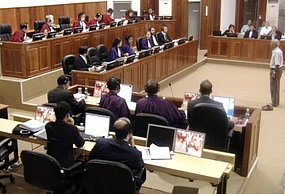
The Extraordinary Chamber of the Courts of Cambodia (ECCC) during a hearing on June 30, 2009. Two judges on the tribunal have been accused of taking instruction from their respective governments. [AFP]
PHOTO

The Extraordinary Chamber of the Courts of Cambodia (ECCC) during a hearing on June 30, 2009. Two judges on the tribunal have been accused of taking instruction from their respective governments. [AFP]

AUDIO from Asia Pacific

David Boyle reports on Cambodia's Khmer Rogue trial

Created: Fri, 30 Oct 2009

Australia Network News

By David Boyle

The beleaguered Khmer Rouge trials in Cambodia have hit another obstacle.

Two pre-trial judges, including Australian Rowan Downing QC, have been accused of taking instruction from their respective governments in a motion filed last week.

The Extraordinary Chambers of the Courts of Cambodia were created to try the leaders of the Khmer Rouge regime, which is accused of killing more than two million people in the 1970s.

The Khmer Rouge tribunal has endured considerable controversy in its four years of existence and now many people believe its become entrenched in its own politics.

The lawyers of accused war criminal, Ieng Sari, have filed a motion requesting that two pre trial judges, including Mr Downing, be removed from the court due to a public perception of bias.

Radio Australia has obtained a copy of the motion that seizes on comments recently made by the Cambodian Prime Minister, Hun Sen.

Mr Sen alleged the two judges have been acting on the orders of their respective foreign governments.

'Fair trial'

Michael Karnavas is one of the co-defence lawyers who filed the motion.

"What we're saying is we're caught in the middle of all of this, we're entitled to a fair trial," he said.

"The average person in Cambodia believes their Prime Minister, the United Nations hasn't stepped up to the plate, to either defend these judges or to show that they've taken any action to look into these allegations."

"The judges haven't spoken up, I suspect because of their position, but we want this matter cleared."

The two pre-trial judges, Mr Downing and Dutch national Katinka Lahuis are unable to comment on either Hun Sen's comments or the motion being filed against them.

Appropriate behaviour

But a spokeswoman for the court, Yuko Maeda, says the court believes all their court officials are behaving appropriately.

"We believe all the judicial officials who work at the ECCC are performing accordingly, independently from any of the executive bodies."

"This is the international standard, ECCC is following the international standard. We believe that none of the judicial officials who are working at the ECCC are influenced by any executive body."

Heather Ryan, a court monitor with the Open Society Justice Initiative, says she's seen no evidence to confirm the allegations, but says they should be publicly addressed to protect the credibility of the court.

"Many of the international players and the judges are in my view, unfortunately reluctant to speak publicly when statements like this that impact the credibility of the court are made," she said.

"I think it's part of that sort of general reluctance of commentators and officials of the courts to speak about what's going on in the court publicly. There's kind of a conspiracy of silence."

Bribery claims

An early report into the court's activities prepared for the US Agency for International Development concluded corruption was "pandemic" within the administration of local officials with bribery a widely accepted practice.

A subsequent report produced by the court, which was initially suppressed, revealed similar findings.

But there is no suggestion that these allegations relate to the judges of the court.

Lawyer Michael Karnavas dismisses any suggestion that his motion is designed further erode the tribunal's reputation, arguing it upholds expectations of transparency and due diligence.

"I haven't made these allegations, somebody else has. I'm not the one getting kick backs from the national staff. I'm not the one who is hiding the UN report, others are doing that," he said.

"So you can't blame the defence for trying to shed light and trying to make this process as transparent as possible."

Mounting scepticism

Ms Ryan, of the Open Society Justice Initiatives, says the court should be concerned about mounting public scepticism over its transparency and capacity to deliver swift and effective justice.

"The court has an obligation now, if it's to preserve its obligation to the people of Cambodia to go out of its way and take additional steps to be transparent, to scrupulously deal with any allegations of misconduct or wrong doing and to ensure that people can see that they actually are serving the interests of justice."

"Right now when everything is done behind closed doors people don't see that and so when statements like the one that is alleged by Ieng Sari's lawyers are made, it feeds on a kind of inherent suspicion."

The Holocaust In Cambodia

Written by John Pilger
PilgerJohn Pilger recalls the stricken society he found in Cambodia in 1979 which he described in his epic dispatches and documentary, Year Zero: the Silent Death of Cambodia He reminds us that the Pol Pot horror emerged from the bombing ordered by Richard Nixon and Henry Kissinger, and that Cambodia was again "punished" when its liberators came from the wrong side of the cold war and the Thatcher government send special forces to train the Khmer Rouge in exile

October 29, 2009 "Information Clearing House" -- The aircraft flew low, following the Mekong River west from Vietnam. Once over Cambodia, what we saw silenced all of us on board. There appeared to be nobody, no movement, not even an animal, as if the great population of Asia had stopped at the border.

Whole villages were empty. Chairs and beds, pots and mats lay in the street, a car on its side, a bent bicycle. Behind fallen power lines lay or sat a single human shadow; it did not move. From the paddies, lines of tall wild grass followed straight lines. Fertilised by the remains of thousands upon thousands of men, women and children, these marked common graves in a nation where as many as two million people, or more than a quarter of the population, were “missing”.

At the liberation of the Nazi death camp in Belsen in 1945, The Times correspondent wrote: “It is my duty to describe something beyond the imagination of mankind.” That was how I felt in 1979 when I entered Cambodia, a country sealed from the outside world for almost four years since “Year Zero”.

Year Zero had begun shortly after sunrise on April 17, 1975 when Pol Pot’s Khmer Rouge guerrillas entered the capital, Phnom Penh. They wore black and marched in single file along the wide boulevards. At one o’clock, they ordered the city abandoned. The sick and wounded were forced at gunpoint from their hospital beds; families were separated; the old and disabled fell beside the road. “Don’t take anything with you,” the men in black ordered. “You will be coming back tomorrow.”

Tomorrow never came. An age of slavery began. Anybody who owned cars and such “luxuries”, anybody who lived in a city or town or had a modern skill, anybody who knew or worked with foreigners, was in grave danger; some were already under sentence of death. Out of the Royal Cambodian Ballet company of 500 dancers, perhaps 30 survived. Doctors, nurses, engineers, teachers were starved, or worked to death, or murdered.

For me, entering the silent, grey humidity of Phnom Penh was like walking into a city the size of Manchester in the wake of a nuclear cataclysm which had spared only the buildings. There was no power, no drinking water, no shops, no services of any kind. At the railway station trains stood empty at various stages of interrupted departure. Personal belongings and pieces of clothing fluttered on the platforms, as they fluttered on the mass graves beyond.

I walked along Monivong Avenue to the National Library which had been converted to pigsty, as a symbol, all its books burned. It was dream-like. There was wasteland where the Gothic Roman Catholic cathedral had stood; it had been dismantled stone by stone. When the afternoon monsoon rains broke, the deserted streets were suddenly awash with money. With every downpour a worthless fortune of new and unused banknotes sluiced out of the Bank of Cambodia, which the Khmer Rouge had blown up as they fled.

Inside, a cheque book lay open on the counter. A pair of glasses rested on an open ledger. I slipped and fell on a floor brittle with coins.

For the first few hours I had no sense of even the remains of a population. The few human shapes I glimpsed seemed incoherent, and on catching sight of me, would flit into a doorway. A child ran into a wardrobe lying on its side which was his or her refuge. In a crumbling Esso filling station an old woman and three emaciated infants squatted around a pot containing a mixture of roots and leaves, which bubbled over a fire fuelled with paper money: such grotesque irony: people in need of everything had money to burn.

At a primary school called Tuol Sleng, I walked through what had become the “interrogation unit” and the “torture and massacre unit”. Beneath iron beds I found blood and tufts of hair still on the floor. “Speaking is absolutely forbidden,” said a sign. “Before doing something, anything, the authorisation of the warden must be obtained.”

After a while, one sound had a terrible syncopation: rising and falling day and night. Without milk and medicines, children were stricken with preventable disease like dysentery. It seemed that the very fabric of the society had begun to unravel. The first surveys revealed that many women had stopped menstruating.

What compounded this was the isolation imposed on Cambodia by the West because its liberators, the Vietnamese, had come from the wrong side of the cold war, having driven America out of their country in 1975. Cambodia had been the West’s dirty secret since President Richard Nixon and his national security adviser Henry Kissinger ordered a “secret bombing”, extending the war in Vietnam into Cambodia in the early 1970s, killing hundreds of thousands of peasants. “If this doesn’t work,” an aide heard Nixon say to Kissinger, “it’ll be your ass, Henry.” It worked in handing Pol Pot his chance to seize power.

When I arrived in the aftermath, no Western aid had reached Cambodia. Only Oxfam defied the Foreign Office in London, which had lied that the Vietnamese were obstructing aid. In September 1979, a DC-8 jet took off from Luxembourg, filled with enough penicillin, vitamins and milk to restore some 70,000 children -- all of it paid for by Daily Mirror readers who had responded to my reports and Eric Piper’s pictures in two historic issues of the paper which sold every copy.

Following on from the Mirror, on October 30, 1979, ITV broadcast Year Zero: the silent death of Cambodia, the documentary I made with the late David Munro. Forty sacks of post arrived at the ATV studios in Birmingham, with £1 million in the first few days. “This is for Cambodia,” wrote an anonymous Bristol bus driver, enclosing his week’s wage. An elderly woman sent her pension for two months. A single parent sent her savings of £50. People expressed that unremitting sense of decency and community which is at the core of British society. Unsolicited, they gave more than £20 million. This helped rescue normal life in faraway country. It restored a clean water supply in Phnom Penh, stocked hospitals and schools, supported orphanages and re-opened a desperately needed clothing factory.

Such an extraordinary public outpouring broke the US and British governments’ blockade of Cambodia. Incredibly, the Thatcher government had continued to support the defunct Pol Pot regime in the United Nations and even sent the SAS to train his exiled troops in camps in Thailand and Malaysia. Last March, the former SAS soldier Chris Ryan, now a best-selling author, lamented in a newspaper interview “when John Pilger, the foreign correspondent, discovered we were training the Khmer Rouge in the Far east [we] were sent home and I had to return the £10,000 we’d been given for food and accommodation”.

Today, Pol Pot is dead and several of his elderly henchmen are on trial in a UN/Cambodian court for crimes against humanity. Henry Kissinger, whose bombing opened the door to the nightmare of Year Zero, is still at large. Cambodians remain desperately poor, dependent on an often seedy tourism and sweated labour.
For me, their resilience remains almost magical. In the years that followed their liberation, I never saw as many weddings or received as many wedding invitations. They became symbols of life and hope. And yet, only in Cambodia would a child ask an adult, as a twelve-year-old asked me, with fear crossing his face: “Are you a friend? Please say.”

Cambodian 'jungle woman' hospitalised

Rochom P'ngieng went missing as a little girl in 1989 while herding water buffalo

PHNOM PENH (AFP)— Cambodia's "jungle woman", whose story gripped the country after she apparently spent 18 years living in a forest, was hospitalised after refusing food, her father and a doctor said Friday.

But the tale of Rochom P'ngieng, which has involved disputes over her real identity and how she spent her missing years, took a further twist when her father then removed her from the clinic against doctors' advice.

Rochom P'ngieng went missing as a little girl in 1989 while herding water buffalo in Ratanakkiri province around 600 kilometres (400 miles) northeast of the capital Phnom Penh.

In early 2007 the woman was brought from the jungle, naked and dirty, after being caught trying to steal food from a farmer. She was hunched over like a monkey, scavenging the ground for pieces of dried rice in the forest.

She could not utter a word of any intelligible language, instead making what Sal Lou, the man who says he is her father, calls "animal noises".

Cambodians described her as "jungle woman" and "half-animal girl".

Sal Lou told AFP by telephone on Friday that Rochom P'ngieng was admitted to the provincial hospital on Monday.

"She has refused to eat rice for about one month. She is skinny now... She still cannot speak. She acts totally like a monkey. Last night, she took off her clothes, and went to hide in the bathroom," Sal Lou said.

"Her condition looks worse than the time we brought her from the jungle. She always wants to take off her clothes and crawl back to the jungle," he added.

But he said in a later call that he had brought her home because it was too difficult to keep her from fleeing the hospital.

"We have to hold her hand all the time (at the hospital). Otherwise she would take her clothes off and run away," he said, adding that he would now appeal to charities to take over her care.

Doctor Hing Phan Sokunthea, director of Ratanakkiri provincial hospital, confirmed that Sal Lou had defied medical advice and checked her out of the hospital.

"We wanted to monitor her situation more, but we don't know what to do because the father already took his daughter out of hospital," he said.

The jungles of Ratanakkiri -- some of the most isolated and wild in Cambodia -- are known to have held hidden groups of hill tribes in the recent past.

In November 2004, 34 people from four hill tribe families emerged from the dense forest where they had fled in 1979 after the fall of the genocidal Khmer Rouge regime, which they supported.

Cambodian dad, four sons electrocuted

Fri, Oct 30, 2009

PHNOM PENH (AFP)- A Cambodian father and his four sons died in a chain of electrocution on Friday when the front door to the family's corrugated-metal house cut into a power line, police said.

The deadly incident happened in Phnom Penh's Russey Keo commune when Mok En, 65, opened the door and it hit a power line connected to his home, triggering his electrocution, local police chief Sun Kanareth told AFP.

"When he opened up the door, it pinched the electric wire and he was immediately electrocuted and fell down with his left hand holding the door," he said.

"But the sons thought he had been hit by a fainting spell and they rushed to help him. So they were all electrocuted as soon as they touched the father," he added.

Four-fifths of Cambodians do not have proper access to electricity, and many use unsafe methods to tap into power grids.

Rainsy’s publicity stunt carries a powerful political message

Ed-Op by Khmerization
29th October, 2009

“Mr. Rainsy’s theatre was without a doubt a publicity stunt, but one that carries a powerful political message that have far-reaching effects in raising national and international awareness about Cambodia’s border problems with its powerful neighbour to the east.”


With Khmer-Thai border dispute at Preah Vihear to the west dominating national and international media headlines for the last one year, which had overshadowed all other issues of national importance, there needs an urgent redress and a dramatic stunt to regenerate national debates about the more pressing Khmer-Vietnamese border issue to the east.

Mr. Sam Rainsy’s theatrical performance of uprooting six border demarcation poles on 25th in front of national and international media has certainly achieved that.

Many people questioned whether Mr. Rainsy was more interested in a theatrical publicity stunt or was he more interested in taking concrete measures to address the border issue. Mr. Rainsy’s theatre was without a doubt a publicity stunt, but one that carries a powerful political message that have far-reaching effects in raising national and international awareness about Cambodia’s border problems with its powerful neighbour to the east.

Since time immemorial, especially during the reign of King Chey Chetha II (r. 1618 - 1627) in the 17th century, Vietnam had secretly forcibly annexed vast territories of Cambodia, known today as Kampuchea Krom, after King Chey Chetha II married one of the Vietnamese princesses. Cambodian republicans, in particular supporters of the Khmer Republic regime of Marshall Lon Nol, have wittingly drummed up powerful anti-monarchy sentiments by accusing King Chey Chetha II of ceding large territories of Kampcuhea Krom to the Vietnamese emperor at the request of his Vietnamese wife. Twenty one provinces have been annexed and the Vietnamese drive for annexations were only cut short with the signing of the French Protectorate in 1863 between France and Cambodia.

Many Cambodians, who are very wary about Vietnam’s past hegemony and expansionism, believe that the Vietnamese leaders still harbour ambition of swallowing Cambodia. They still believe that the Vietnamese intervention in Cambodia in 1979 was not to save Cambodians from being massacred by the Khmer Rouge, but it was an invasion and hegemonism with the aim of turning Cambodia into a second Kampuchea Krom. Many treaties, with all of them favouring Vietnam, were signed between the puppet Cambodian regime and the invading Vietnamese government. These unequal treaties had reinforced their scepticism of Vietnam’s real motives for their intervention in Cambodia.

Critics of the present Cambodian government believe that treaties such as the 1979 Treaty, 1982 Treaty and 1985 Demarcation Treaty had favoured Vietnam and had ceded large parts of Cambodian frontiers to Vietnam. The ratification of the 1985 Supplemental Treaty in 2005 had caused a stir in Cambodia among Mr. Hun Sen’s critics. Many people and border activists who had expressed their oppositions to this particular treaty had been jailed or forced to flee the country. They have alleged that the 1985 Demarcation Treaty and the 1985 Supplemental Treaty, ratified in 2005, have ceded large chunk of Khmer territories to Vietnam. Many Cambodian villages (Phum Dong, Bavet in Svay Rieng, O’Yadao in Rattanakiri) and lately a rice-field near Ang Romdenh Pagoda in Samrong commune, Chantrea district of Svay Rieng province where Mr. Sam Rainsy had just waged a campaign of theatrical publicity stunt to uproot the border poles illegally installed by the Vietnamese authority, had been encroached. Many Cambodians believe that the border poles were illegally installed because they were installed in the middle of Cambodian farmers’ rice-fields. Most Cambodian borderlines with Vietnam, the same with Thailand, have been demarcated using natural features such as natural creeks and mountains as the borderlines. On the contrary, the present borderlines with Vietnam have often cut across Cambodian villages and rice-fields, causing Cambodian villagers to lose their homes and farmlands. As a result, Mr. Rainsy’s theatrical stunt in Samrong commune has generated publicity and reinvigorated the national debates about the fate of Cambodian borders with Vietnam once again.

I have drawn a long list of facts above because I want to highlight the importance of publicity, or a publicity stunt if one wants to term it that way, particularly international publicity, regarding border violations by Cambodia’s neighbours, especially Cambodia’s borders to the east which had been almost forgotten since the invasion of the Preah Vihear areas by Thai troops in the middle of last year which had dominated national and international headlines.

To this effect, Mr. Rainsy’s theatrical publicity stunt by uprooting the six border poles illegally installed by Vietnamese authority had certainly regenerated debates and had drawn national and international attention to the Khmer-Vietnamese border problems once again.

Mr. Rainsy’s action, if anything at all, is just a symbolic gesture but one that carries a political weight and a powerful message to national and international audience about the plight of the Cambodian border issue with Vietnam.

PRESS RELEASE; United States B52 Holocaust Museum, Real Afghanistan and Iraq Weapons of Mass Destruction

United States B52 Holocaust Museum
USB52.COM

The United States B52 Holocaust Museum opens on line at http://usb52.com/

USB52.COM, United States B52 Holocaust Museum, was established to deliver the truth about the B52 holocaust committed on Cambodia by the American government's secret war.

The goal is to educate the international public and help support the present day victims of the B52 bombing in Cambodia.

Through truth USB52 informs and empowers the public about war.

I would like to request your assistance and support to make USB52.COM a success in obtaining additional information such as articles, photos, testimonials, introductions, and materials on the American B52 Bombing of Cambodia for inclusion in our online United States B52 Holocaust Museum located at http://usb52.com/

Recommendation of United States B52 Holocaust Museum for grants, donations, assistance and support in any way that you can help is very much appreciated.

Real Afghanistan and Iraq
Weapons of Mass Destruction Read the recent article on how the dark forces of America profit off war.

Contact:
Craig Crowley, mediainfo@yoxyz.com
66-0879856114
Bangkok, Thailand

In Cambodia, a threatened tribe of Islam

By Brendan B Brady
Asia Times Online

UDONG - Imam San was perhaps once Cambodia's most privileged Muslim. Legend has it that in the 19th century, former King Ang Duong encountered him meditating in the forest and was so captivated by the stranger's spirituality that he offered him land in the royal capital. A more cynical account relates that the Khmer royal family, at a time when its power was dwindling, found a ready and willing ally in the Muslim leader.

On the occasion of Imam San's birthday each October, the sect that emerged from his early followers gathers in the former royal city of Udong, about 30 kilometers outside of the present capital

of Phnom Penh, to honor his memory through prayer and offerings. The colorful mawlut ceremony reaffirms the sect's privileged heritage and its continued isolation from the rest of the country's Islamic community, which is dominated by a group known as the Cham.

The Imam San followers are the only group to remain outside the domain of the Mufti, the government-sanctioned leader of Islam in Cambodia - a status that was renewed by the government in 1988. Successive Imam San leaders, or Ong Khnuur, have held the prestigious title of Okhna, originally bestowed by the palace.

Cambodia's estimated 37,000 Imam San followers live in only a few dozen villages spread throughout the country. Geography has reinforced the sect's isolation, and the mawlut has become an increasingly important opportunity to forge friendships and - more essential to the survival of the community - marriages.

At the annual ceremony, parents search for eligible suitors for their children, who otherwise would not come in contact with teenagers and young adults from other Imam San communities. The day's use for matchmaking may have new importance as the sect's long-standing isolation is challenged by pressures from Cambodia's larger Islamic community as well as from abroad.

Many Imam San followers see their sect's relationship with other Muslims as the biggest threat to their way of life, as their most vehement critics come from within their faith. For Ek Bourt, an elder member of the Imam San community, it is discrimination from other Muslims that he fears most.

"Other Muslims look down on us since we practice our religion in a different way," he said. "I'm afraid the next generation might lose our unique culture and customs."

The pilgrimage to Udong's Phnom Katera - a site of great importance for Khmers' Buddhist and royal traditions - highlights what some other Muslims see as the Imam San community's unholy cultural proximity to mainstream Khmer society. Conspicuously, the mosque on Phnom Katera is adjacent to the tombs of former Khmer kings and its name, "The Islam Cham Temple of Imam San", is written in Khmer, Cham and English, but not Arabic.

Purity perceptions
Descendants of the Cham Bani from Vietnam, who converted to Islam in the 17th century, Imam San followers view themselves as devoted adherents of the Muslim faith even as they maintain religious and cultural practices that are viewed by some as at odds with Islamic teachings. Because they blend faith in the Koran with other religious customs, including animist-like ceremonies, the Imam San followers are seen by many other Muslims as impure.

Perhaps no tradition of the Imam San community is more offensive to critics than praying only once a week, while praying five times a day is standard practice for most Muslims. And none is more bizarre than the chai ceremony, in which they dance in a possessed state, sometimes carrying prop weapons.

In fact, about 85% of Muslims consider the Imam San followers to be so heterodox as not to qualify as Muslims, according to a study by Norwegian Bjorn Blengsli, who has studied Muslims in Cambodia for nearly a decade.

"They're not true followers of Mohammed," said Hussein Bin Ibrahim, a Salafi Muslim who lives in Phnom Penh. "They don't really count as Muslims. For Muslims like us in Cambodia, our Islam is now becoming more like the Islam in Arab countries. We have grown closer to Mecca." Hussein prays in the outskirts of Phnom Penh at the Norul Ehsan mosque, which was recently renovated with funds from Kuwait.

Most of Cambodia's Muslims are ethnically Cham, whose practices have traditionally been moderate. But the last several years have seen a rise of fundamentalism in the Cham community, most notably of Wahhabism, an austere form of Islam originating from Saudi Arabia.

Growing economic ties between Cambodia and Arab countries suggest the trend will only strengthen.

Last year, after making high-level state visits, Kuwait and Qatar pledged hundreds of millions of dollars in soft loans to Cambodia for agricultural development. The aid sparked concerns among some Western officials that the money could be used not just to invigorate Cambodia's farming, but also to radicalize its Muslims.

"There are some organizations here from the Middle East that are very radical and that are very intolerant, and they are trying very hard to change the attitude and the atmosphere of the Muslim population here in Cambodia," said then-outgoing American Ambassador Joseph Mussomeli in his farewell speech to reporters in August 2008.

The primary focus of the most recent state visits has been trade. Yet cultural ties are also at stake: Kuwait pledged some $5 million for Cambodian Islamic institutions, including renovating the dilapidated International Dubai Mosque in Phnom Penh.

Economic ties with Arab countries will reverberate in Islamic practices in Cambodia, according to Blengsli. "Economic ties between Cambodia and Arab countries will lead to more funding for Islamic organisations in Cambodia and, since they are often unhappy with the purity of Islam as its practiced here, there will be increasing Arab influence on local Muslim practices," he said.

Islamic revivalism
The penetration of Islamic missionaries, as well as development and educational organizations into Cambodia, is problematic because of the separation from other cultures these groups encourage, according to Alberto Perez, a Spanish anthropologist who is writing his PhD dissertation on the Cham.

The Imam San community has been further estranged amid a wave of Islamic revivalism embraced by the majority of Cambodia's nearly 350,000 Muslims. In the past, Imam San followers have rejected donations from wealthy Middle East-based Islamic groups and resisted pressure from foreign preachers, whose requests that they convert to orthodox Islam are frequently backed by offers to finance the construction of new mosques.

But this long-maintained separation is weakening under the same foreign influences that, according to Blengsli, have made Cambodia's mainstream Muslims one of the fastest-changing Islamic communities in the world.

The Imam San community is losing numbers to other Muslim sects, including the Salafi, Jamaat Tabligh and Ahmadiyya, which have international standing and deeper pockets, he said. In particular, young Imam San followers who are sent to Phnom Penh to continue their studies face pressure from other Muslim communities to convert to orthodox Islam.

"We're especially afraid that the young will be tempted to join other groups that are well-funded," said Kai Tam, the Imam San's current Ong Khnuur. But such concerns would not have him change his group's practices.

"Our people are strong because we believe in our ancestors and we believe in their culture and the way they practiced Islam - to change would be an insult to our ancestors. We have the same goal as other Muslims, but we get there a different way."

Ahmad Yahya, president of the Cambodian Islamic Development Association and an advisor to the government on Cham issues, has said that Imam San followers should break their isolation and reform their observance. Yahya has aggressively solicited foreign funding for Cambodian Muslims to continue their studies locally and abroad, and he believes Iman San followers should make the changes necessary to avail themselves of such opportunities.

Indeed, some Imam San villages have begun praying five times a day as a compromise to foreign donors who have financed new mosques for them. But for 19-year-old Keu Sarath, whose home is in the same village as the Ong Khnuur's, her faith in the way of her ancestors has not wavered.

"We love God just the same as others," she said. "But we don't tell others how to practice and they should show us the same respect."

Brendan B Brady is a freelance journalist based in Phnom Penh, Cambodia.

Helping out in Cambodia

By MICHELLE LOTTER -
North Shore Times, New Zealand
Last updated 30/10/2009

A Takapuna resident is volunteering her skills in language for a three- month Cambodia trip.

Fiona Whyte, a foreign exchange specialist, is looking forward to working with young Cambodian students through the Global Volunteer Network from November.

"To live and work in Cambodia, to be able to offer my knowledge and skills, that’s the really exciting
aspect of this opportunity."

She is paying for her own food and accommodation as she works with nine teachers from throughout the world as a language teacher in Phnom Penh on a project that provides affordable classes.

The aim is to raise money for the local non- government organisation Cambodian Rural Development Trust who works to improve livelihoods in rural Cambodian communities,
Ms Whyte says.

"Students pay a small fee to attend the classes and funds raised are used to improve the community in areas such as water, sanitation, livestock and agriculture production, and environmental awareness.

"Essentially I’ll be helping students improve their English skills while also assisting in the development of the community."

She travelled to Cambodia last year on a World Vision Cycle Charity Challenge that raised $63,000 and assisted 17,000 people in accessing clean water through the charity’s Cambodian projects.

"It was a wonderful experience made particularly special when World Vision was able to arrange for me to meet the two girls I sponsor.

"Even though we didn’t share the same language, we were able to connect. These people are warm, friendly and amazingly resilient."

She says she is looking forward to seeing the education, health and housing rights projects supported by the trust.

She will help facilitate fair trade with World Vision’s microfinance schemes to distribute goods which are sold in New Zealand.

KL embassy to monitor Chavalit's visit


Published: 28/10/2009
Bangkok Post

The Thai embassy in Kuala Lumpur has been instructed to monitor the activities of Puea Thai Party chairman Chavalit Yongchaiyudh (pictured), who plans to meet Malaysian Prime Minister Najib Razak, Thani Thongphakdi, deputy director-general of the Department of Information, Ministry of Foreign Affairs, said on Wednesday.

Last week, Gen Chavalit travelled to Phnom Penh to meet Cambodian Prime Minister Hun Sen. He came back and said that Hun Sen would welcome ousted premier Thaksin Shinawatra to Cambodia "any time". His visit sparked a furious backlash from the government after he insisted that he would embark on trips to Burma and Malaysia.

Mr Thani said he believes the Malaysian government understands well that Gen Chavalit would be on a personal visit, and it has nothing to do with the government.

He said that the ministry would wait to see the outcome of Gen Chavalit's trip.

Noppadon: M'sian PM invited Chavalit


Published: 28/10/2009
Bangkok Post


Gen Chavalit Yongchaiyuth (pictured), chairman of the opposition Puea Thai Party, will visit Malaysia at the invitation of the country’s prime minister, lawyer and close associate of fugitive former premier Thaksin Shinawatra, Noppadon Pattama, said on Wednesday.

Mr Noppadon denied a report that he was arranging Gen Chavalit's visits to Malaysia and other neighbouring countries. He also denied that Thaksin was involved.

“The plan to visit Malaysia and Burma came from Gen Chavalit as he has good relations with leaders of the two countries,” he said.

Mr Noppadon also denied that Gen Chavalit's plan to discuss the problems in the far South with Malaysian Prime Minister Najib Razak was a bid to paint the Democrat-led government's efforts to end the insurgency in a bad light.

“Gen Chavalit was invited to share various opinions with the Malaysian leader,” he said.

Gen Chavalit said on Tuesday that he will next week visit the lower South for briefings and after that go to Malaysia and Burma. The former premier said he would use his personal connections with leaders of neighbouring countries to help clear up their misunderstandings about Thailand.

Government acting spokesman Panithan Wattanayakorn said on Wednesday that Gen Chavalit's trip to the southernmost provinces would not improve the situation. The Puea Thai chairman had totally failed to solve the problem when he was in government.

Thaksin:Refuge in Bangkok?

Published: 28/10/2009
Bangkok Post - Post Bag

I figure that the recent re-igniting of the man-love flame between Thaksin and Hun Sen must have some ulterior motive. Here's my theory, and it shouldn't sound so far-fetched in light of events in Central America. Manuel Zelaya stoked the fiery passions of his supporters by momentarily crossing the border into his native Honduras from neighbouring Nicaragua, and then by taking refuge in the Brazilian embassy within the borders of his own country.

Now let's draw some parallels and you can join the dots. Cambodia shares a border with Thailand, and also has an embassy in the simmering cauldron that is Bangkok. The red shirts seem to be itching for a spark of inspiration. If Thaksin were to pull a Zelaya, the political situation in Thailand might just reach boiling point. My only advice to Thaksin: please wear a silly looking hat so we have something to laugh at amidst this political inferno.

ABISHEK JIRATHANESWONGSE

Cambodian Youth Program Leader Awarded $25,000 Peace Prize

You can donate to The Cambodian Family here.


Cambodia Phalen Lim fled Cambodia at the age of 2 in 1975, during the regime of the Khmer Rouge, and has never forgotten what it was like to start over as an immigrant in a new country. Now, the community leader is being awarded with a $25,000 California Peace Prize, reports The Orange County Register.

Lim and her family initially sought out help from the service agency The Cambodian Family (TCF) when they arrived in Santa Ana, California.

Now, as the director of youth programs for the organization, Lim's job is to support and inspire young people to become balanced, healthy leaders. Serving refugees and immigrants, The Cambodian Family's emphasis is on community health, such as trauma resolution and stress reduction, employment services and youth programs.

The California Wellness Foundation, a private group whose mission is to improve the health and wellness of Californians, will present the peace awards tonight in San Francisco. It applauded Lim as an "integral leader in an agency that combats gang violence and promotes cultural pride and understanding in Santa Ana."

Lim mentors around 60 Cambodian and Latino youths, and impresses upon them the importance of working with what they have. She plans to put some of the prize money towards her son's education, and allocate a portion of it to the youngsters at The Cambodian Family.

Despite these accomplishments, she remains humble:

"I must have done something good to deserve it," she says now. But she's quick to add: "It's not just about me. It's about the work that I did and about the people that I serve."

Thursday, 29 October 2009

Two chiefs still head border relations [Are CPP officials trying to pit Pol Saroeun against Hun Sen by appointing their nephews to the same position?]

Thursday, 29 October 2009
By Thet Sambath
Phnom Penh Post

TWO military officials appointed earlier this year to the same position within a Banteay Meanchey province border relations office remain on the job but in different locations, officials said Wednesday.

Pol Sinoun, nephew of RCAF Commander in Chief Pol Saroeun, was appointed head of the Thailand-Cambodia Relations Office in June. Three months later, the Ministry of Defence announced that Prime Minister Hun Sen’s nephew, Dy Phen, would head the office.

Tale of two offices
Rather than clarify who officially heads the office, the government has allowed both men to continue to hold the post but operate out of different offices and report to different superiors.

“Another office was opened about a kilometre away from the old office we are working in,” said Tim Sareth, deputy chief of the Thailand-Cambodia Relations Office, who added that Pol Sinoun continues to operate out of the original office in Poipet commune.

Pol Sinoun said Wednesday that despite the overlap of offices, he continues to report to the RCAF High Command, whereas Dy Phen reports to the Ministry of Defence.

“There is no problem because we report to different places,” Pol Sinoun said.

An official who refused to be named said Wednesday that Thai officials consult only with Pol Sinoun because they have worked together for many years and have not been given instructions to consult with Dy Phen.

Dy Phen could not be reached for comment Wednesday.

Thaksin says he will visit: sources


Thursday, 29 October 2009
By James O’toole and Joel Quenby
Phnom Penh Post

DEPOSED Thai prime minister Thaksin Shinawatra has told supporters he plans to travel to Cambodia, a Thai opposition source and media reports said Wednesday.

Speaking to members of the Puea Thai party – known as the Red Shirts – by video conference Tuesday, Thaksin announced plans to travel to Cambodia following an invitation from Prime Minister Hun Sen to serve as his economic adviser, said a woman identified as a Puea Thai member but who refused to give her name.

“Thaksin said he would fly to Cambodia soon to thank Hun Sen,” the Bangkok Post quoted another anonymous Puea Thai official as saying.

Bangkok says it would seek extradition if Thaksin – ousted in a 2006 coup and self-exiled to avoid jail on corruption charges – sought refuge in Cambodia.

Foreign Ministry spokesman Koy Kuong said the government has had no official communication with Thaksin recently, but that a visit to Cambodia was plausible. “I think it could be true, because so far, Prime Minister Hun Sen has given the green light to [Thaksin],” Koy Kuong said.
The source said, however, that Puea Thai was unsure such a visit would be prudent.

“We don’t agree with the idea of Thaksin going to Cambodia.… He’s caused so much trouble for the country recently that he needs to fix before he goes to Cambodia,” she said.

Hun Sen's brother to be appointed Phnom Penh Governor

KHMER INTELLIGENCE NEWS

29 October 2009

Government reduces soldiers and policemen' bonuses (1)

Because of a fall in state revenue due to the economic recession the government is reducing bonuses usually paid to some 200,000 soldiers and policemen. The government normally pays the armed forces "basic salaries" and "bonuses for function fulfillment" on a monthly basis. Bonuses, which had been markedly increased in 2008, can be much higher than salaries. They are now being reduced by 30 percent to 50 percent.

Government withholds councilors' salaries (1)

Over 3,000 district, provincial and municipal councilors elected last May have yet to receive their salaries. The government has been withholding their salaries for five months allegedly because of "administrative problems" and "budget constraints". But in fact, the government also wants to slow down the decentralization process whereby the ruling CPP would have to share some power at the local level with the opposition SRP which controls approximately 20 percent of the commune, district, provincial and municipal councilors.

Hun Sen's brother Hun Neng to be appointed Phnom Penh governor (2)

Prime Minister Hun Sen's elder brother Hun Neng, currently Kampong Cham province governor, will soon be appointed Phnom Penh governor, replacing Mr. Kep Chuptema.

Canadia Bank now controlled by Hun Sen's family (2)

Partly as a result of bad loans linked to the collapsing property sector, Canadia Bank, Cambodia's largest commercial bank, has recently come under the control of Prime Minister Hun Sen's family (wife and children). The information is not made public because of concerns about corruption probe and Canadia Bank is involved in several cases of land grabbing.

The Hun Sen family has also taken control of several large development projects abandoned by South Korean firms, such as the 42-storey Gold Tower.

Foreclosures expected by the end of the year (2)

The government finds it more and more difficult to prevent several nearly bankrupt commercial banks ridden with property-linked bad loans (Canadia Bank, Foreign Trade Bank) from conducting foreclosures. A large number of properties will be seized by the end of the year from the banks' defaulting clients and sold at auction. Observers expect a further drop in property prices in the next few months.

Sam Rainsy in Cairo (1)

Opposition leader Sam Rainsy is currently in Cairo to attend the 56th Congress of Liberal International (LI). The SRP is a member of the center-oriented LI, the world's third largest international political grouping behind those formed by the Conservative and the Socialist. Sam Rainsy who had received the prestigious LI Freedom Award in 2006 in Marrakech (Morocco), will be the main speaker in a ceremony to present a book covering 25 consecutive LI Prizes for Freedom whose recipients included Corazon Aquino (Philippines, 1987), Vaclav Havel (Czekoslovakia, 1990), Mary Robinson (Ireland, 1993), Aung San Suu Kyi (Burma, 1995) and Martin Lee (Hong Kong, 1996).

CPP rejected by Socialist International (2)

The CPP candidacy to be a member of Socialist International (SI) has been continuously rejected in spite of Mr. Hun Sen's repeated demand to join the powerful left-wing international political grouping. The reason for the rejection is related to the CPP's poor human rights records including the Cambodian government's repressive policy against trade unions. Both the CPP and its partner Funcinpec are currently members of the right-wing Christian/Centrist Democrat International (CDI).

King informed about seriousness and complexity of land issues (1)

Since his accession to the throne in 2004, King Norodom Sihamoni has been officially informed about the country's situation only by Prime Minister Hun Sen. For the first time, a group of opposition National Assembly members on October 27 shared with the Monarch the people's concerns as perceived at the grassroots level. The most serious concerns are related to land issues with citizens increasingly and unfairly losing their lands all over the country because of rampant corruption undermining the whole government including the judicial system. The King was also informed about Cambodian farmers continuously losing their rice fields along the border with Vietnam. In a recent past, King-Father Norodom Sihanouk had expressed very strong reservations about the way the Hun Sen government "works" on border delineation with neighboring countries.

Thai-Cambodian Tension Tests Claims of Regional Peace


By MARWAAN MACAN-MARKAR / IPS WRITER Wednesday, October 28, 2009

BANGKOK — The relationship between Southeast Asian neighbors Thailand and Cambodia enters another uneasy stretch following a round of verbal salvoes fired before and during a just concluded regional summit, where much is made of strides in achieving unity.

The Thai media had also stepped into the fray to take on the comments made by Cambodian Prime Minister Hun Sen that appeared to get under the skin of the Thai government, host of the 15th summit of the Association of Southeast Asian Nations (Asean), which ran from Oct. 23-25.

A demonstrator holds a banner with pictures of exiled former Thai Prime Minister Thaksin Shinawatra with Cambodian Prime Minister Hun Sen during a rally outside the Cambodian Embassy in Bangkok on October 27. (Photo: Reuters)

On Tuesday, one Thai commentator described Hun Sen as a "big bully" for the remarks he made just before flying into Cha-am, the resort town south of Bangkok where the Asean summit was held, and soon after he landed.

"Hun Sen Shows Lack of Class and Tact," declared the headline of an editorial in a Sunday newspaper. It seethed with anger about the Cambodian leader's "provocative remarks."

Hun Sen, the region's longest-serving premier, upset the Thais by publicly throwing his weight behind Thaksin Shinawatra, the former Thai premier who was ousted in a 2006 military coup and now living in exile to avoid arrest after being found guilty of violating conflict of interest laws.

Cambodia will offer Thaksin a home, Hun Sen said, before arriving in Cha-am, and then added that Phnom Penh would not extradite the fugitive ex-Thai leader if Bangkok made a request. The increasingly authoritarian Cambodian leader also revealed a role he had for the like-minded Thaksin in the future Cambodia—as an economic advisor.

Thai Prime Minister Abhisit Vejjajiva shot back. "Don't allow anybody to use you as a pawn," he said at a press conference toward the end of the summit, where the outcome of the 10-member regional bloc was to have been the focus.

"If former prime minister Thaksin moves to Cambodia, it will have an effect on our relationship," said Kasit Piromya, Thai foreign minister, in another press conference.

Both Abhisit and Kasit belong to a coalition government that was formed last year with the backing of Thailand's powerful military. It followed a controversial court verdict that resulted in the collapse of a coalition government of Thaksin's allies, who were elected at a December 2007 poll, the first since the 2006 putsch.

Thaksin has been making desperate bids to return to Thailand or to live in a country closer to home than in the Middle East, where he often resides. But he has made little headway with the members of the 42-year-old Asean due to the principle of non-interference in the domestic affairs of a member country that binds this 10-member bloc.

Asean, which has just become a new rules-based unified entity, includes Brunei, Burma (or Myanmar), Indonesia, Laos, Malaysia, Philippines, Singapore and Vietnam, in addition to Thailand and Cambodia.

The war of words that overshadowed the Asean summit added a new twist to an already testy relationship between the two countries that share an 800-kilometre border, much of it being disputed and not clearly marked because Thais and Cambodia use different maps.

The most visible symbol of the underlying tension between the two Southeast Asian kingdoms is a 10th century Hindu temple, Preah Vihear, that sits atop a steep cliff on the Thai-Cambodian border.

The temple was claimed by the French colonists who ruled Cambodia using a disputed 1907 map. After the French left, the Thai troops took over the temple but handed it back to Phnom Penh following a 1962 ruling by the International Court of Justice (ICJ) in the Hague. Since then troops from both countries have faced each other along the heavily mined border.

Since July last year, Preah Vihear has become a flashpoint, stoked by deep-seated nationalism on both sides. It followed a ruling by the World Heritage Committee that month that recognized the temple as a world heritage site and concurred with the ICJ's ruling that the temple belonged to Cambodia.

Thai nationalists were enraged, prompting both Cambodian and Thailand to reinforce their military strength in the still contested land—some 4.6 square kilometers—surrounding the temple.

In April, the soldiers from both countries exchanged gunfire, leaving three people dead.

Over a month before the recent summit, Hun Sen had ordered Cambodian troops to fire if any Thais crossed the border illegally. Around the same time, in September, members of a right-wing conservative Thai political movement marched to the disputed site to flex their patriotic stripes.

Thailand was put on notice by Cambodian Foreign Minister Hor Namhong that Phnom Penh wanted the border dispute placed on the agenda of the 15th Asean summit. But Bangkok rejected the call, insisting that the dispute be addressed through bilateral negotiations than have this issue "internationalized or raised within the Asean framework."


This verbal tit-for-tat even drew Cambodia's envoy in Thailand to comment in the Bangkok Post newspaper on the eve of the summit. "No peace-loving nation on earth like Cambodia wants to make political gains by provoking armed conflict with its neighbors," wrote ambassador You Ay. "The recent tension between the two countries began with the yellow-shirt protesters from Thailand who wanted to enter our Preah Vihear temple."

The simmering tensions between the two Southeastern nations has not gone down well with the rest of Asean, given the bloc's habit of saying it does not need a regional dispute-settling mechanism because the region's leaders are committed to regional peace through local solutions.

Cambodia broke with this tradition last year when the Preah Vihear issue flared up. It reported the dispute to the United Nations Security Council without getting a nod from its Asean allies, prompting Singapore Prime Minister Lee Hsien Loong to warn of the regional bloc's credibility being at stake.

Thai officials are hoping that a quieter approach will help calm tensions between the two countries. "We want people along the border to live peacefully," said Kasit, the Thai foreign minister. "There is a need for civility to forge a relationship and build a relationship as much as possible."

Garment maker seeks to sew up Cambodian sales

29th October, 2009

HA NOI — The Viet Tien Garment Joint Stock Co on Tuesday opened an office for a sole sales outlet for Viettien-branded products in Phnom Penh, Cambodia.

The corporation’s first overseas outlet is a 120sq.m showroom built in partnership with Cambodia’s Caja Top company, and will display a wide variety of garments including khaki, polyester and cotton shirts, trousers, shorts, jeans and coats.

Speaking at the opening ceremony, Director General of the Viet Nam National Textile and Garment Group Vu Duc Giang said that running a business in Cambodia was the aspiration of many Vietnamese enterprises, including the Viet Tien corporation. They wish to provide Cambodian customers with the best products and contribute to the improvement of mutual understanding between the two nations.

Vietnamese goods have been gaining a foothold in the Cambodian market, especially after a series of trade fairs promoting high-quality Vietnamese products to Cambodian consumers.

Observers said that Vietnamese goods, which had been greatly improved in terms of quality, now had a chance to successfully compete with products from Thailand and China, which had so far been flooding the market.

The Viet Tien Corporation will partner with Caja Top to open more showrooms and sales outlets across Cambodia.

According to Phan Van Kiet, Deputy General Director of Viet Tien, the company was planning to open another sales office in Laos next month before launching more outlets in Malaysia, Singapore, Thailand and Indonesia in the future. — VNS

Thai soldiers accused of using excessive force against an unarmed Cambodian lady and her 8 year-old daughter

By Khmerization

Two Thai policemen were accused of using excessive force against an unarmed Cambodian lady and her 8 year-old daughter while they were catching crabs and snails at a creek along the borders, reports Radio Free Asia.

48 year-old Hourn Han from Samakki village, Kork Romiet commune in Thmor Puok district of Banteay Meanchey province, said that on 25th October, she and her 8 year-old daughter went to catch crabs and snails at a creek near Thai Border Post 17 located near Border Pillar 38 in Taphraya district of Sakeo province. She said at 11:30 am, two Thai policemen suddenly appeared and called both of them to go up the ground and without warning started kicking her repeatedly, breaking her left wrist. "I went to catch snails and two of them (Thai policemen) called us to come out of the creek, without asking us any questions, they started kicking on my hands, my back and the last kick caused my arm to break. They shouted for me to run and they fired a single shot at me also", she said.

She added that her 8 year-old daughter was unhurt because she had run away because she was traumatised by the violence perpetrated against her by the two Thai policemen.

This incident happened after another Cambodian man was beaten into unconsciousness by a group of Thai men at Aranyaprathet town on 21st October, 2009.

Mr. Porn Savorn, Cambodian deputy military commander of Thmor Puok district, said that he met with Mr. Chaksokhorn Khanchayabhumi, commander of Thai battalion 17, but the commander denied that his men had beaten the Cambodian lady in question. "Why did they beat her, why did they kick her until her wrist was broken because she was just catching snails?", Mr. Savorn said.

Mr. Chhean Dara, chief of Kork Romiet Police Station, said local Cambodian authority are preparing a letter of complaint to send to the Thai authority regarding Mrs. Hourn Han's case.

Mr. Mao Pov, chief of Samakki village, said Thai soldiers and police had often used excessive forces in the past against Khmer unarmed civilians. "In the past they (Thais) had shot and killed (Khmers) and they accused them of dealing with amphetamines/drugs", he said.

Sky trains to run in Phnom Penh in 2014

By Khmerization

Cambodia will have its first ever sky train in another 5 years, thanks to a $3.6 billion investment from Green Camco Ltd, reports Deum Ampil.

During a meeting with Minister of Finance Keat Chhon on 26th October, Green Camco Ltd revealed that it will invest $3.6 billion to build light rails on the sky of Phnom Penh in order to help alleviate traffic congestion.

During the meeting, Mr. Richard Ronnie, CEO of Green Camco Ltd, said his company plans to build a 39 kilometres light rail track and the 36 kilometres bus routes along the Phnom Penh boulevards as welll as a 180-megawatt solar electricity station to power the sky trains and service the city's electricity needs.

The construction of the sky train system will commence in 2011 and is expected to be completed in 2014, with plans to partially operate some of the services in the middle of 2013.

The sky train services will help ease traffic in Phnom Penh significantly and will service around 60,000 commuters daily, with predictions to reach one million commuters daily by 2043.

Thai yellow-shirted protesters plan to stage anothother protest in front of Cambodian embassy in Bangkok

The protesters burning a placard condemning the 1904-1907 Treaty that returned back the Siem Riep-Battambang-Preah Vihear provinces to Cambodian to control.

By Khmerization

The Thai yellow-shirted protesters from the People's Alliance for Democracy (PAD) have threatened to stage another protest in front of the Cambodian embassy in Bangkok to express their anger with Mr. Hun Sen's offer of political aylum to fugitive ex-Thai PM Thaksin Shinawatra, reports Deum Ampil.

On Tuesday 28th, about 100 People's Assembly of Thailand (PAT) supporters, led by ultra-nationalist Chaiwat Sinsuwong, held a rowdy protest in front of the embassy with the burning of the placards, but there was no violence due to heavy police presence.

There are reports that another PAD group, to be led by another ultra-nationalist leader Veera Somkwamkid, planned to stage another protest on 2nd of November.

Ex-RFA reporter arrested for extortion


By Khmerization

A former Radio Free Asia (RFA) reporter has been arrested for extortion and writing a threatening email to another Mr. Soy Sopheap, publisher of Deum Ampil, reports Deum Ampil.

Ros Sokhith (pictured), who used to file a report for RFA during the 2007 commune election, was recruited by the current RFA director of Khmer Service, Mr. Kem Sos.

He was accused of writing a threatening email by using fake name to extort money from Mr. Soy Sopheap and was detained at Preysor Jail awaiting for a court hearing.

According to Deum Ampil, Ros Sokhith is an addicted gambler and was arrested at Chrey Thom Casino in Kandal province, where he is a frequent gambler.

Cambodian opposition MP loses defamation appeal

Mu Sochua raising a candle in a show of defiance of the court verdict.

Associated Press

Phnom Penh - A Cambodian court on Wednesday upheld the conviction of a prominent opposition lawmaker for defaming Prime Minister Hun Sen in a case that critics charged was part of a pattern of intimidation against his opponents.

Judge Seng Sivutha of the Appeals Court let stand the ruling of the Phnom Penh Municipal Court against Mu Sochua, a member of parliament from the opposition Sam Rainsy Party. He said her action had "incited to other Cambodian women to dislike" Hun Sen.

The original case against her was one of several recent legal actions taken by Hun Sen's government against its critics in the opposition and the press.

"The Court's decision confirms that there is no rule of law in Cambodia when a person dares to challenge the government," her party said in a statement.

When the case against her moved ahead in June, the New York-based group Human Rights Watch said Hun Sen had "a long history of trying to muzzle Cambodia's political opposition and undermine the independence of the legal profession."

The case against Mu Sochua was filed after she attempted to sue the prime minister for remarks he made about her, and he then countersued. In August, she was found guilty and ordered to pay a 8.5 million riel ($2,000) fine to the state and 8 million riel ($1,882) in compensation to Hun Sen.

The Phnom Penh Municipal Court rejected her lawsuit in June, saying it was groundless, but moved ahead with the prime minister's countersuit.

Cambodia's Parliament, dominated by Hun Sen's ruling coalition, then stripped the immunity from prosecution of Mu Sochua and another opposition legislator who was being sued for defamation by Hun Sen and senior military officers, allowing the case to go ahead.

In June, the office of the U.N. High Commissioner for Human Rights in Cambodia criticized the lawsuits against the lawmakers, saying they undermine the constitutional freedom of opinion and expression.

On Wednesday, Mu Sochua said that the legal proceedings were totally influenced by political manipulation, and that she would appeal to the Supreme Court.

"My trial is a political prosecution, not a real trial," she said.

Our World: Cambodia's elite tip the scales of justice

By A. Gaffar Peang-Meth, Ph.D
Pacific Daily News

I wrote in this space last week, on the 18th anniversary of the signing of the Paris Accords on Cambodia, about how the stipulations in the Accords and the articles in Cambodia's Constitution it established promised the country and its people high hopes for the future. After 18 years, both the Accords and the constitution have failed to deliver a "liberal democracy" and "respect for and observance of" human rights and fundamental freedoms, and the idea of an "independent judiciary" has become only a dream.

The international non-governmental organization Global Witness calls Cambodia's ruling elite a "kleptocratic elite" that robs public assets and natural resources to enrich themselves.

Some forty percent of the people in Cambodia live below the poverty line and many have been forcibly evicted from their homes and their land.

American Physicist Albert Einstein said, "Don't listen to their words; fix your attention on their deeds," and America's 34th President Dwight David Eisenhower said: "Remember that it is not by a tyrant's words, but only by his deeds that we can know him."

Here's an illustration of Cambodia's judiciary serving as Premier Hun Sen's tool to punish the opposition:

On Oct 14, Cambodia's Appeals Court upheld the Municipal Court which, on June 10, dismissed Cambodian lawmaker Mu Sochua's lawsuit against Premier Sen for defaming her in a nationally broadcast speech in Kampot province -- Sochua's constituency.

In the speech, Sen spoke of a Kampot woman "choeung khlang" (literally, "strong leg," -- a hustler) who, "in the [July 2008] national election campaign, went to hug someone, then accused someone of undoing her blouse's buttons."

As the press reported, in the July 2008 election campaign Sochua spotted an army officer using a state vehicle in the campaign for the ruling party, an act not authorized by law. In a confrontation, the officer twisted Sochua's arms and her blouse was torn open. Sochua subsequently sued the officer for assault.

Sochua considered Sen's speech an offense to her "dignity," sued the premier for 13 cents for defaming her. But, Sen responded, he didn't mention Sochua's name in his speech; he countersued Sochua for defaming him. A few days after the second exchange, Sen called on the Parliament to lift Sochua's immunity.

In April, the Asian Human Rights Commission's said in a statement, this "seemed to be deliberate and was meant to threaten and intimidate" Sochua. The AHRC referenced Sen's past techniques: "court action, lifting of immunity, imprisonment or exile, and then pardon if [political opponents] surrendered to him."

The American Red Cross

The Municipal Court ruled that Sen did not mention Sochua by name, hence, he never defamed Sochua; and found it was Sochua who defamed Sen by suing him; so on Aug. 4 it ordered her to pay $2,500 in fines to the state, and $2,000 in compensation to Sen. So, about whom did Sen speak in Kampot? Which other woman had her "blouse's buttons" undone? How did the speech touch on the spirit of the law?

Yet, the Appeals Court found the lower court's decision had followed the spirit of the law. Lacking independence, the court's decision was not surprising.

Sochua decided not to appeal to the Supreme Court as the outcome seems predetermined. She declared, "there is no balance of justice in Cambodia ... this law does not render justice for me ... it only rendered justice for the prime minister."

Edmund Burke's words should be recalled here: "All that is needed for the triumph of evil is for good men to do nothing."

Two days after the Cambodian court's ruling in Sochua's case, the Cambodian Center for Human Rights issued a statement of concern on Oct. 16, over provisions in Cambodia's Penal Code that "jeopardize the constitutionally guaranteed right to freedom of expression," and called on the government to bring it "into line with international standards."

With Article 31 of Cambodia's constitution making international law "part of Cambodian law," the CCHR called for "the removal of the offense of defamation from the Penal Code to bring Cambodian domestic law into conformity with international principles." It charges, the Penal Code's "vague and ambiguous terminology ... creates a lack of clarity in the law, leaving it open to judicial interpretation and potential abuse," and it expressed alarm over "the inclusion of excessively harsh penalties throughout the Penal Code."

"It is of utmost importance for justice in Cambodia that our laws -- and particularly legislation as far reaching as the Penal Code -- conform with international law and the treaty commitments Cambodia has undertaken," declared the CCHR.

The American Red Cross

In the United States Congress, a group of lawmakers introduced a House Resolution on the "worsening problem of human trafficking in Cambodia," and condemn "the repression of opposition candidates by the ruling Cambodian People's Party." A non-binding resolution, it was nevertheless attacked by a CPP lawmaker as an "unthoughtful" piece by the "long-noses" who live "more than 1,000 kilometers away" -- "Our laws and those of the U.S. are different."

Still, donor countries, including the U.S., continue to make up half of Cambodia's national budget, and U.S. military aid continues to flow to the regime.

Yet, as Human Rights Watch's Asia director, Brad Adams, put it, "No one has ever been accountable under the Cambodian armed forces for the human rights violations," and, "People who are criminals are senior officials in the Royal Cambodian Armed Forces now."

In the words of Bertrand Russell, "We have two kinds of morality side by side: one which we preach but do not practice and another which we practice but seldom preach."

A Gaffar Peang-Meth, Ph.D., is retired from the University of Guam, where he taught political science for 13 years. Write him at peangmeth@yahoo.com.