A Change of Guard

សូមស្តាប់វិទ្យុសង្គ្រោះជាតិ Please read more Khmer news and listen to CNRP Radio at National Rescue Party. សូមស្តាប់វីទ្យុខ្មែរប៉ុស្តិ៍/Khmer Post Radio.
Follow Khmerization on Facebook/តាមដានខ្មែរូបនីយកម្មតាម Facebook: https://www.facebook.com/khmerization.khmerican

Thursday, 26 February 2009

S'pore minister says Asean can help solve Preah Vihear dispute

http://www.arf-asia.org/amana/prod/images/stories/newsletter/Volume3/Vol3Iss6/surin_sm.gifDr. Surin Pitsuwan, Secretary-General of Asean.
Written by Sam Rith
Thursday, 26 February 2009
Phnom Penh Post

Asean secretary general says if the bloc is asked to help with the crisis, he will send a fact-finding mission to the disputed area.

DIALOGUE MATTERS

Asean Secretary General Surin Pitsuwan said it was good that both sides had now chosen to talk to resolve the border issue. " [Cambodia and Thailand] are now finding ways to reduce tension between themselves through this bilateral arrangement."

SINGAPORE's foreign minister said the Association of Southeast Asian Nations stands ready to help Cambodia and Thailand resolve their long-running border dispute. George Yeo said the 10-member bloc remained concerned at tensions over the 800 kilometres of disputed border.

"Our concern is when these disputes escalate and erupt into violence, which was what happened in Preah Vihear last year," Yeo said, speaking at the Ministry of Foreign Affairs in Singapore last week. "Right now, both sides are talking [but] I know Cambodia is not happy with the speed of progress."

"If Cambodia is aggrieved and wants to [refer the border issue] to Asean, Cambodia can do so," Yeo continued. He said border disputes were common, both between Asean members and around the world, and were best resolved through negotiations.

Troops from the two Asean member states clashed last year at the Preah Vihear temple complex amid escalating tensions that left several soldiers dead.


Both sides are talking [but] ... Cambodia is not happy with the speed of progress.


One of Asean's founding principles is respect for the territorial integrity of all member states. Article 2 of the Asean Charter states that member states must "respect ... the independence, sovereignty, equality, territorial integrity and national identity of all Asean member states" and push for the "peaceful settlement of disputes".

Asean Secretary General Surin Pitsuwan said if the regional body was asked to help resolve the issue, he would first send a fact-finding mission to the disputed area. But, he said, indications were that bilateral negotiations between the two nations seemed to be going well.

Summit sidelines
Prime Minister Hun Sen confirmed Tuesday that he would attend the 14th Asean summit in Hua Hin, Thailand, and would meet bilaterally with Thai Prime Minister Abhisit Vejjajiva on February 27.

Hun Sen said the talks with his Thai counterpart would tackle more than simply the border dispute - they would also cover tourism, economic issues, investment and improved trade cooperation.

"The situation is now calming down between both sides," Surin Pitsuwan told a group of journalists touring Southeast Asia February 12. "[The two countries' leaders] will meet each other again during the 14th Asean summit, and I am sure both sides will discuss this further in the lobbies set aside for this kind of discussion."

Glimpsing Cambodia's lost birds

Written by Kyle Sherer
Thursday, 26 February 2009
Siem Reap
Phnom Penh Post

The Sam Veasna Centre has been bringing tourists face to face with the Kingdom's increasingly rare fauna since 2006, but its now turning a profit - and attracting more than just birdwatchers.
090226_07_1.jpg
090226_07_2.jpg
Photo by: Kyle Sherer/Ron Hoff
Ace birdwatcher and Sam Veasna Centre guide Howie Nielsen and a guide birdspot at Trapeang Pos (above). The "near mythical" Giant Ibis (inset), one of the birds that can be seen at the centre's Tmatboey site.

The Sam Veasna Centre in Siem Reap has been driving people wild since 2006, and introducing naturalists, enthusiasts and tourists to wilderness areas in and around northern Cambodia has paid off.

The tours to see Cambodia's lost birds, and to experience what may be the swan song of several critically endangered species, are so successful that the centre, previously sustained by the Wildlife Conservation Society, became financially self-sufficient at the end of last year, and this year has started to feed money back to the society that nurtured it.

Ten years ago, Cambodian environmentalist Sam Veasna died from malaria while searching for the now-presumed extinct kouprey, and the centre was built in his honour in 2003, with support from the Wildlife Conservation Society.

The centre's aim was to increase awareness of Cambodian natural heritage, and in 2006, after being bombarded with pleas from birdwatchers, the society granted the Sam Veasna Centre the exclusive right to take tour groups into the protected Tmatboey range in Preah Vihear.

This paved the way for many other tours, and this year, to meet the demand of eager sightseers, the Sam Veasna Centre and the Wildlife Conservation Society are preparing new tour sites in Preah Vihear, scheduled to be ready for the 2010 tourist season.

World takes notice
But not only is the centre attracting more tourists, it is also attracting worldwide attention due to its discoveries of rare species.

Ace birdwatcher Howie Nielsen, a Sam Veasna Centre guide, spoke to the Post while twitching at Trapeang Pos, in Siem Reap, during a postcard-perfect sunrise.

Howie, 60, has been birding since the age of 22, when a mentor taught him to "identify birds and drink whiskey" on the banks of the Mississippi river.

He pointed out that Veasna Centre scouts are now logging sightings of critically endangered birds, as well as species that are not even listed as living in Cambodia.

"Because of the last 30 years of turmoil, Cambodia is still ‘terra incognita'," Howie said.

"Only recently have birders started noting what's going on. New birds are being added to the Cambodia list each year. We're finding things and raising eyebrows. Sam Veasna guides are seeing birds and back in New York, people are saying ‘They saw what?'"


YOU SEE BIRDS HERE THAT YOU WOULDN'T SEE IN THAILAND OR
VIETNAM.


Howie believes Cambodia is ripe for exploration.

"You see birds here that you wouldn't see in Thailand or Vietnam. I love the surprise - looking at something and not being sure what it is; never knowing what you're going to see; the element of discovery."

But, he adds, there is a risk that in a few years, the endangered species might vanish altogether.

"I think Southeast Asia is changing faster than any area on Earth. We should work to conserve and experience it before it disappears."

Nick Butler, coordinator of the Sam Veasna Centre, identifies habitat loss, such as the conversion of flood plain to rice paddy at Tonle Sap, and the clearance of flooded forests at Prek Toal, as the biggest threat to endangered birds.

"On top of that, there's always been hunting pressure, and with a growing population that pressure is increasing."

To preserve the wildlife, the centre has to show local communities they can make a greater income from tourists than from logging or hunting.

"Instead of hunting, local communities can establish guesthouses, cook, conduct tours of the village and sell locally made goods, like silk scarves," he said.

Expanding destinations
In 2008, villagers at Tmatboey generated an income of US$12,000 from Sam Veasna Centre bird tours.

Progress at the site won the centre the Equator Prize for Poverty Reduction last year, and the Wild Asia Responsible Tourist Award in 2007.

Giant ibis
While Tmatboey remains the Centre's flagship site, one of the only places where tourists can catch a glimpse of the "near mythical" giant and white-shouldered ibises, the centre also travels to a variety of other destinations including the Florican Grasslands; Prek Toal on Tonle Sap Lake; the Chhep, feeding station for vultures, jackals and leopards; Ang Trapaing Thmor; Kratie; and, most recently, Mondulkiri.

This year, Nick hopes the center can work with hotels to target Siem Reap tourists.

"The hotels will be keen to promote Sam Veasna because they know it's a genuine ecotourism agency, and it gives them something else for their guests to do apart from temples," Butler said.

"For the first time this year, we've had a tour group visiting that are not birders," he added.

"They're visiting the temples, but they're also getting an idea of what Cambodian rural life is like and seeing some exquisitely beautiful countryside that has some very rare birds. It's the complete picture of Cambodia."

Growing concern about new oil wealth in Cambodia

Oil wealth may not help alleviate poverty in Cambodia. File photo Michel Bührer
26 February 09 - Having allegedly exhausted Cambodia’s timber resources business and military elites are plundering mining resources while failing to uphold international human rights and transparency standards, a new report alleges.

IRIN, Phnom Penh - The long-term effects could fuel corruption and contribute to a "resource curse", whereby a tiny elite soaks up the profits instead of using oil and mining revenues to alleviate poverty, London-based Global Witness states in its new report Country for Sale.

Cambodia is Southeast Asia’s second-poorest country after East Timor, with 35 percent of its population living on less than US$1 a day, according to government statistics.

Revenues from the 2005 oil find, which could total more than $1.5 billion annually, according to some estimates, should be directed to achieving its 2015 Millennium Development Goals, say critics.

"I see the rise of Cambodia’s mining and oil sectors as just one part of the wholesale diversification of natural resource and state asset exploitation in Cambodia," Eleanor Nichols, a campaigner for Global Witness, told IRIN.

"Historically, the revenue generated by their misappropriation has reinforced the position and impunity of elites, further strengthening their hold on the levers of power," she said.

Global Witness has had a rocky relationship with the government, having closed its office in Phnom Penh in 2005 after threats over a report implicating top officials of illegal logging.

The Nobel-prize nominated group first monitored the country’s forestry resources in the 1990s when international donors urged logging reform.

Greater transparency demanded

The group, with several other NGOs, continues to urge international donors to demand more transparency in Cambodia’s young oil and mining sectors as a condition for aid.

Cambodia receives about $600 million in aid every year. In 2009, the national budget is $1.77 billion, with donors pledging around $1 billion.

"It is fair to say that the revenue generated would be significant for a country which still relies on donor countries to provide the equivalent of over 50 percent of the annual government budget in development aid," Nichols said.

Secretive mining contracts, mostly in the country’s remote northern provinces, allegedly require the forced, mass evictions of rural poor and indigenous people.

"On some sites, land has been taken from local people and cases of intimidation of residents are reported," Global Witness stated. "There has been no free, prior and informed consent by the local population in any of these cases."

The Cambodian embassy in London issued an angry response to the report, denying the accusations.

"The Global Witness report was fairly underhanded and failed to recognise the tireless work and vision of some in government," Michael McWalter, the Asian Development Bank’s oil and gas adviser to the government, told IRIN in an e-mail.

Oil worries

The International Monetary Fund estimated the find off the southwest coast at two billion barrels, though energy giant Chevron has been tight-lipped about numbers.

Cambodia could follow the patterns of Nigeria, Venezuela and Iraq, where mismanagement and secrecy surrounding oil contracts plunged the countries into further poverty, said Ou Virak, an economist and head of the Cambodian Center for Human Rights.

"There’s every indication Cambodia is heading towards Nigeria. We fit very well of a profile of countries facing a resource curse," he told IRIN. "The fact that all key institutions with money are headed by only a few people indicates there is no intention of having a system in place for transparency and accountability."

Donors last year asked the government to consider joining the Extractive Industries Transparency Initiative (EITI) a global coalition of governments, companies and civil society groups that requires full disclosure of oil, gas and mineral revenues.

The government originally considered signing on to EITI, but reportedly said in October it would not endorse the initiative.

The UN Development Programme (UNDP) hosted a conference last March to address how the government should manage oil and gas revenues to alleviate poverty.

At the conference, delegates from the Cambodian National Petroleum Authority, Supreme National Economic Council, and Norwegian Petroleum Directorate discussed the possibility of establishing an independent fund to manage revenues transparently, a model that has worked in Norway.

Sam Rainsy lodges complaint contesting election body fine


Written by Meas Sokchea
Thursday, 26 February 2009
Phnom Penh Post

The complaint comes one day after Hun Sen threatened to strip opposition leader of parliamentary immunity if he did not pay.

OPPOSITION leader Sam Rainsy (pictured) lodged a complaint Wednesday with the Constitutional Council asserting that a fine levied against him by the National Election Committee and later upheld by the council was illegitimate.

The president of the Sam Rainsy Party (SRP) was recently fined 10 million riels (US$2,400) by the NEC for making derogatory comments about Cambodian People's Party leaders during last year's national election. That decision has since been upheld by the Constitutional Council and the Phnom Penh Municipal Court.

Sam Rainsy has repeatedly claimed that the matter is a penal one and can only be ruled on by the courts.

Also Wednesday, 17 SRP parliamentarians wrote to the council supporting Sam Rainsy's complaint.

The complaint comes one day after Prime Minister Hun Sen warned Sam Rainsy that he would be stripped of his parliamentary immunity unless he paid the fine. Speaking at the National Institute of Education Tuesday, Hun Sen said lifting Sam Rainsy's immunity - which requires a two-thirds vote in the National Assembly - would pose no problem for the CPP, which holds 90 of 123 parliamentary seats.

Jurisdiction
Referring to the council, the letter written by the SRP parliamentarians states: "The CC did not send the lawsuit, which was not under its jurisdiction, to the body that has jurisdiction." This amounts to a constitutional violation, the letter states.

Pit Taing San, secretary general of the council, declined to comment on the case beyond saying that the ruling of the council upholding the fine was final and could not be appealed.

Tep Nytha, secretary general of the NEC, said the NEC is allowed to levy fines against election law violators.

But Heang Rithy, president of the Cambodian National Research Organisation, said Sam Rainsy's claim that the case should be decided by the courts is correct.

Temple Watch: Retoring Ta Prohm

Written by Dave Perkes
Thursday, 26 February 2009
Phnom Penh Post
090226_08.jpg

When early-20th-century restorers started work in Angkor, it was decided to leave the ruin of Ta Prohm unrestored to give the impression of discovering a lost temple. The fabulous tree roots and atmosphere of this famous temple have been a major draw ever since, but safety considerations and visitor numbers have meant that restoration and maintenance were needed. Repairs to the Western Entrance Gopura have now been finished and the western cruciform terrace with Naga balustrade is on the way to completion. The central sanctuary, with its well-known tree, complete with strangler fig over a doorway, has been opened up to visitors with new walkway and fencing. The new viewing platform at the famous East Gopura will deter people crawling over the tree and carvings, but it is likely to upset photographers, who with patience could wait for the tourist groups to disperse. With time, the wood will weather, so the platform will not be so noticeable.Looking at what has been going on at the temple in the last few years, the principle of not restoring Ta Prohm has obviously long since been abandoned. The question now is how far should the restoration go?

Note: The Ta Prohm temple was where the movie, Tomb Raider: Lara Croft, starring Angelina Jolie, was filmed.

Raid closes factories set up to make oil used in Ecstasy

Written by Robbie Corey-Boulet and Thet Sambath
Wednesday, 25 February 2009
Phnom Penh Post

The facilities, in wildlife sanctuary in Pursat province, were not completed and oil had not yet been manufactured, NGO says.
090225_05.jpg
Photo by: RICK VALENZUELA
A Pursat wood carver works the wood of a m'reah prov tree, the roots of which are boiled to make the drug Ecstacy.

TWO factories that had been set up to distill a raw ingredient used to produce the drug Ecstasy were shut down during a raid conducted in Pursat province last month by the environmental conservation group Flora and Fauna International (FFI), working in conjunction with rangers from the Ministry of Environment, an FFI official said.

The operation resulted in four arrests - two when the factories were discovered on January 3, and two more when the raid was conducted on January 29 and January 30, said Wood, an FFI field coordinator, who is based at Phnom Samkos Wildlife Sanctuary in the Cardamom Mountains, where the factories were located.

Wood said FFI had passed along the names of about 10 people believed to be affiliated with the factories to Cambodian authorities, but he declined to provide any of the names, citing an ongoing investigation.

"All we know is that there were some Vietnamese nationals involved," he said.

An FFI press release distributed Tuesday morning said the factories were "run by Vietnamese syndicates".

The factories had been set up to distill sassafras oil, which is produced by boiling the roots of m'reah prov trees, according to the press release. Wood said construction of the factories had not been completed at the time of the raid and that production of the oil had not yet begun.

The oil can be used in the production of cosmetics or "as a precursor chemical in the altogether more sinister process of producing MDMA - more commonly known as Ecstasy", the release states. Wood said it was not clear what the owners of the factories had intended to do with the oil.

Environmental damage
Factories producing sassafras oil "have a very destructive impact on the fragile habitats and ecosystems in the sanctuary" in part because the production process requires "enormous quantities of fuel wood from other rainforest trees" and results in "significant pollution of the environment", the release states.

FFI staff estimated in 2006 that there were "at least 75" such factories in the western Cardamom Mountains.

Thuk Kroeun Vutha, an undersecretary of state at the Ministry of Environment, said Tuesday that the government began a crackdown on the factories five years ago and that the production of sassafras oil had decreased since then.

Dane Sings Against Cambodian Corruption

Karl Bille, a Danish singer/songwriter and well-known actor, is now travelling around Cambodia for the second time along with the organisation LICADHO to inform the population on how they can fight corruption and the growing problems with land grabbing, where poor people are forced into giving up their land.

The first trip to the Southeast Asian country made such a big impression on the young musician that he wrote 13 songs about it. The anti-corruption songs are on his newest record “Love and Eviction”, which is already released in Cambodia and will be out in Denmark next month.

A 2500 year-old ancient tomb found in Cambodia

The burial site at Snay village. Photo by Amakak.

Koh Santepheap newspaper
25th Feb, 2009
Reported in English by Khmerization

A pre-historic burial site has been found in northwest Cambodia. A Japanese team of archaeologists has just finished digging a 500 B.C pre-historic burial site in Snay village, Rohal commune, Preah Net Preah district in Banteay Meanchey province.

The excavations, which were led by Dr. Miyasuka who is a project leader and Prof. Yusino Riyasuda, from the Japanese Centre for International Research, began at the beginning of 2008 and were completed on 21st February 2009.

Prof. Yusino Riyasuda said that the excavations of 9 tombs resulted in the finds of 42 human remains and three brick tombs. The professor said that, according to the research by other Japanese archaeologists, the burial site could be dated back to 500 B.C (Before Christ).

Prof. Riyasuda said that the findings of the three brick tombs proved that the Khmer ancestors were very clever who have built water tanks/reservoirs for their own use and have practised a corpse preservation (mummify the corpse?) since ancient time. The professor said that the team will study the mystery of the period’s civilsation, the irrigation systems and the constructions of the tombs at Snay village.

Prof. Riyasuda said that the excavation project was financed by the Japanese government and the U.S embassy in collaboration with Cambodian Ministry of Fine Arts.

At the completion of the excavations, the Japanese team built a memorial shrine to house the ancient human remains found at the site.

Mr. Prak Sovannara, director of heritage at the Cambodian Ministry of Fine Arts, said that the Japanese team will return back to the site to study the mystery of this ancient civilisation and the irrigation system used in the area 2500 years ago.
-----------------------------------------


Excerpt from a PowerPoint presentation by Yoshito Miyatsuka
Miyatsuka Institute of Archeology

(Thanks to Bora Touch, Esq.)

Click on each slide to zoom in

Female Khmer Rouge Defendant Blames Comrades in Genocide Trial

Tuesday, February 24, 2009


PHNOM PENH, Cambodia — The sole female defendant charged by Cambodia's genocide tribunal blamed two Khmer Rouge colleagues Tuesday for the atrocities the group is accused of committing in the late 1970s.

Ieng Thirith, 77, told the court that she had been "charged with a crime that I never committed."

The social affairs minister in the 1975-79 Khmer Rouge administration, Ieng Thirith spoke at a hearing on her appeal to the U.N.-assisted tribunal for release from pre-trial detention. She is one of five former senior Khmer Rouge being held for crimes against humanity.

An estimated 1.7 million Cambodians are believed to have died under the communist movement's regime as a result of starvation, disease and execution.

Her lawyer asked that she be freed for health reasons, and the presiding judge said a decision would be announced later.

In an angry tone, Ieng Thirith told judges that two other defendants — prison chief Kaing Guek Eav and Nuon Chea, the movement's chief ideologue — were responsible for killings by the regime.

"I have nothing to do with Nuon Chea, but I know he is the murderer, he killed people, killed my students ... don't link him with me," she told the hearing. Ieng Thirith had been a professor of English before the Khmer Rouge came to power.She said anyone who tried to implicate her would be cursed to go to the seventh level of hell.

Kaing Guek Eav, better known as Duch, will be the first defendant to be tried. The tribunal announced Tuesday that his full trial will begin March 30.

Duch's trial began last week with two days of hearings on procedural issues. He is the only defendant to express remorse over his actions, and his lawyer said he does not challenge the factual basis of the indictment against him.

Ieng Thirith said she did not know Duch or where the S-21 prison he commanded was. The prison was a torture center where about 16,000 men, women and children suspected of disloyalty to the Khmer Rouge were held before being taken away to be executed.

Related Stories

Photo Essays

Although she appeared frail at the hearing — two female guards at times had to help keep her upright in her seat — she also let her temper flare.

Her lawyer, Phat Pouv Seang, said that lack of sleep contributed to her apparent anger. He said her health has been deteriorating for a long time, an apparent reference to mental stress she is said to suffer.

Her husband Ieng Sary, 83, the regime's foreign minister, is also detained on charges of crimes against humanity. He was taken to a hospital Monday with a urinary tract problem, said tribunal spokesman Reach Sambath.

Ieng Sary is due before the court Thursday to appeal for release from detention.

Vietnam, Cambodia agree to accelerate border marker planting

The inauguration of one of the border markers along the Khmer-Vietnamese borders.

26th Feb, 2009

VietNamNet Bridge – The eighth session of the Vietnam-Cambodia joint technical subcommittee for land border demarcation and marker planting was held in Phnom Penh from Feb. 23-25.

The Vietnamese delegation was headed by Nguyen Hong Thao, Deputy Head of the Foreign Ministry’s National Border Committee and member of the Vietnam-Cambodia joint border committee, whilst the Cambodian delegation was led by Long Visalo, Secretary of State of Foreign Affairs and International Cooperation and Head of the Joint Technical Committee for Land Border Demarcation and Marker Planting.

Based on the results of the border demarcation and marker planting activities undertaken by Vietnam and Cambodia as well as the current situation in each country, the two sides agreed to propose adjustments to the master plan governing the matter for the 2009-2012 period.

They also discussed preparations for the third session of the Vietnam-Cambodia Joint Committee for Border Demarcation and Marker Planting.

CAMBODIA: Cursed by oil and poverty


Photo: WFP Cambodia
About 35 percent of the country's more than 14 million inhabitants live below the poverty line
PHNOM PENH, 25 February 2009 (IRIN) - Having allegedly exhausted Cambodia's timber resources to fund its 1990s civil war, business and military elites are plundering mining resources while failing to uphold international human rights and transparency standards, a new report warns.


The long-term effects could fuel corruption and contribute to a "resource curse", whereby a tiny elite soaks up the profits instead of using oil and mining revenues to alleviate poverty, London-based Global Witness states in Country for Sale.

Cambodia is Southeast Asia’s second-poorest country after East Timor, with 35 percent of its population living on less than US$1 a day, according to government statistics.

Revenues from the 2005 oil find, which could total more than $1.5 billion annually, according to some estimates, should be directed to achieving its 2015 Millennium Development Goals, say critics.

"I see the rise of Cambodia's mining and oil sectors as just one part of the wholesale diversification of natural resource and state asset exploitation in Cambodia," Eleanor Nichols, a campaigner for Global Witness, told IRIN.

"Historically, the revenue generated by their misappropriation has reinforced the position and impunity of elites, further strengthening their hold on the levers of power," she said.

Global Witness has had a rocky relationship with the government, having closed its office in Phnom Penh in 2005 after threats over a report implicating top officials of illegal logging.

The Nobel-prize nominated group first monitored the country's forestry resources in the 1990s when international donors urged logging reform.


Photo: ReliefWeb
A map of Cambodia and surrounding countries
Greater transparency demanded


The group, with several other NGOs, continues to urge international donors to demand more transparency in Cambodia’s young oil and mining sectors as a condition for aid.

Cambodia receives about $600 million aid every year. In 2009, the national budget is $1.77 billion, with donors pledging around $1 billion.

"It is fair to say that the revenue generated would be significant for a country which still relies on donor countries to provide the equivalent of over 50 percent of the annual government budget in development aid," Nichols said.

Secretive mining contracts, mostly in the country's remote northern provinces, allegedly require the forced, mass evictions of rural poor and indigenous people.

"On some sites, land has been taken from local people and cases of intimidation of residents are reported," Global Witness stated. "There has been no free, prior and informed consent by the local population in any of these cases."

The Cambodian embassy in London issued an angry response to the report, denying the accusations.

"The Global Witness report was fairly underhanded and failed to recognise the tireless work and vision of some in government," Michael McWalter, the Asian Development Bank's oil and gas adviser to the government, told IRIN in an e-mail.

Oil worries

The International Monetary Fund estimated the find off the southwest coast at two billion barrels, though energy giant Chevron has been tight-lipped about numbers.

Cambodia could follow the patterns of Nigeria, Venezuela and Iraq, where mismanagement and secrecy surrounding oil contracts plunged the countries into further poverty, said Ou Virak, an economist and head of the Cambodian Center for Human Rights.

"There's every indication Cambodia is heading towards Nigeria. We fit very well of a profile of countries facing a resource curse," he told IRIN. "The fact that all key institutions with money are headed by only a few people indicates there is no intention of having a system in place for transparency and accountability."

Donors last year asked the government to consider joining the Extractive Industries Transparency Initiative (EITI) a global coalition of governments, companies and civil society groups that requires full disclosure of oil, gas and mineral revenues.

The government originally considered signing on to EITI, but reportedly said in October it would not endorse the initiative.

The UN Development Programme (UNDP) hosted a conference last March to address how the government should manage oil and gas revenues to alleviate poverty.

At the conference, delegates from the Cambodian National Petroleum Authority, Supreme National Economic Council, and Norwegian Petroleum Directorate discussed the possibility of establishing an independent fund to manage revenues transparently, a model that has worked in Norway.

Ecstasy threatens rainforests in Cambodia

mongabay.com
February 25, 2009

Authorities, working with conservationists, have raided and closed several 'ecstasy oil' distilleries in Cambodia's Cardamom Mountains. The distilleries posed a threat to the region's rich biological diversity, reports Fauna & Flora International (FFI), the conservation group involved in the operation.

"The factories had been set up to distill 'sassafras oil'; produced by boiling the roots and the trunk of the exceptionally rare Mreah Prew Phnom trees and exported to neighbouring countries," said FFI. "The oil is used in the production of cosmetics, but can also be used as a precursor chemical in the altogether more sinister process of producing MDMA – more commonly known as ecstasy. The distillation process not only threatens Mreah Prew Phnom trees, but damages the surrounding forest ecosystem. Producing sassafras oil is illegal in Cambodia."

The raids followed a month-long investigation by FFI and the Ministry of Environment which turned up several newly built sassafras factories run by Vietnamese syndicates in Phnom Samkos Wildlife Sanctuary. The sassafras oil is usually smuggled to Thailand or Vietnam.


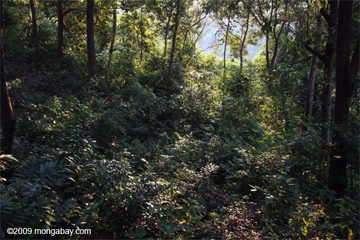
Forest habitat for Mreah Prew Phnom. According to FFI, Sassafras oil processing plants are typically located beside streams to provide water for boiling. These streams become highly polluted by factory waste. Mreah Prew Phnom trees are cut down and the roots are then mechanically shredded and boiled in a cauldron over a wood-fire oven. Many more trees in the area are felled to provide fuel for the fire. The distillation process takes about 12 hours to make 30 liters of sassafras oil. Oil is carried out by hand, often over many kilometers of jungle terrain, to roads from which it is smuggled out of Cambodia to Thailand or Vietnam. The workers are paid around US$25 per month plus cigarettes.
"The re-emergence of the sassafras factories in Phnom Samkos Wildlife Sanctuary is of enormous concern to us," Tim Wood, FFI Field Coordinator at Phnom Samkos Wildlife Sanctuary, said. "Not only are we faced with the prospect that the oil may be used for producing illicit drugs, but the factories have a very destructive impact on the fragile habitats and ecosystems in the sanctuary.


"These factories are located close to streams and by-products from the distillation process causes significant pollution of the environment. In addition, the distillation process itself uses enormous quantities of fuel wood from other rainforest trees. Finally, the factory workers typically engage in poaching wildlife from the surrounding forests to supplement their basic diets. Thankfully, on this occasion we were able to locate and destroy the factories before they were in full production mode."


View Larger Map

FFI says the number of Mreah Prew Phnom processing plants in the western Cardamom Mountains has fallen significantly from more than 75 in 2006 since it launched its monitoring effort.

"Recent law enforcement operations clearly show that this threat still persists and that we must remain ever vigilant in our effort to suppress this and other forest crimes." Wood said. "The rangers deserve our highest praise for their efforts in combating forest crime. They are at the front line of conservation and without their dedication and efforts the Mreah Prew Phnom trees would certainly have become locally extinct."

"Super" malaria threat on Thai-Cambodia border

Cambodian men, women and children receive treatment for malaria

LONDON (Reuters) - The fight against malaria could be undermined by the emergence on the Thai-Cambodian border of strains that are resistant to the most potent type of drug, the World Health Organization said on Wednesday.

Artemisinin, a compound extracted from a Chinese herb, is regarded by medical experts as the best drug against malaria and is recommended for use in combination with other medicines to stop the development of resistance.

But the WHO said there was growing evidence that parasites resistant to artemisinin had emerged along the border between Cambodia and Thailand, where workers walk for miles every day to clear forests.

The risk is similar to the development of so-called "superbugs" that are resistant to antibiotics.

"If we do not put a stop to the drug-resistant malaria situation that has been documented in the Thai-Cambodia border, it could spread rapidly to neighboring countries and threaten our efforts to control this deadly disease," Hiroki Nakatani, WHO assistant director-general, said in a statement.

The WHO plans to try and contain the spread of resistance with the help of a $22.5 million grant from the Bill & Melinda Gates Foundation. The prevalence of malaria has been reduced considerably over the past 50 years, but the disease still kills more than a million people every year.

Resistance along the Thai-Cambodia border started with chloroquine, followed by resistance to sulfadoxine-pyrimethamine and mefloquine, drugs used in malaria control several years ago.

The risk of resistance to any drug increases when it is used on its own, which is why the WHO recommends the routine use of artemisinin combination therapies, such as Novartis AG's Coartem.

(Reporting by Ben Hirschler, editing by Will Waterman)

Cambodia plans to close largest football-gambling agency


Macau Daily Times
Wednesday, 25th February, 2009

Cambosix, the largest football- gambling agency of Cambodia, has to be closed as it had made some trouble for the country in terms of social security, said Prime Minister Hun Sen (pictured) here on Tuesday.
"We didn't get much tax incomes from Cambosix, but instead it made us have social disorder, domestic violence, family divorce and robbery," he told a student graduation ceremony of a university in Phnom Penh.
"The City Hall and the Ministry of Economy and Finance have to compromise with Cambosix and (guarantee that) the deal is a success. If possible, close it today," he said.
"We will follow the legal procedures of the country to close it. We do it in a way that won't affect other private investment in the kingdom. And we have to pay the compensation for their licensing price and end their licensing term before date," he said, adding that the Cambosix license will terminate in 2011.
The Cambodian government used to present the 4-year-long football-gambling license of about 8 million U.S. dollars for private companies to bid.
Cambosix, the only legitimate football-betting operator in Cambodia, won the license from the government for the first time in 2001 and managed to renew it in Feb. 2007.

Wednesday, 25 February 2009

Khmer Surin organised a student exchange program with students in Cambodia

Below are exchanges between Mr. Nov Try, a Khmer who donated the money to help Mr. Chey Mongkol, a Khmer Surin who is trying to teach Khmer Surin children Khmer language. My hat off to Mr. Nov Try for his generosity to help our Khmer Surin brothers and sisters. Please have a read.
--------------------
Dear Lok Nov Try,
The donation has successfully completed. I apologize for being quiet because I have been busying with Bon Pkar Samakki from Sren (Surin) to Kampong Cham. I was back to Sren on Sunday and I have found your email informing about the donation.
We have also made achievement but we also face with resistance. This is not easy piece though. Most people are misled to think that they are not Khmer.
Our work has just begun, and it takes time to make some real achievement. We have push the Khmer language through local politicians and then again take time. You know the nature of politicians, do you? It is the same anywhere.
By the way, we have 35 fine students that can read and write Khmer perfectly well. I will take them to Kampong Cham for 4 days to join the Summer School for Kon Nen. We hope always that we will be closer than ever.
Thank you for donations and please continue your support for the Khmer Literacy Project in Sren (Surin). Without Khmer people's support, we don't go anywhere. These days I have to do some extra works and that surely takes me away from Sren at least two or three days a week. I want to devote my time for the project but in the other hand I have to find way to make the project going.
Yours sincerely,
Chey MongKol
khmersurin@gmail.com

------------------
Dear Krou Mongkol !

Thank you very very much for this devotion. You are surely one of my heroes. I know sometime you may feel like walking in the desert without seeing the end but we, Cambodians in the world, will back you and support you. Khmer Leu (Surin), Khmer Kandal and Khmer Krom are all Khmer.

I like your idea of summer school student exchange. If we could do that more often we will get along and closer then ever.

I'm so exited and joyful of your actions that I have to Copy this conversation to all my dear compatriots in the world.

Respectfully,

Nov

Demarche to prevent the lifting of Sam Rainsy's parliamentary immunity

February 25, 2009

THE LIFTING OF SAM RAINSY'S PARLIAMENTARY IMMUNITY

The following demarche was made today to prevent the lifting of SRP President Sam Rainsy's parliamentary immunity:

1- Sam Rainsy lodged a complaint at the Constitutional Council pointing to the unconstitutionality/illegality of recent election-related decisions made by the National Election Committee and the Constitutional Council. Those decisions are pertaining to a "criminal offence" that is under the exclusive jurisdiction of the Tribunal under the Supreme Court.

2- As required by the law, a number (17) of National Assembly Members wrote to the Constitutional Council to support Sam Rainsy's legal complaint.

3- Sam Rainsy wrote to National Assembly President Heng Samrin to inform him about the SRP demarche.

Read the three documents in Khmer at http://tinyurl.com/byqx7f

SRP Cabinet

In Sihanouk's words: the Cambodian monarch's private archives

The Saigon Daily

PARIS, Feb 25, 2009 (AFP) - In meticulously labelled boxes piled on shelves in an old Paris building lies the hidden story of Cambodia's King Norodom Sihanouk, his personal chronicle of 30 years of Khmer suffering and death.

This file picture taken on Feb. 24, 1995 shows King Norodom Sihanouk praying during a Buddhist ceremony at Wat Mony Prasittivong outside Phnom Penh (AFP photo / files)

After abdicating in 2004, the self-proclaimed "king-father" of the country, now aged 87, handed France his personal archives last January for safe-keeping at the National Archive.

"Rarely does a foreign head of state give archives to another country," said Olivier de Bernon, head researcher at the Far-East French Institute (EFEO) and the first to browse the "historically significant" papers.

"The archives were never in Cambodia, but came directly from Sihanouk's home in Beijing," said de Bernon.

It took him two years, with the help of two researchers and an archivist, to sift through the king's 10,000 photographs and one million documents. An inventory of the "Sihanouk Fund" is to be published this year.

Destroyed by later regimes, no personal records remain of Sihanouk's first reign, coronation or childhood. The Paris archives cover the later agitated times that followed Lon Nol's pro-American coup which overthrew Sihanouk on March 18, 1970.

Among the gems are a photograph of Sihanouk's resignation speech as head of state of the Khmer Rouge regime on April 2, 1976 and pictures of North Korea, where he was invited by the country's founder, the late Kim Il-Sung.

Head of state turned political prisoner, Sihanouk spent 1976-79 under house arrest in his Phnom Pen palace with Queen Monique.

A one-time sympathiser of the extremist Cambodian communist movement nicknamed "the red prince" during the Vietnam War, it was the king himself who came up with the name "Khmer Rouge" in 1960.

But de Bernon said Sihanouk was never a supporter of the extremists, with five of his children and 14 grandchildren killed under the murderous Khmer Rouge regime, which left a total of two million Cambodians dead.

"The king was in Beijing from April to September 1975 and was only in power for a year under the Khmer Rouge before resigning. It was only in 1977, like many others, that he understood how the regime operated, and in fact high-ranking Chinese officials had to intervene to ensure he wasn't killed," said de Bernon.

Letters signed Zhou Enlai, Malraux, Arafat, Mandela or Reagan are among Sihanouk's letters.

One from actress Jane Fonda congratulates him for the Khmer Rouge victory and offers to take up their cause in the US.

"Sihanouk has a literary style that shines through in his letters, speeches and thousands of drafts," said de Bernon.

A workaholic with a wide variety of interests, Sihanouk wrote poems, songs and even recipes, and played the saxophone and piano. He could sing in a dozen languages, sometimes for four or five hours at a time, and shot dozens of films glorifying Cambodia.

Source: AFP

Seven smuggled Khmer artifacts heading home

By: ANUCHA CHAROENPO AND LAMPHAI INTATHEP

Bangkok Post
Published: 25/02/2009
Newspaper section: News

Thailand will return to Cambodia seven Khmer artifacts seized by Thai authorities nearly 10 years ago.

Some of the artifacts being returned to Cambodia.

The decision to return the objects was approved by the cabinet meeting in Cha-am district of Phetchaburi yesterday. It was in line with a Thai-Cambodian agreement to return all cultural properties to their country of origin.

The seven sandstone pieces are among 43 items thought to have been smuggled into Thailand. These seven objects are the only ones verified by the Fine Arts Department as being from Cambodia, acting government spokesman Panitan Wattanayagorn said.

The rest were being examined and would be returned if they were found to from Cambodia, he said.

All seven are part of the heads of ancient Khmer deities and giants made in the Bayon style.

"The return of these artifacts will help strengthen relations between Thailand and Cambodia," Mr Panitan said.

Fine Arts Department chief Kriengkrai Sampatchali echoed the view, saying: "It is a good step to improve ties between the two countries after the long dispute over the Preah Vihear temple."

The decision was made ahead of the summit this weekend of the Association of Southeast Asian Nations, which includes Cambodia and Thailand among its members.

The cabinet has not yet scheduled the return date, only telling Foreign Ministry officials to contact their Cambodian counterparts about the return.

The 43 smuggled Khmer artifacts were intercepted by customs officials at a port in Samut Prakan in May 2000. They were handed over to the Fine Arts Department to determine their country of origin. Cambodia was then asked to verify the findings.

The two countries stepped up efforts on the verification process after Cambodian Prime Minister Hun Sen asked then prime minister Samak Sundaravej to return the smuggled artifacts during his official visit to Cambodia last year.

Little closure for Cambodia


The Bangkok Post
Published: 25/02/2009
Newspaper section: News

When the judges and the defendant entered a Phnom Penh courtroom last week, the narrative told to the world was that the Khmer Rouge were about to face the criminal tribunal they surely deserved. Thirty years and a month after their short, bloody regime was toppled, the reality was something different.

The first and only prisoner in the dock was Kaing Guek Eav, better known as Comrade Duch. He was a particularly nasty actor at an especially gruesome centrepiece of the Pol Pot regime. The trial of the former political prison warden, however, only made it more likely that the men and women responsible for the deaths of millions of their citizens will never have to face justice.

It is not that Duch is a scapegoat, for he was involved in hundreds of heinous murders and worse. It is unlikely that his stated defence - that he only was following orders - will be accepted. Nor should it. Yet it is true he was merely a functionary in the Khmer Rouge violence machine. Claiming that the trial of Duch brings either Khmer or international justice to the victims of the Khmer Rouge regime is at best an exaggeration.

Duch ran the S-21 prison in Phnom Penh for most of the time that the Khmer Rouge ran Cambodia, from April 1975 until the beginning of 1979. Some 17,000 to 20,000 people entered the prison, in the Tuol Sleng area of the city. Duch and his cadres at S-21 tortured, starved, beat or shot to death almost every prisoner. Just 17 survived, of whom four are alive today. Before their deaths, all prisoners confessed to their crimes, which were almost always alleged to be spying for the CIA, the Vietnamese or Thai governments - often all three. The area where Duch's warders tossed the dead prisoners into pits became known as Choeung Ek, the Killing Fields.

The crimes of Duch are highly documented. The torture chambers, concentration camps and meticulous record-keeping by Duch of each prisoner's interrogation and death prove terrible crimes. It is proper that Duch receive his day in court. The four known survivors and the families of the dead may feel some closure if the Duch trial ever is concluded.

The hideous crimes of Duch, however, were far surpassed by his superiors, including Pol Pot as head of the 10-person, inner circle of Angka, as the regime was known. The toll they took will never be known accurately. The accepted figure of Cambodians who died as a direct result of the inner circle's policies is 1.7 million. Many experts believe it was twice that.

Life and justice are often unfair, but it is misleading for the Cambodian government and its supporters to claim that the Khmer Rouge leadership is being brought to the tribunal. Top leader Pol Pot and his wife Khieu Ponnary died in 1998 and 2003, respectively; Son Sen and wife Yun Yat in 1997, Ke Pauk in 2002, and the brutal Ta Mok in 2006. "Brother Number Two" Nuon Chea, ex-foreign minister Ieng Sary and his wife Khieu Thirith, and Khmer Rouge ideologue Khieu Samphan are technically under arrest. None seems close to the courtroom steps. All are approaching the natural end of their lives. The reasons why they likely will escape justice are varied. Among them, long-time Prime Minister Hun Sen was himself a senior Khmer Rouge military officer who does not want to be mentioned in defence testimony.

One hopes that the surviving perpetrators of the brutal regime can be brought before the tribunal. But it is a pretence of justice to claim that the trial of Duch is an accounting for that regime.

Norwegian Children Against Trafficking in Thailand and Cambodia

Christian children from Adventkirken in Nedre Eiker, Øvre Eiker and Drammen municipalities have donated about 150.000 kroner to NGOs, who fight against human trafficking in Cambodia and the Northern part of Thailand. The money will primarily go to children – and especially girls – who is sold into prostitution.

Since a representative from ADRA Norway (A christen aid foundation, founded by the church of the Seventh-day Adventist) told the Norwegian pupils about the situation for trafficked children, they have collected money in the neighbourhood to help the trafficked children in Asia, for example by arranging Christmas bazaars, fundraisings and other arrangements.

Time of reckoning for Khmer Krom

Written by Brendan Brady
Wednesday, 25 February 2009
Phnom Penh Post

Khmer Krom monks in Phnom Penh prepare to mourn slain brethren, while Vietnam is called to defend treatment of ethnic Khmers amid fresh stream of criticism by rights groups.
090225_04.jpg
Photo by: BRENDAN BRADY
At Wat Samaki Reangsay in Phnom Penh, abbot Young Sin stands at a memorial to a slain former student Eang Sok Thoeun.

EUROPE TAKES NOTICE AMID REPORTS OF ABUSES

In December 2008, two Italian parliamentarians - one representing the EU - visited the region to advocate for greater cultural and religious freedoms for Khmer Krom. They were prevented from boarding a flight from Phnom Penh to Ho Chi Minh City. The rebuff came from a Vietnamese state tour agency claiming the pair failed to supply sufficient itinerary information before their arrival, but to most local observers it seemed to be a thinly veiled attempt by some Vietnamese government officials to thwart any attempts at advocacy for ethnic Khmers in their country. Two months earlier the EU passed a resolution calling for increased pressure on human rights reforms in Vietnam, including a specific mention of "discrimination" and "persecution" against Khmer Krom, and, in one of its few references to individuals, singled out the case of Tim Sakhorn, an outspoken Khmer Krom monk who disappeared in Phnom Penh 2007, with some reports stating that he was crammed into a Toyota by unidentified assailants. He resurfaced in Vietnam, was charged with violating national unity, and after a year in prison, now reportedly lives under house arrest in Vietnam.


IN February 2007, a young politically active monk was found dead at the Tronum Chhroeung pagoda in Kandal province: His throat had been slit.

The body of the monk, an ethnic Khmer born in Vietnam named Eang Sok Thoeun, was discovered the morning after he had taken part in a demonstration at the Vietnamese embassy in Phnom Penh protesting the treatment of ethnic Khmers in southern Vietnam - a group known in Cambodia as Khmer Krom, or Southern Khmer.

Police declared his death to be suicide and disposed of his body without further investigation. Rights groups and Khmer Krom activists suspected his murder was politically motivated.

This Friday, Khmer Krom clergy will gather at Wat Samaki Reangsay, their spiritual base in Phnom Penh, to commemorate the second anniversary of Eang Sok Thoeurn's death.

The commemoration comes on the eve of a much larger forum to address what rights groups and Khmer Krom activists describe as a persistent and often violent campaign by the Vietnamese and Cambodian governments to stifle the rights and distinct identity of the ethnic group.

Pledge of action
Two centuries ago, what is now the southern delta of Vietnam was part of the Khmer Kingdom. Vietnam says one million ethnic Khmers still live there. Khmer Krom leaders put the number 10 times higher and claim a further 1.5 million Khmer Krom have migrated to Cambodia.

Abuses against Khmer Krom by the Vietnamese state will be raised at the United Nations Human Rights Council in May, according to local rights officials.

In meetings with the UN's special rapporteur on human rights defenders, Margaret Sekaggya, and the UN refugee office in Bangkok last month, Ang Chanrith, executive director of the Phnom Penh-based Khmer Kampuchea Krom Human Rights Organisation, was told the international body would call on Vietnamese officials to defend charges against its treatment of Khmer Krom and Montagnard hill tribes, as well as other indigenous groups.

"She said she would take action on the situation and that our case would be presented," he said, adding that the UN High Commissioner for Refugees (UNHCR) in Bangkok had also agreed to revisit past reports of official violent suppression received from Khmer Krom seeking asylum in Thailand. He said the UNHCR had previously not been receptive to these reports.

The news has renewed hope for Khmer Krom activists. For Young Sin, president of the Khmer Krom Buddhist Monks Association and a former teacher of the slain monk, the United Nations may be able to exert leverage over Vietnam in a way that regional groups cannot.


The government should be trying to engage in peaceful dialogue with the Khmer Krom, rather than throwing them in jail.


"If the UN intervenes and puts pressure on the Vietnamese government, it wouldn't dare continue carrying out the kinds of repression it has inflicted on the Khmer Krom people," said Young Sin, who is also abbot of Wat Samaki Reangsay.

A history of violence
Just how politically sensitive the topic is can be judged from the responses from Cambodia and Vietnam to a comprehensive report by Human Rights Watch (HRW) on the subject. Released last month, the report stated that Khmer Krom monks in Vietnam seeking greater religious and personal freedoms had been unfairly threatened, defrocked and imprisoned. In Cambodia, the rights group said, activist Khmer Krom monks have been deported to Vietnam.

The report - "On the Margins: Rights Abuses of Ethnic Khmer in Vietnam's Mekong Delta" - tracked escalating tensions between Khmer Krom and the authorities on both sides of the border.

Hanoi's Foreign Ministry spokesman Le Dzung rejected the report as a "total fabrication", and said freedom of speech and religion in Vietnam were constitutionally protected, the state-controlled Viet Nam News agency quoted him as saying. A spokesman for the Vietnamese embassy in Phnom Penh also rejected the report, saying that his government did not discriminate against any of its 54 official ethnic groups.

HRW also accused the Cambodian government of abetting Vietnam, "a close ally", to suppress the voices of Khmer Krom who flee across the border to Cambodia and advocate for greater freedoms for their communities.

Citing eyewitness accounts and confidential internal documents prepared by Vietnamese security officials, HRW said Vietnamese agents have long operated inside Cambodia with help from the government to identify "cells of reactionary" Khmer Krom and devise "effective measures of interdiction and management".

Rights advocate Ang Chanrith corroborated the charge, saying the Cambodian government allows Vietnamese agents to operate locally: "We often see Vietnamese agents at our gatherings. They wear plainclothes and videotape us in order to identify the monks who attend demonstrations. They speak Vietnamese to each other, and our demonstrators see them often and can now recognise them."

Reaction from the Cambodian government to HRW's report was unsympathetic. Religious Affairs Minister Min Khin declined to comment, while Minister of Information Khieu Kanharith rejected the report's findings, saying "criticism by civil society groups of the [Cambodian and Vietnamese] governments does not help protect the Khmer Krom".

"They don't know anything. They work only for money," he added. "But the Cambodian government works peacefully with Vietnamese authorities for the prosperity of the Khmer Krom."

Reporting in the Cambodian press was mixed. The major newspapers affiliated with the ruling Cambodian People's Party, such as Rasmey Kampuchea and Kampuchea Thmey - did not mention the HRW report, saying they did not receive it. Opposition-affiliated papers did.

Um Sarin, president of the Cambodian Association for the Protection of Journalists, said fears of government disapproval drove some newspapers to ignore the scathing report.

International image
Activists say the consequences of official suppression are thoroughly debilitating.

"Khmer Krom live in poverty, and their identity and religious practices have been destroyed," said Thach Setha, head of the Khmer Kampuchea Krom Community. "The Vietnamese government doesn't allow Khmer Krom to use the internet, to listen to Voice of America or Radio Free Asia on the radio, and has blocked our access to education."

But Ang Chanrith is confident international attention to the issue will force Vietnamese authorities to relax their treatment, if not agree to real concessions.

"We have to use international groups to put pressure on the Vietnamese government to allow Khmer Krom to exercise their rights," he said.

He recently returned from a trip to Stockholm, where he presented reports of abuses against Khmer Krom, including allegations of collusion between Cambodian and Vietnamese authorities to keep a tight grip on activists. He is banking on the UN, however, to bring results.

The human rights record of each UN member state is subjected to public scrutiny, or a Universal Periodic Review, every four years. This May, Vietnam's number is up, amid a fresh stream of criticism against its government's treatment of ethnic groups living within its borders.

Sara Colm, a senior researcher for Human Rights Watch, said that given the lack of independent oversight within the tightly controlled communist state, international organisations, including her own, submitted reports to the UN Human Rights Council detailing rights abuses in Vietnam, including the situation of the Khmer Krom. Vietnam is thought to have filed its own report to the UN over statements accusing it of rights abuses, although a spokesman for the Vietnamese embassy in Phnom Penh said he was unaware of any such response.

Brad Adams, Asia director for Human Rights Watch, said that although Vietnam has a bitter past with much of the West and remains a communist state, its integration into global markets means it needs to take international opinion into account.

"It's clear Vietnam cares about its international image, including its track record on human rights," he said. "In recent years, it has taken pride in its enhanced global standing through its admission into the World Trade Organization and its election to a two-year seat on the UN Security Council."

"The challenge now is to get the Vietnamese government to replace its rhetoric about human rights with actual progress on the ground. The government should be trying to engage in peaceful dialogue with the Khmer Krom, rather than throwing them in jail," Adams said.

Meanwhile, as the UN prepares for its review, the monks at Wat Samaki Reangsay rehearse the prayers they will chant for the soul of their slain brethren. Abbot Young Sin said threats will not deter his monks from practising their religion and fighting for others to do so. And he
rejected accusations that monks are overstepping their role as clergy.

"Buddhism is absolutely compatible with calling for peace," he said. "Advocating for the freedoms for lay people is our responsibility."

ADDITIONAL REPORTING BY NETH PHEAKTRA