
VOA News
March 15, 2016
March 15, 2016
 |
| FILE - Bones, suspected to belong to members of Iraq's Yazidi community, are seen in a mass grave on the outskirts of the town of Sinjar, November 30, 2015. |
The
U.S. House of Representatives on Monday passed a bipartisan resolution
declaring that systemic violence committed by the Islamic State group
against Christians, Yazidis, Kurds and other ethnic and religious
minorities in Iraq and Syria constitutes genocide.
The vote comes just three days before a deadline set by Congress for Secretary of State John Kerry to deliver the Obama administration's decision on whether it will declare that IS atrocities in Iraq and Syria constitute genocide. The atrocities include mass murder, crucifixions, beheadings, rape, torture, enslavement, and the kidnapping of children.
What is genocide?
In 1948, the United Nations defined genocide – the word didn’t exist prior to 1944 -- as any of the following acts committed with intent to destroy, in whole or in part, a national, ethnical, racial or religious group, as such, by:
Killing members of the group;
Causing serious bodily or mental harm to members of the group;
Deliberately inflicting on the group conditions of life calculated to bring about its physical destruction in whole or in part;
Imposing measures intended to prevent births within the group;
Forcibly transferring children of the group to another group.
The U.N. decided the following acts shall be punishable:
Genocide;
Conspiracy to commit genocide;
Direct and public incitement to commit genocide;
Attempt to commit genocide;
Complicity in genocide.
The vote comes just three days before a deadline set by Congress for Secretary of State John Kerry to deliver the Obama administration's decision on whether it will declare that IS atrocities in Iraq and Syria constitute genocide. The atrocities include mass murder, crucifixions, beheadings, rape, torture, enslavement, and the kidnapping of children.
What is genocide?
In 1948, the United Nations defined genocide – the word didn’t exist prior to 1944 -- as any of the following acts committed with intent to destroy, in whole or in part, a national, ethnical, racial or religious group, as such, by:
Killing members of the group;
Causing serious bodily or mental harm to members of the group;
Deliberately inflicting on the group conditions of life calculated to bring about its physical destruction in whole or in part;
Imposing measures intended to prevent births within the group;
Forcibly transferring children of the group to another group.
The U.N. decided the following acts shall be punishable:
Genocide;
Conspiracy to commit genocide;
Direct and public incitement to commit genocide;
Attempt to commit genocide;
Complicity in genocide.
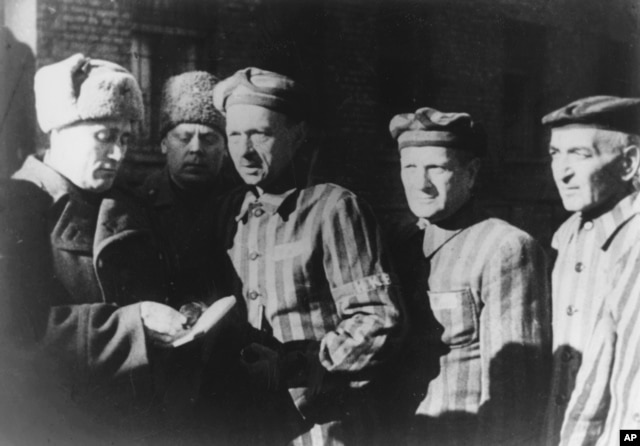 |
| FILE- In this file photo dated January 1945, three Auschwitz prisoners, right, talk with Soviet soldiers after the Nazi concentration camp Auschwitz, in Poland, was liberated by the Russians. |
Key Terms
Genocide:
Violent crimes committed against a group with the intent to destroy the
existence of the group. The specific “intent to destroy” particular
groups is unique to genocide.
Crimes against humanity: A closely
related category of international law, crimes against humanity, is
defined as widespread or systematic attacks against civilians.
War crimes: Criminal acts committed during armed conflicts and referring to grave breaches of the rules of warfare.
Historical cases
Not
all incidents listed below are genocide; some are instances of mass
killings that have not been legally classified as genocide.
Holocaust:
Between 1933-1945, the Nazi regime in Germany and its collaborators
carried out the systematic, bureaucratic, state-sponsored persecution
and murder of 6 million Jews.
Armenia: About 1.5 million Armenians living in Turkey were killed or forcibly removed from their homeland from 1915-1918.
Bosnia:
Between 1992 and 1995, an estimated 100,000 people were killed, 80
percent of whom were Bosnian Muslims. As many as 8,000 male Bosnian
Muslims from Srebrenica were killed in July 1995, counting as the
largest massacre in Europe since the Holocaust.
Myanmar:
Anti-Muslim violence has targeted the more than 1 million Rohingya, a
Muslim minority group living in Myanmar. The Rohingya have no legal
status in the country, and the U.N. and U.S. State Department have
documented widespread hate speech, blocking of aid and restrictions of
basic rights.
Cambodia: Between 1975 and 1979, nearly 2 million
people died when Cambodia’s Khmer Rouge subjected the country’s citizens
to forced labor, persecution and execution in the name of the regime’s
ruthless agrarian ideology.
Rwanda: From April to July 1994, Hutu radicals killed an estimated 800,000 people, most of them Tutsis.
Central
African Republic: In 2013, Seleka fighters seized power in the
majority-Christian nation, sparking reprisals by "anti-balaka" Christian
militias loyal to Bozize. Groups and individuals are now being targeted
because of their Christian or Muslim identity.
Democratic
Republic of the Congo: Ongoing conflicts in North and South Kivu, Ituri
province and north Katanga over the past two decades have killed more
than 5 million civilians, and displaced millions more. Most have died
from preventable diseases as a result of the collapse of infrastructure,
lack of food and health care, and displacement.
Iraq: The
Islamic State group targeted religious and ethnic minorities, including
the Yazidis, in northern Iraq in September 2014. The campaign of
violence forcibly displaced more than 800,000 people and resulted in the
deaths of hundreds, if not thousands, of civilians.
Darfur,
Sudan: General Omar al-Bashir took power in a coup in 1989. Conflicts
increased between African farmers and many nomadic Arab tribes. In 2003,
rebel groups took up arms against the Sudanese forces, leading
al-Bashir’s government to unleash the Janjaweed, Arab militias, who
attacked hundreds of villages. The genocide in Darfur has claimed at
least 400,000 lives and displaced more than 2.5 million people. In 2009,
al-Bashir, became the first sitting president to be indicted by
International Criminal Court for directing a campaign of mass killing,
rape and pillage against civilians in Darfur.
Sudan: Sudan has
experienced protracted social conflict and civil war. More than 2.5
million civilians have been killed in regional conflicts since the
Arab-dominated government of Sudan began to impose its control over
African minorities in the region. Continued clashes between government
and rebel forces have killed tens of thousands of civilians and have
displaced more than 2 million. A U.N. report said nearly 3 million
people need humanitarian assistance.
Syria: A conflict arising
from the Arab Spring has pitted the Syrian government with various rebel
groups since March 2011. The fighting has killed more than 250,000
people and displaced millions more. Hundreds of thousands of Syrians are
in refugee camps throughout the region and are fleeing to Europe, which
is experiencing the largest migration crisis since World War Two.
Sources: U.S. Holocaust Museum, United Nations, United to End Genocide, CIA World Factbook


No comments:
Post a Comment