
Cambodia’s Indigenous Groups Suffer Under Climate Change, Deforestation
More than 80 percent of Cambodia’s population relies on agriculture, a major economic pillar of the country.
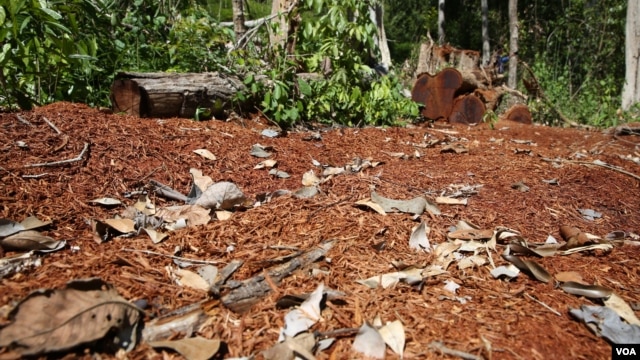 |
| A recently cut-timber that were secretly cut down in forest in Ratanakiri province, photo taken onDecember 2015. (Nov Povleakhena/VOA Khmer) |
Sok Khemara VOA Khmer
14 December 2015
PHNOM PENH—
In
the remote province of Ratanakiri, in northeastern Cambodia,
deforestation and climate change are taking a heavy toll on communities.
Drought
has damaged crops, from rice to sesame, cashews, beans and potatoes,
making it hard for farmers here to earn a living. And deforestation has
greatly reduced the amount of natural resources communities here used to
count on.
In
Paris this month, nations forged an international agreement to reduce
carbon emissions and curb global warming, but here, it is still a worry.
“Our
first concern is our food source,” 48-year-old farmer Sal Kan, from
Tanorng village, in Adong Meas district, told VOA Khmer. “We’re worried
we won’t have anything to eat or anything to plant, since it is hot like
this.”
He
has seen a crop that generally yields four tons drop to only one ton
over the last few years, where rainfall has been poor. The lack of rain
in August and September, along with rising temperatures, have forced
some farmers to sell livestock to support themselves.
Chom
Laeb, a 55-year-old farmer from Tanorng, said his crops of sesame,
rice, chili, tobacco and peppers have all been affected by the lack of
rainfall. “We depend on the rain, unlike other villagers, which have
irrigation systems and machines,” he said. “We don’t have anything here;
we make due with little things.”
His
wife, Rormeam Onhch, 52, said the lack of rainfall has damaged the
rice’s ability to seed this year. “It gets no seeds due to no rain,” she
said. “We cannot live when nothing we farm yields anything.”
More
than 80 percent of Cambodia’s population relies on agriculture, a major
economic pillar of the country. But in Ratanakiri, communities also
rely on the forests. Here, deforestation from illegal logging also takes
a toll.
Sal
Nheiy, 60, an ethnic minority from Kanarth Thom village, Andong Meas,
said timber harvesters have secretly cut down four square kilometers of
forest. “With forests gone, the local communities have nothing to rely
on,” he said. “There are no more national resources. Now we are facing
drought; second, we don’t have wood to construct homes; third, forest
timber is gone. The local communities are affected. There are no trees
or wild animals anymore.”
Meanwhile,
experts at the UN Food and Agricultural Organization are working to
mitigate the impacts of climate change on farmers. Stacy Crevello, chief
technical adviser, said the agency has projects for reforesting,
returning nitrates to the land, water maintenance and improved farming
practices.
Seng
Kimhean, a technical advisor and office coordinator for FAO in
Cambodia, said some farmers may need to look at fast-yielding crops that
require less water, such as cassava, otherwise, “it will be impossible
to have yields.”
Loun
Hoklek, at the Equitable Cambodia in Ratanakkiri, said forestry and
agriculture, hunting and farming, are critical here, because daily
sources of food cannot easily be purchased from outside the region.
“They are happy to live in the traditional way, but they ran out of
those, so they are facing everything because of environmental changes,”
he said.
Traditional
forest here has been cut down and replaced by large crops of rubber and
cashew. That has led to a decline in the forest resources. Many here
blame the irregular rainfall on the companies who have come to the
forests. And while that might not be scientifically true, it speaks to
the growing animosity of people here toward the companies.
Prime
Minister Hun Sen has sought to allay the concerns on villagers,
espousing the government’s achievements in water dredging, the
deployment of the armed forces to help the rice harvest, distribution of
seeds, and other measures.
Still
people like Chom Laeb, an ethnic minority Kanhchok, said his livelihood
remains a concern. These days, he’s had to buy rice from the market,
rather than eat what he grew. “We’ve had insufficient food for months
last year, four months, to be exact,” he said. “And we don’t know about
this year.”


1 comment:
khmers and poor people around the world can thank the central banks for the deforestation [ around the world ]especially the central bank of the USA known as the FED -- NOT own by the gov but by a few wealthy families --- they create money out of thin air and lend it to their rich friends [ who own corporations] with no interest charge... they use that money that the central banks just printed to buy up everything valuable in sight [ from expensive woods to lands ] what do people get in return just piece of papers which the rich people have convinced them that it is valuable...[ for now ]
Post a Comment