
Angela Merkel has faced
up to how a humanitarian emergency is threatening a continent’s defining
values. The rest of Europe should pay attention, and follow suit
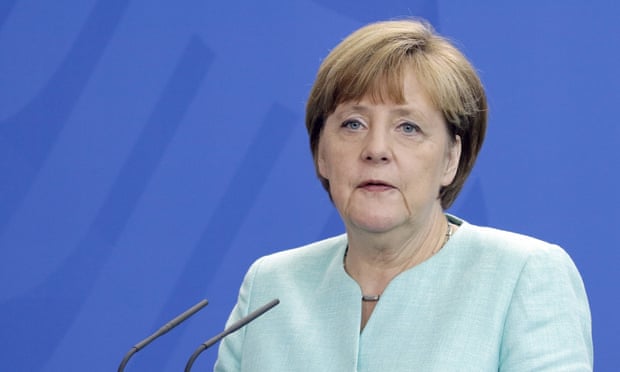 |
| ‘Mrs Merkel has sent a timely signal that the lowest instincts must now be confronted. She has reminded Europe that it was built on values.’ Photograph: Reiner Zensen/Imago/Barcroft Media |
Visionary
language is rarely heard from pro-Europeans these days; attempts to
cast the EU as a morally based endeavour risk ridicule and scorn. The
brave stance that Angela Merkel, not an easy woman to mock, has taken on
the refugee and migrant crisis thus deserves close attention. The
German chancellor has taken the lead on an issue that has, for too long,
produced nothing but squabbling among member states, and fodder for the
populists who would wall their countries off from the outside world.
Hundreds
of thousands are fleeing war zones and persecution in Europe’s worst
refugee crisis since the second world war. The situation is not likely
to change any time soon, and so it is welcome that someone with clout is
taking the high ground, instead of pandering to demagoguery. Mrs Merkel
has put it bluntly: “If Europe fails on the question of refugees, its
close connection with universal civil rights will be destroyed.” Days
after European opinion was shaken by the discovery of 71 decomposing
bodies of migrants inside a truck on an Austrian highway, the chancellor
is sending out a strong message. Mrs Merkel had already taken a unique
initiative in announcing that all Syrian refugees would be eligible to
claim asylum in Germany – unilaterally, and rightly, waiving the
so-called Dublin procedures, under which displaced people must claim
asylum in the first EU state that they arrive in.
Could
this be a turning point? Throughout Europe, there is a growing
realisation that nations need to act together – not “talk at each
other”, as Mrs Merkel puts it – in the face of an ongoing tragedy that
has claimed 2,500 lives during 2015. But a new impulse to help jostles
with resurgent xenophobia and indifference towards those in need of
protection: witness the outrageous noises coming from some capitals
about admitting only Christian, and not Muslim, refugees. Witness also
the fences erected, in Hungary and elsewhere, to try to stem the flow of
the desperate. Some of Europe’s oldest democracies are content to
trample on basic notions of solidarity, by rejecting all talk of fair
sharing of asylum seekers. Britain’s record remains particularly dismal,
the government having announced that only 1,000 Syrians would be
granted asylum. It was heartening to hear Yvette Cooper argue, in
explicitly moral terms, for a tenfold increase in that figure on
Tuesday.
The
point isn’t that Europe should take on all the misery of the world –
framing the debate that way fans the fearmongering that needs to be
defeated. The task at hand is to manage, practically and humanely, a
crisis of unprecedented dimensions. Drawing up a common European asylum
policy is urgent, and so is finding the resources to back it up. Just as
important, legal channels must be created for refugees to claim asylum
without undergoing deadly voyages across the sea or hidden in trucks.
The longer-term solutions are about anti-trafficking cooperation and
development policies for Africa, the Balkans and other places where dire
economic circumstances persuade young people that the only way to a
better life is to emigrate.
EU
summits in the coming weeks must grapple with all this detail. But Mrs
Merkel has sent a timely signal that the lowest instincts must now be
confronted. She has reminded Europe that it was built on values,
including the imperative of “never again”, which flows directly from
1930s memories of Jewish refugees from Germany and Austria being shunned
by other nations. Some will see other special reasons why Germany is
proving more willing than others to open up to refugees, such as a
rapidly ageing population, which strengthens the economic benefits of
inward migration. But don’t dismiss Mrs Merkel’s indisputable point,
which is that Europe must come together on a strategic issue that cannot
be wished away.
More
such language is needed, more vision and more bravery, from other
leaders – not shallow slogans of rejection, which solve nothing and
deliver only collective shame.


No comments:
Post a Comment