
More youth are organizing public events aim to improve social development and to solve social issues.
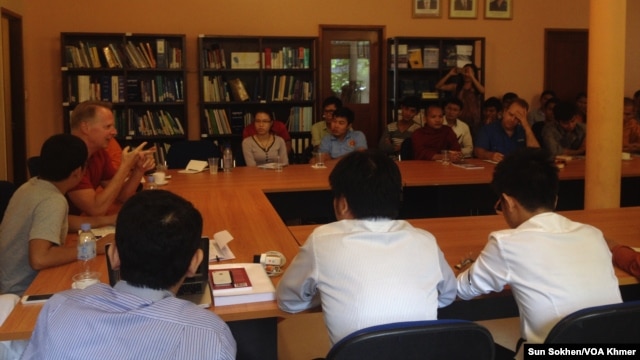 |
| Discussion between speaker and youth in Politikoffee at Konrad Adenauer Stiftung office in Cambodia on August 1, 2015. (Sun Sokhen/VOA Khmer) |
Sou Pisen, VOA Khmer
10 September 2015
PHNOM PENH—
An
unexpected new trend has begun to emerge among Cambodian
youth—organizing public events that aim to improve social development
and to solve social issues.
Most
are students, and while they may not have training or experience in
setting up events, they possess the commitment to put their time and
effort into working with others to get an event off the ground.
Lok
Sopharith, 20, is vice president of the Student Commission at Phnom
Penh’s Royal University of Fine Arts (RUFA). He was involved in
organizing “Talent and Achievement,” an annual exhibition of RUFA
students’ work, which ran for three days in April this year.
Sopharith told VOA Khmer that holding such an event is not easy.
“We have to plan our goals clearly: What is the aim of this event? What can we do, and how can we make it happen?” he said.
Organizing
the event helped to build good lines of communication between students
across the school’s faculties, he said, requiring students to work
together to overcome obstacles.
“For
example, when it comes to making a decision in a meeting, we have to
figure out why some people deny our decision while others agree. Then we
can find a solution that fits for both sides.”
In the same spirit of promoting Cambodian arts and culture, another event, Bonn Phum, is also being organized by youth annually.
The
event, which gives opportunities to aspiring Cambodian artists,
attracted about 3,000 participants this year, three times the number who
attended last year. This year, Bonn Phum took place in ancient pagoda
Wat Preaek Thloeng, 11 kilometers from the capital, just ahead of Khmer
New Year.
A
co-founder and festival director of Bonn Phum, Rithy Lomorpich, 22,
said that organizing the event involved leading a team by sharing a
vision and gaining the team’s trust.
“As
a leader, I have to be open minded and let my co-workers express what
they want to do,” she said. “A leader doesn’t just have to lead, but has
to listen and accept members’ ideas.”
Lomorpich
said that she faced challenges getting financial support for the first
Bonn Phum in 2014, but she managed to succeed with her clear vision to
organize the event and the team.
The
idea for the event came while Lomorpich was working on her thesis at
the Royal University of Phnom Penh (RUPP) and was working on a
documentary film about Lakhorn Sbek Thom, a traditional Khmer form of
Shadow Theater. She later formed a group called Plerng Kob and
cooperated with a local radio station to hold the first Bonn Phum.
Neak
Chandarith, director of international studies at RUPP, said that
organizing public events was a good way for students to learn about
writing proposals, managing people and team building.
“We
just guide them a little bit, and they can perform well. They can do
everything from design, gathering members and communications and can
start from organizing local events to international events,” he said.
The trend was also helping to foster leadership skills, he said.
“They
can use their leadership to organize effectively,” said Chandarith.
“For youth, they should have the spirit of working in a team in order to
discuss about the problems and find solutions. The leadership skill is
not just about leading, but observing the situation and contributing.”
The
trend for young people to organize events themselves comes amid
increased youth engagement in charity events. Future leaders find in
such activities an outlet for their energy and a way to hone leadership
skills while setting up events.
Ros
Vutha, 26, a teacher at RUPP and a co-founder of One Ticket One Child,
an event that raises funds for the Kantha Bopha Children’s Hospitals,
said he wanted to show younger students that they could contribute to
the good of their country.
“We
want youths to think that they can do something that can bring impact
to their society when they are still students,” he said, adding that he
was entrusting the One Ticket One Child event to students to organize
this year and next year.
He
said the students just needed a little bit of knowledge about how
events are organized as encouragement. “We are just giving them advice,”
he said.
Aside
from local events, Cambodian youth have also put together regional
events like the Asean Festival 2015, which was organized by a team of
nearly 100 young people to promote culture from across the 10 countries
of the Association of Southeast Asian Nations, from food to traditional
games to performance.
One
of the lead organizers, Heng Sonya, a third-year student majoring
International Studies at RUPP, said that among other challenges, it took
time for his inexperienced team to get commitments from sponsors.
“If
we need to organize an event, we need to have a realistic plan that
makes it possible to take place. We should do it step by step and not
rush,” he said. “If [people organizing events] do not know what to do,
they should ask for advice from experts in this field. Like my team: We
needed advice from our teachers to do it.”
Professor
Sombo Manara, deputy director of history at RUPP, said it was positive
that “nowadays our youths know what they want to do for their nation.”
“I am proud for them that they have produced such good events,” he added.


No comments:
Post a Comment