
Cambodian women turn to tech in hope apps can turn tide of gender violence
Women’s groups in Cambodia are using the youth obsession with technology to try to change attitudes in a society where many think domestic violence is normal
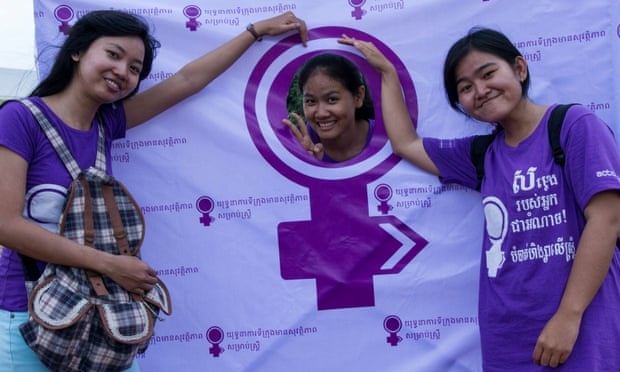 |
| Women at the launch of a safe cities campaign to end violence against women, launched in July 2014. Photograph: Safe Cities for Women Cambodia |
Marta Kasztelan in Phnom Penh
Monday 21 September 2015 Guardian
In Phnom Penh’s bustling cafes,
hip-looking young people hunch over their mobile devices. According to
Dany Sun, a women’s rights activist likewise armed with a smartphone,
this relatively new trend is representative of modern Cambodia.
But
the technological progress, Sun observes, has not been accompanied by
advances on gender equality. Traditional attitudes and cultural norms,
which portray women as subservient and inferior to men, continue to
underlie the country’s harrowing statistics on violence against women.
“Since
the day we are born, we are less valued than men. We are also still
expected to follow cultural norms like those included in the outdated
Chbap Srey [women’s code of conduct], which reinforces male dominance
and stipulates that women have to be quiet and submissive,” says Sun,
23.
“At
the same time, many people don’t realise that what they are doing is
wrong because they are uneducated, and often both men and women think
domestic violence is normal.”
Cambodia has a high rate of gang-rape, with many young men in urban areas treating it as a recreational activity
Sun
is one of three women who have been supported by the Asia Foundation to
tap into Cambodia’s growing hunger for mobile technology to tackle
violence against women. Sun has designed Krousar Koumrou, an educational
app meant to prevent domestic violence by challenging negative
attitudes towards women. In Khmer, Krousar Koumrou means model family.
A
2013 UN paper on men and violence in Asia and the Pacific found 25% of
women in Cambodia said they had experienced intimate partner violence –
physical, sexual or psychological harm – at least once. The same study
found that among men aged 18 to 49, every fifth man interviewed had
raped a women once, either within or outside a relationship.
After
Papua New Guinea, Cambodia has one of the highest rates of gang-rape in
the region, with many young men in urban areas treating it as a
recreational activity. The study found that of roughly 1,800 male
interviewees, 5.2% confessed to having participated in a gang rape,
locally known as bauk.
“The
significant factors in Cambodia that increase perpetration of intimate
partner violence can be linked to alcohol abuse, media exposure that may
normalise or condone violence against women, witnessing or exposure to
violence as a child, and level of education,” says Erin Bourgois,
manager of the Ending Violence against Women Programme at the Asia
Foundation.
“But
it is important to note that the cause of violence against women is
gender inequality and a sense of entitlement by men,” she says.
Cambodian
proverbs such as “men are gold, women are cloth” or “plates in the
basket usually rattle” show just how deeply entrenched ideas of women’s
inferiority are in society.
The
basket, Sun explains, is a metaphor for family and, “since you live
together, you are in physical proximity to each other, so sometimes you
hit each other and things break”. The prevailing perception is that
violence – be it physical, sexual or psychological – is inevitable and
normal, she says.
An
Asia Foundation report found that 94% of Cambodians own a mobile phone,
while 39% of the urban population and 21% of the rural population have
smartphones.
Rachana
Bunn, who works for ActionAid Cambodia on their safe cities for women
campaign, designed Safe Agent 008, a messaging system that sends women’s
GPS coordinates to family and friends when they feel in danger and
allows them to report violence anonymously.
The
third app, 7 Plus, is the brainchild of Sreytouch Phat, a former beer
promoter who wanted to help food and service sector workers claim their
rights and stay free from sexual harassment and violence in their
workplace.
Sun’s
app uses animation to teach women about their rights. One animation,
for example, explains that, contrary to the common belief shared by both
men and women in Cambodia, intimate partner violence is not normal and
should be talked about.
Perhaps
most important, however, Krousar Koumrou connects women with services
they might need, such as pro bono legal advice, psycho-social support,
shelter or medical care. Sun says this feature addresses the scarcity of
public services available to survivors of domestic violence, whose
claims of abuse are often ignored by local authority representatives.
While
it will take time to gauge the apps’ effectiveness – all three were
launched at the beginning of September – women in Phnom Penh seem eager
to start downloading.
Kuca
Pisa, a 25-year-old sociology student at the Royal University of Phnom
Penh, says Krousar Koumrou could change the way Cambodian young people
view intimate partner violence.
This,
she says, is particularly important in the capital, where it is
becoming increasingly acceptable for young women to have boyfriends – a
shift in a still traditionally conservative country where, until a few
years ago, the idea of “boyfriends” was largely frowned upon. Women were
expected to marry their love interest as soon as possible.
“I
heard about instances of violence, sometimes even rape, perpetrated by
male students, many of whom come here from the countryside and think it
is OK to hit their girlfriends because this is what they saw at home,”
she says.
But Pisa is less worried about intimate partner violence and far more concerned about her safety on the streets of Phnom Penh.
“Sometimes I don’t even feel safe during the day,” she says.
She
is not alone in her anxiety. According to an ActionAid study based on
interviews with 380 women, including university students, women working
in garment factories, sex workers and beer promoters, 22% said they had
experienced sexual harassment in public places in Phnom Penh, with 77%
citing verbal harassment, and 25% reporting violent physical attacks.
Pisa
moved to the city from Pursat province three years ago to pursue her
studies, and she says her social network is not as strong as she would
have liked, which is why she will download the Safe Agent 008 app.
“The
option of quickly sending a message to my boyfriend and family with my
whereabouts when I am in danger makes me feel much safer,” she says.
Bunn believes her app is a “sad necessity”.
“The
change in social attitudes towards women will take a very long time,”
she says adding that she too often gets hassled by men in the street.
“Cambodia remains a man’s world, so as women we need this app.”


No comments:
Post a Comment