
Cambodia’s Senate has passed a set of laws that would cement the government's control over the country’s courts. The move also raises questions about the millions of dollars foreign donors have spent on judicial reform.
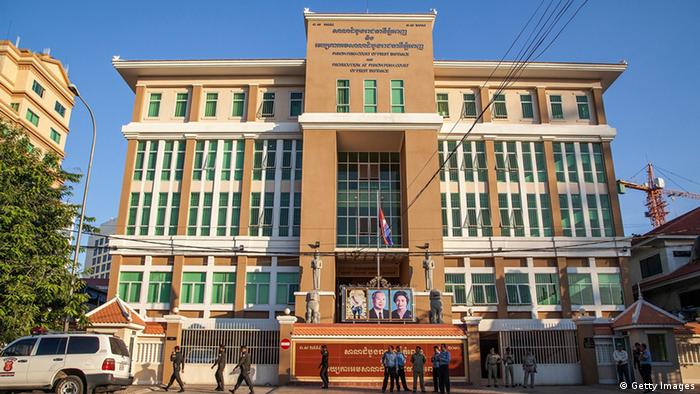
The new laws, which await only a rubber stamp from the king, would give the government more administrative control over the judiciary. The move has the potential to further erode an already weak legal system, but also raises questions about donor accountability in a country where tens of millions of dollars have been spent on judicial reform.
"Aid has been particularly ineffective when it comes to judicial reform," said political economist Sophal Ear. "In fact, when I looked at global data on aid and governance, the one dimension of governance that worsened as a result of aid was rule of law."
Ear, who is the author of "Aid Dependence in Cambodia: How Foreign Assistance Undermines Democracy," tells DW the problem has been particularly protracted in Cambodia, where the executive wields vast control.
The expert points out that democracy is undermined when, for instance, property rights are introduced, but then twisted to grab land from the poor and hand it over to the rich.
"Another example is when a Royal School of the Magistracy is created to train judges but then becomes immediately embroiled in a bribes for seats scandal," he said. "Donors can help, but so far they've been outwitted at almost every turn."
The fundamentals
First proposed shortly after the signing of the Paris Peace Accord in 1991, the "three fundamental laws," as they are commonly called, were envisioned as a way to ensure an independent judiciary.
In 2005, donors and the government ostensibly began a drafting project in earnest. Though progress was sporadic and slow, the draft they produced contained promising provisions. But after eight years of work, the laws were abruptly pulled out of the hands of the working group and handed over to the Ministry of Justice.

After the last election, Prime Minister Hun Sen vowed to carry out judicial reforms
While there, checks and balances were stripped out and the Minister of Justice granted control over the administration. "One article which initially said that the judiciary would not be under the power of executive or legislative or any political party, was later removed from the approved version," said Duch Piseth, a Trial Monitoring Project Coordinator at the Cambodian Center for Human Rights, adding that that the new laws provided much more power to the Ministry of Justice.
In recent months, as the Law on the Organization of the Courts, the Law on the Statute of Judges and Prosecutors, and the Law on the Organization and Functioning of the Supreme Council of the Magistracy moved through the final stages, legal experts and rights groups grew increasingly agitated.
UN special envoy Surya Subedi said last month that he was "deeply concerned" about the content of the laws, particularly about the Ministry of Justice’s strong hand.
"In order to preserve the independence of the judiciary, no member of the executive should be involved in issues related to the appointment and promotion of judges or any disciplinary matters affecting them,” he wrote in a statement.
Failed models
The judicial law debacle comes on the heels of an even larger, though far less-publicized failed rule-of-law project on "model courts." In 2004, the government launched a legal and judicial reform strategy that included a model court proviso. Donors, particularly Australia provided vast funds and resources to a project that would turn four courts into ideal bodies to be emulated by the rest of the nation’s judiciary.
Over the course of seven years, Australia, with the assistance of Denmark and the US, toiled to set up the program, even with increasing signs of resistance from the government.
"The process of developing the legal and judicial reform strategy was very good and developing the model court program was fine. But when it came to implementation, that’s when it started having problems," said Michael Engquist, a consultant who previously worked on the program as an advisor with the Danish International Development Agency.
In a damning report about the efficacy of its aid programs, the Australian government blasted the model court program and implied donor countries may have been foolish for believing the government strategy was a true reflection of their intentions.
"Like many Cambodian strategies, the Legal and Judicial Reform Strategy appears to have been written to meet the expectations of donors, without any real commitment to its implementation," the auditors wrote in their December 2012 report.
"Some of the change processes promoted… particularly the model courts, were too sophisticated for the counterparts to manage. More fundamentally, they assumed that a lack of institutional capacity was the binding constraint on improving the justice system. In fact, the constraints are largely political."
The government has repeatedly downplayed such criticisms.
After the last election, which the opposition accused the ruling party of stealing, the country’s strong-arm Prime Minister Hun Sen vowed that judicial reform would be a cornerstone of the current mandate.
Engquist, for his part, remains skeptical. Asked if judicial reform is a good area for donors to invest money, he laughed. "When you put it this way, yeah I’m disappointed of course. There’s been a lack of political will, definitely in this area."
- Date 13.06.2014
- Author Abby Seiff, Phnom Penh
- Editor Gabriel Domínguez


3 comments:
Is that a Supreme Court building of the entire Cambodia Nation. I'm sorry, every country in this universe are very much value the Freedom and Justice. Thus, people equally value and respect the professions of the legal justice system, and freely and independently to adjudicate, defend, and prosecute every matter involved accordingly. So does the Judicial Housing must equally appears Superior, Respectful, Welcome to all man kind. Not appear to be enclosed, unreceptive to all man-kind, and prison-like.
Below is the Superior and Respectful symbol of Supreme Justice, and every member that represents her are very candid, courteous, clean, legitimate, independent, and extremely powerful.
[every country in this universe are very much value the Freedom and Justice. ]
just on paper, in real life money can buy everything including the judicial court even the US supreme is no exception....they are now siding with the interests of corporations more than the welfare of the people [ people have lost many lawsuits against corporations brought to the supreme court. ]... you need to wake and quit watching fake news on TV and hollywood's propaganda.
Respond to the amateur writer above.
Undoubtedly, you are a charlatan, a poser, and last but not least a sham.
Can you name a case, e.g., particular case law, or cited title of case law, that a matter or anything similar to your manufactured or imaginary story that heard in the U.S Supreme Court. Just name one case law.
If you don't have one, and you made a fabricated, pathetic story that ridicule, defame, and slender the Supreme Court of The United States of American, you are putting yourself in jeopardy, idiot.
Next time when you don't know anything, don't pretend to say something smart. Keep to yourself or share them among your clans in Khmer.
Post a Comment