A Change of Guard

សូមស្តាប់វិទ្យុសង្គ្រោះជាតិ Please read more Khmer news and listen to CNRP Radio at National Rescue Party. សូមស្តាប់វីទ្យុខ្មែរប៉ុស្តិ៍/Khmer Post Radio.
Follow Khmerization on Facebook/តាមដានខ្មែរូបនីយកម្មតាម Facebook: https://www.facebook.com/khmerization.khmerican

Wednesday, 2 November 2011

China sovereignty vs. international law


Nov. 2, 2011
By Dr. A. Gaffar Peang-Meth
Pacific Daily News (Guam)

My last column in this space on China's sovereignty claim over more than 80 percent of the South China Sea -- shown in China's "nine-dash line u-shaped" map presented to the U.N. Commission on the Limits of Continental Shelf in 2009 -- also gave a glimpse at an emerging arms race in the South China Sea.

While China's own white paper, "China's Peaceful Development," assures China "does not pose a military threat to any other country." And Beijing declared, "There is no question about the freedom and safety of navigation in the South China Sea." China's assertion to its "indisputable sovereignty over the islands in the South China Sea and their adjacent waters," backed by her naval modernization and maritime activities, increase anxiety in the region.

Brunei, Malaysia, the Philippines, Singapore and Taiwan -- all claimants to the disputed South China Sea Islands -- have upgraded their naval forces while looking for support from the United States. Japan and Australia also are readjusting their defense postures.

It wasn't helpful that the September English language Global Times, owned by the People's Daily, the China Communist Party's official mouthpiece, published Chinese analyst Long Tao's "Time to teach those around South China Sea a lesson," calling the Spratly and Paracel Islands "an ideal place" to "punish ... the Philippines and Vietnam, who have been acting extremely aggressive these days" and "who infringe upon our sovereignty to steal our oil."

Time.com's Kirk Spitzer, who cited specialists on China's military capabilities in his Sept. 15 "Japan Worries About China -- Later," reminded, "for all its bellicosity, it will be a decade at least before China could pose a credible military threat to Japan or U.S. forces in the region."

Yet last year, the People's Liberation Army's first joint maneuver of its three regional fleets in the South China Sea and more frequent patrols there by its ships have caused countries in the region to be wary of their large neighbor. Long Tao's assertion that "more than 1,000 oil and gas wells," in the South China Sea "will be burned to the ground" in any dispute over Chinese sovereignty has only added to fear and anxiety.

On Oct. 25, the Global Times editorialized that the Philippines and Vietnam are "exploiting" China's "mild diplomatic stance" on the sea disputes, and warned "countries currently in sea disputes with China" that "If these countries don't want to change their ways with China, they will need to prepare for the sounds of cannons. We need to be ready for that, as it may be the only way for the disputes in the sea to be resolved."

"South China Sea Conflict? No Way," is the title of an article in The Diplomat by Rukmani Gupta, a fellow at the Institute for Defence Studies and Analyses in New Delhi. Reason? "China has too much to lose by escalating territorial disputes."

Meanwhile Secretary of State Hillary Clinton told Time's Richard Stengel in an interview that "it's no classified secret -- that China is increasing its military assets. ... China began to show some muscle, ... motivated by their assessment ... (that) we couldn't really be as involved as we once had been. (The) future, I think, demands us to be."

Last week, Defense Secretary Leon Panetta affirmed, "We are a Pacific nation. We will not only remain a Pacific power, but we will strengthen our presence in this area. ... We are here to stay, and that's an important message to send to the region and to send to all our allies."

China's defense ministry was quick to declare: "Maintaining peace and stability of the South China Sea is not only in the interest of China but also in line with the interest of other countries involved. It needs joint efforts to keep the peace and stability in the area."

Foreign affairs analyst Richard Heydarian described, in "The South China Sea Conundrum -- Analysis," China's "sophisticated bi-multilateral approach" in foreign policy: "China tends to use multilateralism as a component of its charm-offensive strategy, but it simultaneously utilizes bilateral ties in order to reinforce, if not impose, its interests."

In a paper to a conference on major policy issues in the South China Sea, professor Carlyle Thayer spoke of an "international backlash" created by China's assertive sovereignty claims in 2009 and 2010.

Thayer referenced meetings of the ASEAN-China Joint Working Group in December 2010 and April 2011 as when it became clear that progress to a solution to the sea disputes was blocked by China's insistence that territorial and sovereignty claims could only be settled by the states concerned, while ASEAN member-states prefer a multilateral approach.

Back to Secretary Clinton's interview: "There was a lot of activity in the South China Sea, about China asserting itself, China moving to block oil exploration to countries, and more along that line. So I felt strongly that we had to say freedom of navigation is an international right. There are methods for resolving disputed claims over territories. ... We're going to strongly assert the rule of law and a rules-based approach to solving these issues."

We're back to China's "indisputable sovereignty" claims vs. international law and principles prescribed in 1982 United Nations Convention on the Law of the Sea. A miscalculation can be dangerous for all.
A. Gaffar Peang-Meth, Ph.D., is retired from the University of Guam. Write him at peangmeth@yahoo.com.

Work on 5th Cambodia-China Friendship Bridge begins in Cambodia's capital

The first chroy Changvar Bridge or Cambodia-Japan Friendship Bridge.

PHNOM PENH, Nov. 2, 2011 (Xinhua) -- Cambodia on Wednesday broke ground for the construction of the 5th Cambodia-China Friendship Bridge, or 2nd Chroy Changvar Bridge, across Tonle Sap River to reduce traffic congestion and to keep up with the country's fast pace of economic development.

The would-be 719-meter bridge is located in Phnom Penh's Russei Keo district, connecting the capital Phnom Penh in the west of the river to National Road No. 6 in the east of the river.

The bridge is in parallel with the existing Cambodia-Japan Friendship Bridge, or Chroy Changvar Bridge.

The ground-breaking ceremony was presided over by Prime Minister Hun Sen and Chinese Ambassador to Cambodia Pan Guangxue, and was also attended by top government officials, diplomatic corps, some 12,000 local people and students.

Speaking at the ceremony, the premier said the bridge is very essential to ease traffic from the eastern and northeastern parts of Cambodia into Phnom Penh and the construction is to keep up with the country's rapid growth of development.

"The bridge connects Phnom Penh to the National Road No. 6, which is the strategic road for the economic development, it links to ASEAN highway and Greater Mekong Sub-region highway," he said.

Hun Sen said it is the fifth Cambodia-China Friendship Bridge. The first four bridges are Se Kong Bridge in Stung Treng province, Prek Kdam Bridge on the outskirts of Phnom Penh, Prek Tamak Bridge in Kandal province, and constructing Takhmao Bridge across Tonle Bassac River in Kandal province.

"All achievements today come from the very good relations between Cambodia and China leaders at all levels," he said.

There would be two new Cambodia-China Friendship Bridges in the near future, he said.

"On behalf of the government of Cambodia and Cambodian people,I 'd like to express sincere and heartfelt thanks to the government of China and her people for the constant contributions to the development of Cambodia," he said.

Meanwhile, Pan Guangxue said as a good friend of Cambodia, China was pleased to see the development of Cambodia.

"China will continue to help Cambodia its effort to develop the economy," he said. "China has no any hesitation to assist Cambodia for any development proposal that Cambodia raises and that proposal boosts economic growth and poverty reduction."

According to the master-plan, the construction of the 5th Cambodia-China Friendship Chroy Changvar Bridge is made possible under the China's soft loan of 27.5 million U.S. dollars.

The China Road and Bridge Corporation will undertake the construction, which is expected to complete in 38 months.

Sen Don Ta (Pchum) celebration by Khmer in Khukhan, Sisaket province, Thailand


Dinner with the departed

November 2, 2011
By Phoowadon Duangmee
Khukhan, Si Sa Ket

The Festival of the Dead is full of life and colour in Si Sa Ket

There is no such thing as a Halloween party in Srisaket, a northeastern province that shares a border with Cambodia. But in the small town of Khukhan, the Khmer-speaking communities have their own way of celebrating the dead: the annual Saen Donta Festival where they feed the deceased members of their families.

"Sons, daughters, in-laws, grandchildren - all family members will return home," says an 80-something grandmother, as she starts to explain the notion of this reunion of family members - both alive and dead - for the Saen Donta Festival. "The members [the one who are alive, of course] help to prepare the food and offer it to the dead ones."

Do dead and the living have dinner together, I wonder?

The mysterious traditions of Saen Donta have always intrigued me. So late in September, shortly after the harvesting season, I hoof it up to Khukhan district some 65 kilometres east of downtown Si Sa Ket where I fully expect a spooky, almost paranormal experience that will send me skedaddling to the nearest temple.

What I find is a small town springing to life with dances of joy and throngs of beautiful floral floats. The local people, dressed in their unique tribal costumes, carry baskets full of roasted chicken, barbecued fish, fried meats, mainly pork, vegetables, cigarettes and jars of rice wine before gathering at the public park in front of the town hall. Apparently, this impressive feast should make the hungry ghosts happy for a few days.

"We, the Kui people, have a strong commitment to making offerings during the Saen Donta Festival," says Suwan, the old Kui woman. The Kui are a Khmer-speaking people who are scattered around Si Sa Ket, Surin, Buri Ram and the southern part of Thailand's Northeast. "Otherwise, the hungry spirits will curse us."

The Saen Donta Festival lasts for two days, kicking off the day before the new moon of the 10th Lunar Month.

"On the eve of new moon, the relatives will bring tray of offerings - including roasted chicken, pork, khao tom and dessert - to the family at the top of their lineage," says the woman. "Names of every departed one will be called to take the offering. Not a single name is to be missed or we're in trouble with the curse of the deceased ancestor."

On the second day, the day of new moon, the villagers wake up early to make offerings at the community temple. Once back from the temple, the villagers take small portions of food to their paddy fields and leave them around for the wandering hungry ghosts - whose relatives probably don't care to feed them.

I'm happy to be a living visitor to the Saen Donta tradition

Actually, the festival is a real treat for hungry travellers too and we catch sight of several Saen Donta "groupies" convening along the main road. As we're waiting for the new floats to arrive, the locals offer the onlookers some steamed rice buns, bananas and sort of rice cake. Gulping down the throat-burning, home-made rice wine, I practise my Khmer and earn some good-natured laughter.

We spend all day at the festival before Si Sa Ket's governor arrives on elephant-back in a grand procession. He presides over the offerings, again involving tonnes of food, to Takacha - the most important departed Kui hero in Khukhan.

The rite ends as the last incense burns down to ashes and the villagers head home with baskets full of roasted chicken for dinner.

Generals Detained In Drug Raid [Former King Sihanouks' loyalists purged?]


Cambodian military police display equipment used to make methamphetamine outside Phnom Penh, June 2, 2009. (AFP)

2011-11-01
RFA

Anti-drug police nab two Cambodian officials for methamphetamine.

Cambodian authorities have arrested two military generals linked to a “major” drug trafficking ring, police said Tuesday, as the country’s anti-narcotics task force battles internal corruption and increased trade in stimulants across the Mekong region.

National police spokesman Gen. Kirth Chantharith said Lay Virak and Khun Rouen, both active duty two-star generals who also work as advisors within the defense ministry, were detained Monday while exchanging nearly 1 kilogram (2.2 pounds) of methamphetamine, a powerful stimulant.

Sex trafficking in Cambodia: fabricated numbers versus empirical evidence

Large numbers of sex trafficking victims, on the order of 80,000–100,000, have been alleged to exist in Cambodia over the past decade. Empirical results obtained from measuring the numbers of such victims in Cambodia are contrasted with the lack of support for the widely circulated guesstimates of these numbers. Examples of similar fabrications are discussed and followed through some of their early publication history. The methodology of conducting empirical field research in less developed countries is discussed and the origin of the guesstimates is probed in detail. Both the multiple methodologies employed by and the results of a program of empirical research on trafficking numbers in Cambodia conducted from 2002 to 2008 are discussed. These are compared with the results of additional empirical studies, and with the guesstimates. The existence of empirical results creates location knowledge of victims, presenting ethical questions.

Year of publication: 2011
Theme: Human Rights and Law, Migration and Mobility, Research Ethics and Methods
Author: Thomas M. Steinfatt

Cambodia floods bring mounting disease toll


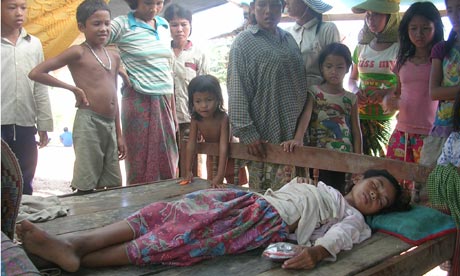
MDG : Flooding in Cambodia A young girl with dengue fever during recent floods in Cambodia. Photograph: John Macgregor/cwars.org

Thousands of people have been left stranded in dire conditions by the heavy monsoon rains that have caused devastation around south-east Asia

Mark Tran
guardian.co.uk, Tuesday 1 November 2011

Thousands of people are encamped with their farm animals on tiny strips of land surrounded by floodwaters in Battambang province in northwestern Cambodia.

John Macgregor, an aid worker who has been accompanying teams delivering food and water to Battambang, described the area as a vast inland sea where conditions are dire and malnutrition is common.

"Diseases are becoming more common and yesterday our doctors diagnosed the first cases of cholera. People are sleeping in extended family groups on rush mats which sit on the mud, under strips of clear plastic. Ducks, chickens, dogs and cats are often in there with people - a factor in the mounting disease toll," said Macgregor, communications director of Cambodian War Amputees Rehabilitation Society (CWARS) from Phom Penh, the Cambodian capital.

CWARS delivered food to 6,000 people and its medical teams treated 1,600 patients in seven days.

"We drove for six hours – the roads are wrecked from rain – then waded through floodwater for half an hour, then got a boat for about an hour," Macgregor said. "Much of northern Cambodia has become a vast inland sea – an astonishing sight. We travelled by boat for an hour at a time between bits of dry land."

Like other countries in the region, Cambodia has been hit by heavy monsoon rains that have overwhelmed swollen rivers, dams and canals, causing the worst flooding in decades. It is estimated that 250,000 people in the three worst-affected provinces are inundated and without aid.

According to the UN, more than 20 provinces in Thailand – one third of the country – are under water. Twelve provinces are on high alert, including Bangkok, and around 2.4 million people have been affected countrywide; 700,000 are estimated to be children. In Cambodia, 17 out of 23 provinces continue to be flooded while 250,000 people have been affected in Vietnam. Half a million people have been affected in Laos, with damage to more than 64,000 hectares (158,000 acres) of farmland, while 254,400 people in the Philippines have felt the brunt of a series of typhoons.

Many flood victims have been children. In Vietnam's Mekong delta, 49 of the 57 deaths since August have been children, according to the national flood and storms control department. In Cambodia, at least 80 children have died, while more than 50 have been killed in Thailand, all mostly from drowning, according to the UN.

In Battambang, Macgregor saw a canoe carrying three children overturn. "They started to drown. The villagers, who couldn't swim, threw them some of our empty water containers and they were saved," he said.

Children have made up around a quarter of the nearly 800 deaths reported since July across Thailand, Cambodia, Vietnam, Laos and the Philippines, according to the UN. Every year, an estimated 240,000 children aged up to 17 die mostly because they have never learned to swim.

That annual number is roughly equal to the total deaths from the 2004 Indian Ocean tsunami, but day-to-day water deaths attract little attention.

The floods have also taken a heavy economic toll: in addition to the damage to Thailand's rice crop, the market is concerned about typhoons hitting production in the Philippines, the world's biggest importer until last year, and seasonal floods in Vietnam's Mekong delta.

Election fraud in Cambodia recognized by observers from the European Union


November 1, 2011

The Editor
The Phnom Penh Post
Phnom Penh

Sir,

In your November 1 article “Rainsy asylum claim” the secretary general of the National Election Committee (NEC) said he was “unaware” of a lawsuit the SRP filed against the CPP immediately after the July 27, 2008 national election. The SRP accused the CPP of forgery in relation to a fake ID document called Form 1018 delivered by the CPP-affiliated chief of Boeung Tumpun commune in the capital city’s Meanchey district, Mr. Suos Sarin, to an illegitimate voter named Kong Kiet. Under pressure from the CPP, Mr. Kong Kiet did fraudulently cast a ballot for the ruling party but he shortly after came to see me to expose the truth and to denounce the CPP-organized election fraud. Just after his courageous decision to stand as a witness against the CPP, Mr. Kong Kiet escaped arrest by the police and was forced to go into hiding for more than three years. He was given political asylum in U.S.A. only last week and now lives in North Carolina with his wife and their three children.

I would like to specify that the SRP filed the criminal lawsuit against the CPP not at the NEC but at the Phnom Penh Municipal Court (attached herewith is the SRP legal complaint dated August 25, 2008).

Mr. Kong Kiet’s case is not an isolated one but reflects the pattern of a massive election fraud that contributed nationwide to the CPP “landslide victory” in 2008. This “astonishing success” was largely obtained through, on the one hand, countless ghost names on CPP-controlled voter lists, and on the other hand, fake ID documents called Forms 1018 using the above ghost names delivered by the CPP to countless illegitimate voters but real human beings. To illustrate the fraud pattern I have documented countless cases similar to Mr. Kong Kiet’s throughout the country and have exposed them at http://tinyurl.com/4272v3e

During and after the 2008 election campaign I met with many independent observers, especially those from the European Union (EU), and drew their attention to this form of election fraud using the Form 1018. I am grateful to eventually read in the final report of the EU Election Observation Mission to Cambodia published on October 13, 2008 this “Essential Recommendation” from the EU observer team: ”The use of the Form 1018 should be abolished prior to any future election.” Read the full EU Report at http://tinyurl.com/3fgsnxa

Final remark: The Phnom Penh Municipal Court, under the orders of the CPP, did nothing with the above-mentioned complaint for forgery that the SRP lodged against the CPP in 2008. They just buried it and forgot about it! But when it comes to any complaint lodged by the CPP against me, such as the one – also for forgery – the Hun Sen Government lodged against me in 2009 for posting on the Internet a map produced by the U.S. Army and published on the Web a long time ago, the same Phnom Penh Municipal Court was very quick to prosecute me and to hand down on me a 10-year jail sentence!

Sincerely,

Sam Rainsy
Elected Member of Parliament

Flood Relief for Cambodian flood victims on 29 October 2011 [by Cambodian-Australians]


CambodiaWatch Team took an initiative to organise a food supply distribution after a team member returning from Cambodia had witnessed the devastating effects of flooding.

With a small group of friends and support network, and in collaboration with expat friends in Phnom Penh, we were able to successfully deliver supplies to a number of flood affected families.

"I saw families who ate nothing more than donated rice and vegetable grown in nearby rice fields. I saw young children in constant hunger as they sat next to their mothers waiting for their meal."
Below is an account from our friends in Cambodia who took their time off work to meet those in need, and spent the past week organising the logistics. We couldn’t have assisted those in need without their supports. For that, we thank them wholeheartedly, and we are looking forward to working together again on the next projects.


____________________________________________________________________

Flood Victims of Tram Klar Village, Tbeng Commune, Kampong Svay District, Kampong Thom Province, Cambodia - 29 October 2011


Like many families who lived in Kampong Svay district of Kampong Thom Province, the population of Tram Klar Village of Tbeng commune which comprised of about 300 families had been severely affected by flood waters around mid September 2011, just a few days before Pchum Ben holiday. The situation got worse soon after Pchum Ben.
Those who were only able to afford to construct houses at ground level were the most affected as their dwellings and possessions were quickly inundated. They found they had nowhere to stay and their rice crop and village plantations were soon under water. The families who were well-off generally constructed houses on stilts higher up which provided better protection against flooding, and they were relatively safe. It had now been around 5 to 6 weeks since the flood.

The local school in Tram Klar village was also inundated, with initially one of the children reported drown, and 2 more were reported on 29 October.

With the support of the local Red Cross, around 140 families were evacuated to Toul Chan Prum, about 2 kilometres away. Toul Chan Prum is located at a higher elevation near a National Highway, so it was a logical site for temporary accommodation for the victims.
The Red Cross provided communal tents, which I believe were donated by the Japanese Government. Each tent is estimated to be 6m x 3m and was shared between 5 families, with women and children stayed in the tent at night and the men remained outside. Some men returned to the village when possible, to safeguard their possessions which were left behind. Other necessary items provided by the Red Cross were manually operated emergency pumps to extract clean drinking water.

Since their arrival at the relatively safe site in Toul Chan Prum on 21 October, each family received one plastic water container and 2 kilograms of rice.
Natural disasters are known to have the greatest impact on the poorest of the poor, and this is heartbreaking.

I’ve returned from Australia to live and work in Cambodia since 1992 and, at my friends’ request, agreed to take a trip to the site to learn of the situation first hand. While the assistance received from the Red Cross was most appreciated by the flood victims, it was limited in quantity, and much more supports were needed.

The hardship was severely felt by the elderly and families with young children, those who were least able to fend for themselves. I saw families who ate nothing more than donated rice and vegetable grown in nearby rice fields. I saw young children in constant hunger as they sat next to their mothers waiting for their meal. The sights of hungry children were hard to bear as I had firsthand experience of being in constant hunger myself during my time with the Khmer Rouge between 1975 and 1979.

After confirmation with my friends in Australia about the date of distribution and the types of foods to be donated, we purchased 2,800 kilograms of rice, 840 bottles of fish sauce, dozens of water bottles, plus sweet and biscuits for young children.

On 29th October, we travelled for 3 hours from Phnom Penh to Kompong Thom City, then we shipped our supplies to Toul Chan Prum, which is 16 kilometres north of Kompong Thom. We finally arrived at 10:30am and distributed foods to 140 families, with each family receiving 20 kilograms of rice and 6 bottles of fish sauce. The cost of supplies provided to each family was about $16 (including transport from Kompong Thom City), which was a small sum of money that made a great difference to their well-beings. Sixteen dollars could provide emergency sustenance for a family of 5 for up to 10 days, which meant a lot when one was in dire straits and had no means to earn an income for an extended period of time. About 150 children were also very happy that same morning as biscuits and water bottles were shared all round.

As I walked through the camp an hour after the distribution I could see hundreds of smiling faces. Everywhere, there were greetings and thanking gestures with hands put together, and the words “thank you, thank you, thank you, and thank you, thank you...!” As volunteers on site, we were happy to witness that moment but we also knew that they would be facing further hardship for several months to come. Then a woman in her mid 30s who had many small children with her lowered herself to the ground with her hands together and said with gratitude “thank you for bringing us rice.” She said it with such sincerity that it was heartbroken to hear it, knowing that her family had been without adequate food for quite some time now.

Our donor friends in Sydney and Melbourne, Australia, should be proud of their initiative. They are among those few who decided to donate to help the poorest of the poor. For me, they are the role models for the other Cambodians across the globe and, indeed, for individuals in Cambodia who have the capacity to assist those less fortunate. As we found out, it takes very little to ease the suffering of others.

We thank you all.

Expat friends in Cambodia

Fighting corruption in the developing countries

Cambodia's Hun Sen proves himself to be a 'machiavellian' par excellence in the mould of Russia's Joseph Stalin. But for all his political animal instinct that defines his cult and prolongs his political career, he has never been one to hesitate using physical violence to hammer home his advantage over his opponents, whenever political maneuverings and cunnings alone fail to secure sought objectives. However, there is a distinction between 'High Machiavellian' and 'Low Machiavellian': which of these categories best defines this unflinching exponent of violence? One thing is clear: Mr Hun Sen has done nothing to reverse the 'climate of fear' that had prevailed in the country prior to his coming to power; a climate that breeds and necessitates corruption. He will be judged by posterity as another Khmer autocrat who (not unlike Sihanouk in his era) has missed a golden opportunity to arrest his country's decline by refusing to democratise public institutions (School of Vice).

Development Centre (oecdobserver.org)
"Many politicians owe their careers and status to corruption and few of them, if any, will take a stand against it, either for fear of upsetting their own careers or the political status quo generally. . . But the real impediments to the fight against corruption are as much the interests of the politico-administrative apparatus as the fatalism and ignorance of the victims, maintained by a culture of fear nurtured by those who benefit from corruption."


The World Bank says corruption hurts the poorest most acutely (BBC news)

The fight against corruption is not the monopoly of the industrialised countries. Nor can recipes that have worked in OECD countries necessarily be applied to developing ones. Of the 134 countries that attended the 9 th International Anti-Corruption Conference organised by Transparency International in Durban last October, over a hundred were developing countries. More and more of these countries are expressing their resolve to combat corruption, echoing international initiatives, such as the OECD Convention.
Despite the real efforts made, there has been little concrete progress to date.
In most developing countries today, corruption is widespread and part of everyday life. Society has learned to live with it, even considering it, fatalistically, as an integral part of their culture. Not only are public or official decisions – for instance, on the award of government contracts or the amount of tax due – bought and sold, but very often access to a public service or the exercise of a right, such as obtaining civil documents, also has to be paid for.

Prasat Wat Phu

Prasat Wat Phu

(Locates in Champasak, south Laos)


Brief Description:

The Champasak cultural landscape, including the Vat Phou Temple complex, is a remarkably well-preserved planned landscape more than 1,000 years old. It was shaped to express the Hindu vision of the relationship between nature and humanity, using an axis from mountain top to river bank to lay out a geometric pattern of temples, shrines and waterworks extending over some 10 km. Two planned cities on the banks of the Mekong River are also part of the site, as well as Phou Kao mountain. The whole represents a development ranging from the 5th to 15th centuries, mainly associated with the Khmer Empire (whc.unesco.org).

Phnom Penh, Cambodia - TV Documentary showing markets, food, and sites

By Mark Wiens


(Courtesy of Vimeo video)


Migration Mark travels to Phnom Penh, Cambodia to see what the city has to offer. Old market, Kandal market, Russian market, local Khmer and weird foods to eat, crazy traffic, and smiling people.

Tuesday, 1 November 2011

Credit rating drops [Standard & Poor's downgrades Cambodia credit rating because of Hun Sen's dictatorship plan]

Analysts said Hun Sen (L) is grooming his son, Hun Manet (R), to succeed him a Cambodia's Prime Minister.

“[Cambodia has an] untested succession mechanism and a corollary key-man risk,” he [Standard & Poor's] said, referring to Prime Minister Hun Sen’s 26-year run as prime minister of the country.

Tuesday, 01 November 2011
Liam Barnes
Phnom Penh Post

Standard & Poor’s yesterday downgraded Cambodia’s sovereign credit rating, pointing to what it said was an unstable political environment and low per capita income.

These constricting factors, in addition to the country’s highly dollarised economy and reliance on international donors, led the rating agency to lower the Kingdom’s long-term sovereign rating to B from B+, Agost Benard, an S&P credit analyst, told the Post yesterday.

“As a result of our new rating methodology introduced in June, we reassessed Cambodia’s rating, placing greater emphasis on per capita income and political environment and quality.”

S&P believes the weaknesses of the “political score” in its review of the Kingdom include ineffective institutions and governance and a lack of ability in transferring political power, according to Benard.

“[Cambodia has an] untested succession mechanism and a corollary key-man risk,” he said, referring to Prime Minister Hun Sen’s 26-year run as prime minister of the country.

Although these negative factors are expected to be long-standing issues, even with a general election slated for next year, an improvement on the fiscal front could benefit Cambodia’s credit rating in the future, Benard said.

“If revenue-generated capacity is increased, reliance on international donors declines, and more money is spent on human and physical infrastructure, the Kingdom may be upgraded in the future.”

Benard said another factor weighing negatively on S&P’s assessment of the Kingdom’s political score was the continuing arrears on sovereign debt to Russia and the US, “which indicates a weak debt-payment culture”.

But the impact of the downgrade on a country like Cambodia was expected to be negligible, he said.

“Cambodia is not part of the international bond market, has no commercial external debt and all funding needs are taken care of by concessionary loans. So the rate cut is unlikely to have a material impact on the cost of funds.”

Although the Kingdom’s long-term sovereign credit rating, which assesses the credit horizon for more than a year, was lowered by a notch, the short-term rating, assessing less than 12 months, remained at B, according to the S&P statement released yesterday.

S&P defines B-grade debt as speculat-ive, saying a country with such a rating is “more vulnerable to adverse business, financial and economic conditions but currently has the capacity to meet financial commitments”.

The United States-based financial service company also downgraded the US in August – a move experts said would have both positive and negative effects on Cambodia.

ANZ Royal Bank chief executive Stephen Higgins told the Post in August the effects of the US debt downgrade might ripple out to Cambodia, even though the Kingdom’s economy was “booming” at the moment.

But he yesterday emphasised the lack of impact Cambodia’s sovereign downgrade would have on the financial sector.

“The significance is fairly limited, given that Cambodia doesn’t currently have access to public markets and there are no bond issues,” Higgins said.

“However, on the margin, it may cause some potential investors to re-assess their position, if they don’t take time to look at the fundamental reasons [to invest in Cambodia]."

Higgins said the sector was not overly concerned by credit ratings, “considering the recent debacle”– a reference to credit agencies’ role in the US sub-prime mortgage crisis.

“Rating agencies have hardly covered themselves in glory in recent years. People should take their ratings with a pinch of salt.”

Although she could not be reached for comment yesterday due to the national holiday, National Bank of Cambodia director-general and spokeswoman Nguon Sokha in August echoed Higgins’ sentiments.

“Ratings give some indication of the strength of the economy, but we should not 100 per cent rely on that,” she said, adding that the government had no immediate intention to issue sovereign bonds.

Confessions of a Spin Doctor: Shedding illusions as a flak for the Cambodian People's Party

Via www.ki-media.blogspot.com

--By Rita Colorito for
Toward Freedom, November 1999
Originally posted at: http://www.ritacolorito.com/uploads/Confessions_of_a_Spin_Doctor.pdf

Every year foreign political leaders, governments and related principals hire lobbyists, lawyers, and public relations professionals to polish their images in the United States. As of June 30, 1998, 549 such pros, representing 728 foreign entities, were registered with the US Department of Justice. Foreign political consulting is a multi-million-dollar business in Washington. And sometimes, the cash comes from unsavory characters.

In graduate school, I remember reading an article on Edward von Kloberg III, a spin meister who's represented murderous clients like Zaire's Mobutu Sese Seko and Iraq's Saddam Hussein. Despite vowing to avoid such people, two weeks after receiving my Masters in International Affairs, I began work for the Cambodian People's Party (CPP) and, indirectly, Hun Sen -- an autocrat accused of human rights abuses and ousting his co-prime minister in a bloody 1997 coup.

In the summer of 1998, the CPP had hired DMG, Inc., a Washington-based strategic communications firm, to represent the party in the US during Cambodia's first ever self-sponsored national elections. David Morey, the firm's president, was a professor of mine at Columbia University. His past clients include Philippine President Corazon Aquino, the Dalai Lama, and South Korean President Kim Dae-Jung.

He explained that the CPP wanted advice on conducting free and fair elections, improving human rights, and establishing an international tribunal for the Khmer Rouge, responsible for the deaths of some two million Cambodians from 1975 to 1979. Thus, I became part of Cambodia's Washington team, which included lawyers James Stearns of Porter, Wright, Morris and Arthur and William Rogers of lobbying powerhouse Arnold & Porter.

Based on Morey's record, I accepted the client's altruistic intentions and thought we could help. You see, representing such clients requires not only fooling others, but yourself. I soon realized, however, autocrats don't want advice about justice. Like claiming we worked for the party's reform wing, saying we were helping to improve human rights simply provided a "feel-good" excuse. Our client clearly wanted to preserve the status quo.

Rationalizing the Vote

In the months before Cambodia's July 27 elections, Washington frequently voiced its dislike and mistrust of the CPP and Hun Sen. The Clinton Administration, congressional leaders, and newspaper editorials advocated postponing the elections. By ousting his co-prime minister, they argued, Hun Sen had strong-armed his way into holding new elections he could control.

Taking semantics to absurdity, we argued that the coup was merely a military confrontation between the armies of Hun Sen and Prince Norodom Ranariddh. Fortunately for our side, the Clinton Administration agreed. Maybe they were still feeling guilty about the secret US bombing of Cambodia during the Vietnam War.

Tony Kevin, the former Australian Ambassador to Cambodia, also voiced our version of the coup. Although Kevin called Hun Sen a thug and denounced his human rights record, he advocated that the elections proceed as planned.

The media charged Kevin whitewashed Hun Sen and accused him of being a CPP supporter. He wasn't, but we couldn't have asked for a better "neutral" advocate.

We actively promoted Kevin during his visit to Washington. Arnold & Porter hosted a dinner for him, inviting a handful of reporters and academics. In addition, I secured a speaking engagement for him at the National Press Club, and helped edit an op-ed he published in The Christian Science Monitor. On election day, the ambassador would lead the Volunteer Observers for Cambodian Elections, one of several international observer groups whose job was to monitor the vote.

During a human rights panel on Capitol Hill, Kevin also voiced his fear that the Khmer Rouge might return -- another idea we harped on. We argued incessantly that only Hun Sen could deal with the lingering threat. Although he had driven the regime from Phnom Penh in 1978 -- with the help of the Vietnamese army -- we ignored the fact that he'd once been a Khmer Rouge lieutenant. More important, as of June 1998, the Khmer Rouge amounted to some 400 ill-equipped guerrillas in Cambodia's far northern jungles. Yet, our campaign mantra focused on this vastly exaggerated fear.

We also insisted that Ranariddh was colluding with the brutal ex-regime. By ousting him, we said, Hun Sen had saved Cambodia from a Khmer Rouge double-cross and return to power. Stearns convinced James Zumwalt, a freelance journalist and Vietnam Veteran, to write an op-ed in the Washington Times condemning Ranariddh. After Hun Sen became Cambodia's sole Prime Minister and offered Ranariddh a figurehead role as president, the "scheme" was conveniently forgotten.

Image Problems

Zumwalt was one of the few writers on our side. Mostly, the media disliked Hun Sen intensely. Reports accused the CPP of intimidating Cambodia's journalists and denying opposition leaders equal access to TV and radio air time.

Damning editorials in the New York Times and Washington Post particularly infuriated our client. Hun Sen and Var Huoth, Cambodia's Ambassador to the US, drafted lengthy, irate responses. Although we repeatedly advised them that the Times and Post wouldn't publish an 800-word letter to the editor, we met with stubborn resistance.

Accustomed to getting their way, CPP officials said that once the editors agreed to publish, they'd shorten the letters. Until then, Hun Sen's text was to remain intact. His responses were never published.

After the elections, the Cambodian Ambassador asked me directly how we could make the media like them. "You can't just say you'll investigate killings, you actually have to do it," I explained, referring to the 100 opposition

supporters that had been killed since the 1997 coup.

The Washington team advised they investigate at least one killing to demonstrate progress. We suggested Thong Sophal, whom Cambodian police claimed had committed suicide. Sophal's eyes had been gouged out, his arms and legs cut off, and his body skinned. The ambassador looked at me blankly, then uttered the standard refrain: "It's not easy. It will take one, maybe two years."

Besides media criticism, we faced political attacks. Several congressmen, led by Rep. Dana Rohrabacher of California, signed a resolution calling for Hun Sen to be tried for crimes against humanity. Although the resolution went nowhere, it panicked our client.

Shattered Illusions

A few weeks before the vote, a CPP delegation arrived in Washington to convince the Clinton Administration and Congress the elections would be free and fair. Since Congress decides appropriations -- and Cambodia desperately needs aid -- the delegation focused on charming the Hill.

They assumed they would have instant access to the State Department and congressional leaders. Instead, officials met mostly with information officers and congressional staffers. In Cambodia they were big fish. In Washington's foreign policy pond, they weren't even minnows.

Stearns and I met the delegation, led by Cambodia's then Secretary of State Uch Kiman, in his room at the Hotel Washington. We were then ushered next door by Svay Sitha, a CPP spokesman. Sitha assured us of victory on election day. CPP internal poll numbers showed the final seat allocation for each party, which -- surprise, surprise!! -- was almost the exact allocation that emerged after the vote. Apparently, an impoverished country had 99 percent accurate polling capability.

Although Sitha served on Cambodia's Human Rights Committee, he never asked for policy suggestions. When we stepped into the hallway, however, he said, "It's too quiet here. I work better in chaos." During lunch we asked about the killings. Investigations would take time, he replied. Supposedly, Sitha was later put in charge of investigating the extrajudicial killings.

The next day, we met at the embassy to advise the Ambassador Var Huoth on his press conference. We suggested he focus on the future, move the focus away from Hun Sen, and talk about the progress on media access and the human rights commission. I sounded like a trained parrot. No progress had been made.

We knew Hun Sen needed positive exposure, and so promised to get an exclusive election-day profile published in a major magazine. Fat chance. When it came to Cambodia, magazines were only interested in that genocidal mastermind, Pol Pot, who had died in April.

Morey wanted Sydney Schanberg of The Killing Fields fame. Schanberg wasn't exactly a fan of Hun Sen, but his name recognition increased the chances of publication. Schanberg said he would have a tough time convincing an editor to buy it and pay his expenses. When Morey and Stearns suggested other payment options, without directly going through the CPP, Schanberg declined.

I suggested Tina Rosenberg, a Pulitzer-prize winning journalist and New York Times editorial writer. She'd been one of my professors at Columbia. Rosenberg's specialty was political villains. I told her Hun Sen would be an interesting character study. According to Morey and Stearns, who had met him several times, he wasn't as bad as everyone claimed. The man was charming, they said. He even liked to play golf.

The reasoning, of course, was oversimplified. No one ever said villains can't be charming. Even the wolf behaved pleasantly toward Little Red Riding Hood -- right before he tried to eat her.

After initially declining the offer, Rosenberg decided to write the exclusive for the Times' Sunday Magazine. We eagerly awaited the results. But the piece, titled "Hun Sen Stages an Election," didn't provide the resounding praise we wanted. An emergency phone conference was held to spin the article before the client even read it. I also heard we had 'enemies' in Cambodia who wanted us off the contract. Apparently, they thought there would be kickbacks if lobbyists they hired received the contract.

Morey assured me Rosenberg's article wasn't my fault. Why should I be blamed, I wondered, if she saw what every other reporter had seen in Hun Sen, a leader who rules with impunity? Still, for the next several weeks, my presence wasn't requested at embassy meetings. I suspect Rosenberg's article put me in disfavor.

Fine by me. Unlike public relations prostitute Edward von Kloberg, who insists he works for "democratic causes," I could no longer fool myself. I couldn't separate my principles from my paycheck.

The Spin Goes On

Toward the end, I asked Morey if I could remain in the background, and work with other, less contentious clients. I even suggested the firm not renew its CPP contract, which expired in September, because of the uninvestigated killings and lack of progress on human rights. But Morey said Rogers, whom he respected, would argue that we could effect positive change by continuing to work with the CPP. I no longer believed it.

The Cambodian People's Party didn't care about human rights progress or an international tribunal. It simply wanted favorable media coverage and renewed international aid. It also wanted Cambodia to reclaim its seat at the UN and gain membership into the Association of Southeast Asian Nations (ASEAN). Basically, the client wanted money, power, and prestige.

Since then, Cambodia has achieved most of those goals. Today, it has a UN seat, millions in aid from Japan and the European Union, and membership in ASEAN. For the moment, however, the US appears intent on tying economic aid to an international tribunal, something Hun Sen continues to stall. When my DMG contract ended last December, I didn't renew.

Two-star generals caught with ice [former Sihanouk's loyalists purged?]

Lay Virak (File photo)

Tuesday, 01 November 2011
Meas Sokchea
Phnom Penh Post

A pair of two-star generals, one of them a former provincial governor, had been caught with about a kilogram of crystal methamphetamine and arrested yesterday, a government spokesman said.

Interior Ministry spokesman Khieu Sopheak, said former Oddar Meanchey provincial governor Lay Virak and Khuon Roeun were caught with the drug commonly known as ice.

“[We] have real evidence after finding [the drug] in his [Lay Virak’s] car, and another two-star general is involved,” he said, adding that both men were advisers to the Ministry of Defence.

Lay Virak is former senior member of the Funcinpec party, previously led by then co-prime minister Prince Norodom Ranariddh.

Norodom Ranariddh Party spokesman Pen Sangha said Lay Virak had no association with the prince’s new eponymous party.

Lay Virak, Khuon Roeun and Defence Ministry spokesman Chum Socheat could not be reached for comment yesterday.
------------------------
Cambodia arrests generals over drugs

From: AAP
November 01, 2011

POLICE in Cambodia say they have detained two army generals suspected of trafficking methamphetamine.

National police spokesman General Kirth Chantharith says the two had been under surveillance for months and were detained yesterday.

He identified the two today as Lay Virak and Khun Rouen. Both are active duty major generals who also hold advisory positions within the defence ministry.

In January, three senior police officers including a head of the country's anti-drug trafficking agency were arrested and charged with drug-related corruption.

South East Asia has long been a major producer and exporter of heroin, and in recent years it has also become a major source of stimulant-type drugs such as methamphetamine.

Indonesia ‘ready’ to send border observers

Tuesday, 01 November 2011
Cheang Sokha and Vong Sokheng
111101_02
Photo by: Heng Chivoan
A Cambodian soldier at the 11th-century Preah Vihear temple in February.
Phnom Penh Post

Nearly three months after Yingluck Shinawatra was sworn in as new Thai Prime Minister, heralding a rosy new era in relations with Cambodia, both sides are making baby steps toward resolving the long-running Preah Vihear border dispute.

Indonesian Foreign Minister and Association of South East Asian Nations chair Marty Natalegawa told reporters recently his nation was ready to send border observers to the troubled area.

The Cambodian government said it had been training 400 police expected to be deployed in the area around the Preah Vihear temple after troops have been withdrawn.

Natalegawa said the “dynamic” new Thai government had brought about a positive environment conducive to resolving the dispute, which sparked fierce clashes in February and April that left at least 28 people dead.

“So, I am waiting for both the Thai government and Cambodian governments, how they proceed to end the problem and how ASEAN can help,” Natalegawa told reporters at the 2011 Journalists Visiting Program in Indonesia on October 17.

“If the Thais and Cambodians need the observers to be sent, we are ready . . . In whatever way, we will be there to help them.”

Lieutenant General Kirt Chantharith, spokesman for Cambodia’s National Police, said yesterday a one-and-a-half month training program on national and international laws, including heritage conventions, had recently been completed by tourist, heritage and border police.

“We don’t know when we will deploy those individual officials. It is a preparation to comply with the government’s policy and the ruling of [the International Court of Justice],” he said.

“We are focused on the history of the Preah Vihear temple, culture, the territorial sovereignty and the strategy of ensuring security.”

Thai government spokeswoman Titima Chaisang said the Ministry of Interior held a meeting yesterday about an ICJ ruling handed down in July that ordered the establishment of a demilitarised zone around the 11th-century temple.

However, she said no details had been released from the closed-door meeting, the outcome of which will likely be raised at a November 8 cabinet meeting.

The decision from the United Nation’s highest court also demanded the immediate deployment of independent ASEAN observers to protect the temple from any further potential damage.

It followed an April 28 request from Prime Minister Hun Sen’s government that the ICJ issue an interpretation of its 1962 decision, which granted territorial sovereignty over the Hindu temple to Cambodia.

Cambodia also requested the ICJ rule on provisional measures to safeguard the temple.

The decisions came at a low time in the neighbouring country’s relations, with Prime Minister Hun Sen later describing his dealings with then-Thai PM Abhisit Vejjajiva as a “nightmare”.

Since the election of Yingluck’s Pheau Thai party, relations have improved, punctuated by high-level visits to Cambodia from new Defence Minister Yutthasak Sasiprapa and Yingluck’s fugitive brother, the ousted former Thai PM Thaksin Shinawatra.

In September, government officials from both countries played a historic football match at Olympic Stadium in which Prime Minister Hun Sen scored a goal before being subbed off.

However, no significant concrete steps have yet been taken to implement the provisional demilitarised zone. General Srey Doek, military commander of division 3, which is stationed near Preah Vihear, said
he had yet to receive any order to withdraw his forces from the area.

ADDITIONAL REPORTING BY DAVID BOYLE

Rainsy asylum claim

The SRP's complaint to the NEC dated 28th August 2008 and signed by Sok Pheakdey, Prersident of the SRP's Legal Office in Phnom Penh.

Tuesday, 01 November 2011
Meas Sokchea
Phnom Penh Post

Opposition leader Sam Rainsy said yesterday a Cambodian man and his family had gained political asylum in the United States after escaping arrest three years ago when he stepped forward to allege electoral fraud by the ruling party during the 2008 national ballot.

In a statement yesterday, Rainsy said Kong Kiet, of the capital’s Meanchey district, along with his wife and three children, had not been a registered voter during the 2008 election, but “CPP-controlled authorities” had given him and others money and fake identification, allowing them to cast ballots for the CPP at polling stations.

“Because he dared to publicly expose the truth and to . . . . testify in the complaint that the SRP lodged against the CPP authorities, the police came to arrest Mr Kong Kiet, who luckily managed to escape,” Rainsy said, adding that Kong Kiet and his family had lived in a “neighbouring country” before attaining asylum.

Senior CPP lawmaker Cheam Yeap said he did not know who Kong Kiet was and denied that CPP leaders had ordered the NEC or local authorities to do anything illegal during elections.

“We see that this is just defamation against the ruling party,” he added.

Tep Nytha, secretary general of the National Election Committee, said he was also unaware of the case and that the SRP had never filed a complaint to the NEC.

But senior SRP lawmaker Mu Sochua was quick to refute the last assertion, pointing out that the complaint in question had been publicly posted on opposition-related news blog KI-Media and that she clearly remembered the case.

“[Sam Rainsy] made a nationwide appeal for people who had been given wrong identification to come forward, and Mr Kiet was one of the people [who did].

“They wanted to arrest him,” she said. “I remember so well because Mr Rainsy spent a lot of time nailing down these irregularities.”

Mu Sochua added that the credibility of voter lists was crucial with commune elections looming

“Mr Kiet’s case was not an isolated one,” she said. “That’s why we want a fundamental review of the system.”

US embassy spokesman Sean McIntosh could not be reached for comment on Kong Kiet’s status.

Construction spend nears $1bn

Tuesday, 01 November 2011
Soeun Say
111101_07
Photo by: Pha Lina
A cyclist leaves the site of the US$100 million Elite Town housing development, on Diamond Island in Phnom Penh, yesterday.
Phnom Penh Post

The total value of approved construction projects in the Kingdom soared 97 per cent year-on-year through September, according to official figures, reaching nearly US$1 billion.

The number of projects fell to 1,689 for the first nine months of 2011, down from 1,718 in the same period last year, according to the Ministry of Land Management, Urban Planning and Construction.
But the total value of those projects reached $999.3 mill-ion, a significant jump from the $508.1 million in 2010.

Lao Tip Seiha, director of the ministry’s construction department, said yesterday the main reason for the increase was Cambodia’s political stability, as it made local and foreign investors confident to undertake development projects in the country.

A steadily increasing gross domestic product was also attractive to investors, he said.

“As we already expected [after the half-year mark], the value of investment in construction continued to increase in the first nine months of this year because of strong Cambodian economic growth.”

Lao Tip Seiha noted that in September alone, the ministry had approved a large number of construction projects including apartments, villas, garment, fertiliser and sugar factories, as well as guesthouses and hotels.

“We strongly believe the sector still continue to increase through the end of this year,” he said, claiming that foreign investors were returning to invest in Cambodia from regional countries such as Malaysia, South Korea, Japan, Malaysia, China and Vietnam.

Property experts have agreed that a recovery is taking place in the domestic construction and real-estate markets, although they said it was not at the level seen prior to the global financial crisis.

Knight Frank country head Sunny Soo said yesterday he had yet to see strong foreign interest in Kingdom real estate since the boom that peaked in 2008, but remained optimistic.

“For a time, I didn’t see foreign investors come to invest in the property sector, but I can see local Cambodian investors come out more and more to start construction and support the real-estate market,” Soo said.

Cambodia Property Limited managing director Cheng Kheng said the latest report was proof that the industry was showing steady improvement since the previous downturn.

“It's the right time to re-start construction and housing development projects,” Cheng Keng said.

Plea to Russia for temple aid

Tuesday, 01 November 2011
Bridget Di Certo
111101_05
Photo by: Will Baxter
The sprawling roots of a silk cotton tree cover part of the Ta Prom temple in Siem Reap province. Sections of the 12th- or early 13th-century structure are being restored.
Phnom Penh Post

Without an increase in international assistance, the Kingdom’s stunning Angkorian-era temples would be at the mercy of nature and human neglect, Council of Ministers officials said yesterday.

Deputy Prime Minister Sok An last Wednesday encouraged a group of visiting Russian diplomats to contribute to the restoration of one of the temples in Siem Reap, Ek Tha, a spokesman from the Press and Quick Reaction Unit of the Council of Ministers, said yesterday.

In a meeting with Alexander Ignatov, the ambassador of the Russian Federation to the Kingdom of Cambodia, Sok An said the country had an estimated 1,000 temples, many of which were in great need of restoration and conservation.

In Siem Reap province alone, home of the famous Angkor Wat complex, there are about 90 temples.

“UNESCO listed Angkor as a World Heritage site in 1992. Since then, more than 60 temple restoration projects are under way or have been completed, with support from 16 countries,” Ek Tha said.

Donor countries who have completed or are conducting restoration work in Cambodia include China, France, India, Japan, Hungary, Switzerland, the US and Italy.

Last week, the Post repor-ted the discovery of a Buddha statue by the Indian archaeological team conducting restoration at Ta Prom temple, in the Angkor complex.

“The reason why we call on Russia, not only China, but major countries that have been friendly with Cambodia, is because it creates a good economic and cultural relat-ionship and a good image for the countries,” Ek Tha said.

“We do not want the temples damaged by nature and war to disappear, because they are a striking attract-ion – but we just don’t have the financial and technical means to conduct all the restoration ourselves,” he said, adding that Cambodia’s restoration specialists had all been killed during the Khmer Rouge regime.

UNESCO culture program specialist Philippe Delanghe said bilateral restoration projects were making a significant contribution to human resources in the Kingdom.

“A lot has been achieved from Cambodia in that sense,” Delanghe said. “The capacity of the government has improved tremendously.”

The International Co-operation Committee, formed by the Japanese and French governments in 1993 to protect the Kingdom’s temples, is due to meet in December.

Representatives from the Apsara Authority were not available for comment.

Cambodia/ Malaysia: Domestic Workers Face Abuse

Written by:
November 1, 2011

The Cambodian and Malaysian governments’ failure to regulate recruiters and employers leaves Cambodian migrant domestic workers exposed to a wide range of abuses, Human Rights Watch said in a report issued Monday. Tens of thousands of Cambodian women and girls who migrate to Malaysia have little protection against forced confinement in training centers, heavy debt burdens, and exploitative working conditions.

The 105-page report, “‘They Deceived Us at Every Step’: Abuse of Cambodian Domestic Workers Migrating to Malaysia,”documents Cambodian domestic workers’ experiences during recruitment, work abroad, and upon their return home. It is based on 80 interviews with migrant domestic workers, their families, government officials, nongovernmental organizations, and recruitment agents. The report highlights the numerous obstacles that prevent mistreated women and girls from obtaining justice and redress in both Cambodia and Malaysia.

“Cambodia has been eager to promote labor migration but reluctant to provide even the most basic protections for migrant women and girls,” said Jyotsna Poudyal, women’s rights research fellow at Human Rights Watch. “The government should stop abdicating responsibility to unscrupulous recruitment agencies and clean up exploitation and abuse.”

Since 2008, forty to fifty thousand Cambodian women and girls have migrated to Malaysia as domestic workers. Some recruitment agents in Cambodia forge fraudulent identity documents to recruit children, offer cash and food incentives that leave migrants and their families heavily indebted, mislead them about their job responsibilities in Malaysia, and charge excessive recruitment fees.

Domestic workers told Human Rights Watch that agents forcibly confine recruits for three months or longer in training centers without adequate food, water, and medical care. Some labor agents coerce women and girls to migrate even if they no longer wish to work abroad. Workers who escape from the training centers face retaliation for escaping or for failing to pay debts related to the recruitment process.

The husband of a domestic worker who escaped from a training center told Human Rights Watch:

The representative from the company said if my wife doesn’t return he will auction this house and land. And if the auction is not enough, they will arrest me and put me in jail.

At times collaboration of government officials with private recruitment agencies makes it almost impossible for workers to seek effective redress, Human Rights Watch found. One domestic worker said that two women had attempted suicide in a training center in Cambodia after the agency refused their request to return home.

The agency then held a meeting with all recruits. Two police officials were there.

“The police officials told us that if we [attempted to] commit suicide, then they would put us in jail,” one of the workers said. “They also said that we should never try to escape. Even if we escape, the police will find [us] and we will still be sent to Malaysia.”

In the first successful prosecution of a recruitment agency, a Cambodian court in September 2011 sentenced a manager of the VC Manpower recruitment agency to 13 months in prison for illegally detaining child workers. However, the government has failed to arrest and prosecute other recruitment agents involved in similar abuses, and it has not revoked the license of a single recruitment agency.

“While the conviction of one abusive agent in Cambodia is a step forward, it remains an exception,” Poudyal said. “The Cambodian government should put an end to systematic exploitation of domestic workers by ensuring that all agents are held accountable for their acts.”

Once in Malaysia, Cambodian women and girls often have to surrender their passports to their agents or employers, making it harder for them to leave if they are mistreated. Many work for 14 to 21 hours a day without rest breaks or days off. And many are forcibly confined to their work places, are not given adequate food, and are physically and verbally abused. Some have been sexually abused by their employers. None of the workers Human Rights Watch interviewed said they had received their full salary.

Malaysian labor laws exclude migrant domestic workers from key protections, such as a weekly day of rest, annual leave, and limits on working hours. Immigration laws tie a domestic worker’s residency to her employer, so the employer can terminate a domestic worker’s contract at will and refuse permission to transfer jobs. These policies restrict domestic workers’ ability to seek redress and to change employers, even in cases of abuse, Human Rights Watch said.

Human Rights Watch documented cases in which the combination of deception and indebtedness during recruitment, forced confinement, unpaid wages, and threats of retaliation for escaping or failing to pay debts amounted to forced labor, including trafficking and debt bondage. Abused workers often turn to the local agents of their recruitment companies, since they are typically the only contact the worker has in Malaysia, but may face intimidation and a return to the same abusive employer.The Cambodian embassy in Kuala Lumpur, Malaysia’s capital, has also returned workers, including those who experienced sexual and physical abuse, to their recruitment agency or employers.

The Cambodian government should introduce a comprehensive migration law, strengthen monitoring of recruitment agencies, and imposesignificant penalties when violations occur, Human Rights Watch said. The Malaysian government should revise its labor and sponsorship laws to strengthen protection for domestic workers. Both countries should increase support services for abused workers, including legal aid and psychosocial services.

Human Rights Watch also urged Cambodia and Malaysia to ratify the International Labour Organization Convention on domestic work. The treaty obliges governments to ensure decent working conditions, to impose a minimum age requirement for domestic work, and to protect domestic workers from violence and exploitative recruitment practices.